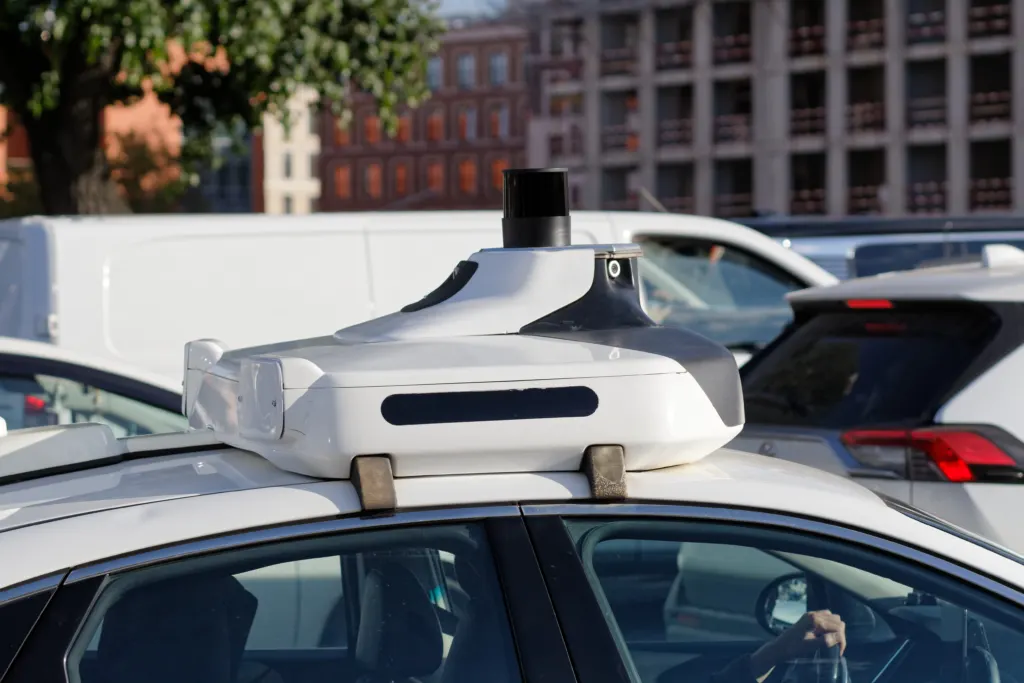
Lidar is the spinning or boxy sensor you see on the roofs of most robotaxis, and it does one simple thing very fast: it fires pulses of laser light and times how long they take to bounce back. Repeat that hundreds of thousands of times a second in every direction and a car gets a live 3D map of everything around it.
Here is how it works, from its physics and history to uses that run from Mars helicopters to iPhones.
Measuring distance with light
The name stands for light detection and ranging. The core sum is the same one a bat or a ship’s sonar uses, only with light. A pulse leaves the sensor, hits an object and returns; the distance is the speed of light multiplied by the round-trip time, divided by two. Because light covers about 30 centimetres in a billionth of a second, lidar electronics have to time returns with extreme precision.
Most non-scientific lidars use lasers between 600 and 1,000 nanometres, in or just past the red end of the visible spectrum, kept at low power so they are eye-safe. Some systems use 1,550-nanometre lasers, which the eye’s water absorbs before they reach the retina, allowing more power and longer range.
From single dots to a point cloud
A single beam gives one distance. To see a whole street, the sensor has to sweep. Classic units spin a laser and mirror assembly through 360 degrees; newer solid-state designs steer the beam with tiny MEMS mirrors or optical phased arrays and have no large moving parts; flash lidar lights the whole scene at once. Each return becomes a point in space, and millions of them form a point cloud that software turns into cars, kerbs, cyclists and lane markings.
Why self-driving cars use it
Lidar’s big advantage is that it measures shape and distance directly instead of inferring them from a flat camera image. It works in darkness because it brings its own light. Lidar was the key enabler for Stanley, the Stanford car that won the 2005 DARPA Grand Challenge, and the earliest adaptive cruise control systems relied on lidar alone.
It has limits. Heavy rain, fog and snow scatter the pulses and add noisy echoes to the data, and researchers have shown lidar can be spoofed. For that reason robotaxi makers usually fuse lidar with radar and cameras rather than relying on one sensor. Cost has been the other brake, with typical sensors priced at about $1,200 to more than $12,000 each.
Beyond the road
The same principle maps forests from aircraft, measures wind for turbine makers, tracks the distance to reflectors on the Moon to millimetre precision, and helped NASA’s Ingenuity helicopter fly on Mars. Since 2020, Apple has put a small lidar scanner in Pro iPads and iPhones to speed up focus and power augmented-reality apps.
Driverless cars are drawing more public attention as fleets grow. Badiyaa has reported on a US proposal for cyan marker lights that would flag driverless cars to other road users, and on the viral moment when a pastor’s first Waymo ride in Atlanta left the robotaxi stuck sideways.
Further reading
Image: Retired electrician, CC0 via Wikimedia Commons
This article was produced with AI assistance and reviewed by our Editorial Desk. How we work.