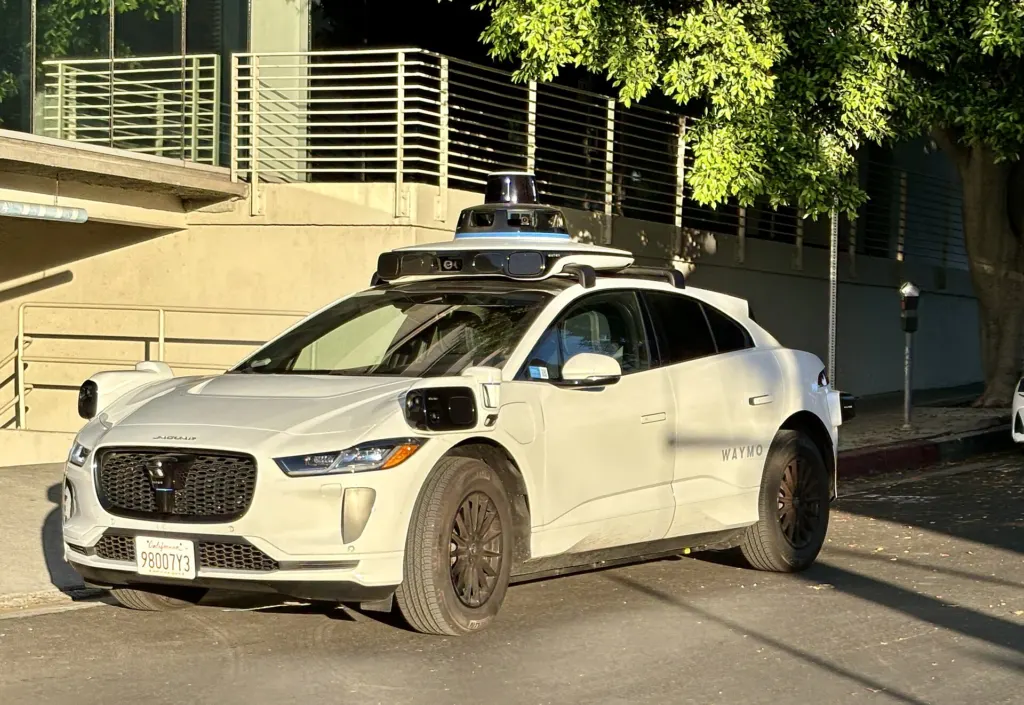
A self-driving car on US roads could soon carry between four and eight steady cyan lamps that light up only while software is doing all of the driving. The National Highway Traffic Safety Administration announced the proposal on Friday, October 23, and the formal notice appeared in the Federal Register on Monday, October 26, which opens a public comment window that runs until November 25.
The lamps would be optional. The agency says it does not have enough information to show that every automated vehicle needs one, so it is writing an “if equipped” rule: no carmaker has to fit the lights, but any that does must follow one federal specification.
What the cyan light would tell you
The meaning is narrow. Under the draft, the lamps may be lit only when a vehicle is “operating without the expectation that an occupant is monitoring the roadway,” in the notice’s words, and they go dark as soon as a person is expected to pay attention again. A car running a driver-assistance feature that still needs someone watching the road would therefore not qualify. Because the rule ties the lamp to automated driving, it would also bar fitting the lamps to cars that have no automated driving system at all.
The proposed hardware rules are specific:
- Color: cyan, the blue-green shade already defined in the SAE J578 color standard.
- Number: one or two lamps each at the front, the rear and on each side, so four at minimum and eight at most.
- Height: at least 15 inches (38 centimeters) above the ground, inside or outside the body.
- Behavior: steady burning, all lamps switching on and off together, with no blending into a daytime running light.
- Brightness: a front lamp tops out at 125 candela, the same ceiling as a parking lamp.
Why a new color at all? Red, amber and white already carry fixed meanings on a vehicle, and the regulator argues that reusing one of them for a robot-driver signal would leave people guessing. SAE International, whose experts from carmakers, suppliers and research groups weighed the options, reached the same conclusion in J3134, its recommended practice for automated-driving marker lamps, first issued in May 2019 and revised last December to add side and rear lamps.
Where the US plan differs from industry and from China
The federal version does not copy J3134 wholesale. The agency judged that the brightness levels in the industry document would make required signals, such as turn signals, harder to see, so it pegged the front cyan lamp to parking-lamp values: at least 4 candela straight ahead with the headlamps on and five times that, 20 candela, with them off.
Mercedes-Benz, which has tested turquoise lamps on cars running its Drive Pilot system, pushed for the idea at United Nations lighting meetings and with US officials, and ran five lamp-equipped cars on California roads from 2023 to 2025 to see how other road users reacted. China is moving in parallel. Its industry ministry opened comments on October 20 on a draft revision of its vehicle lighting installation standard that would make similar blue-green lamps optional on cars with Level 3 or higher automation, ban them on everything else, and take effect on January 1, 2028.
The two drafts disagree on height. China’s minimum mounting height is 250 millimeters, about 9.8 inches; the US figure of 15 inches works out to 381 millimeters, roughly half as high again. A carmaker building one robotaxi for both markets would have to design to the stricter US floor.
The other half: cars with no steering wheel
The same notice rewrites lighting-control rules written for human hands. Today, a turn signal must cancel itself as the steering wheel turns back and must also be cancelable by hand, and the high-beam switch must work by hand or foot. For vehicles built without manual driving controls, those design requirements would go. The cars would still need working turn signals and a way to switch beams. The agency’s reasoning is that, unlike a person, the software “cannot forget that the turn signals are active.” Dashboard telltales for turn signals and high beams would also become unnecessary in those vehicles.
Two changes reach every new car: integral-beam headlamps, the model-specific units the market has largely moved to, would be tested at the maker’s stated voltage rather than the 12.8 volts fixed in 1967, and an old rule forcing the low beam to sit above the high beam in a stacked layout would be dropped.
In the agency’s announcement, its administrator, Jonathan Morrison, framed the package this way: “These proposed updates address unnecessary regulatory burdens for vehicles built without traditional manual controls while establishing clear performance standards for automated vehicle marker lamps.”
What it means for robotaxis like Cybercab
For buyers, nothing changes yet: the notice says vehicles without manual controls are not on sale to consumers. The proposal matters most to fleet operators. Tesla’s Cybercab, built without traditional human controls, is already the subject of an agency audit query opened on September 4 into how Tesla self-certified that it meets federal safety standards. At the time, the regulator said it was working on rule updates, including lighting, and that existing standards stay in force until that work is finished.
How to comment, and what comes next
Comments go to docket NHTSA-2026-1519 on the federal regulations portal, by fax or by mail, and all of them are posted publicly. The agency is specifically asking whether the cyan lamps should be allowed to flash to signal a car’s next move to pedestrians, noting it knows of no research supporting that use, and whether its color and brightness choices are right. After the window shuts, it must weigh the responses before issuing a final rule, for which it has set no date. The US window closes on November 25; China’s closes on December 19.
Further reading
- Federal Register: Modernization of FMVSS No. 108 to accommodate ADS-equipped vehicles
- NHTSA: Updates to vehicle lighting standards for automated vehicles
Image: Alexis Doine, CC0 via Wikimedia Commons
This article was produced with AI assistance and reviewed by our Editorial Desk. How we work.