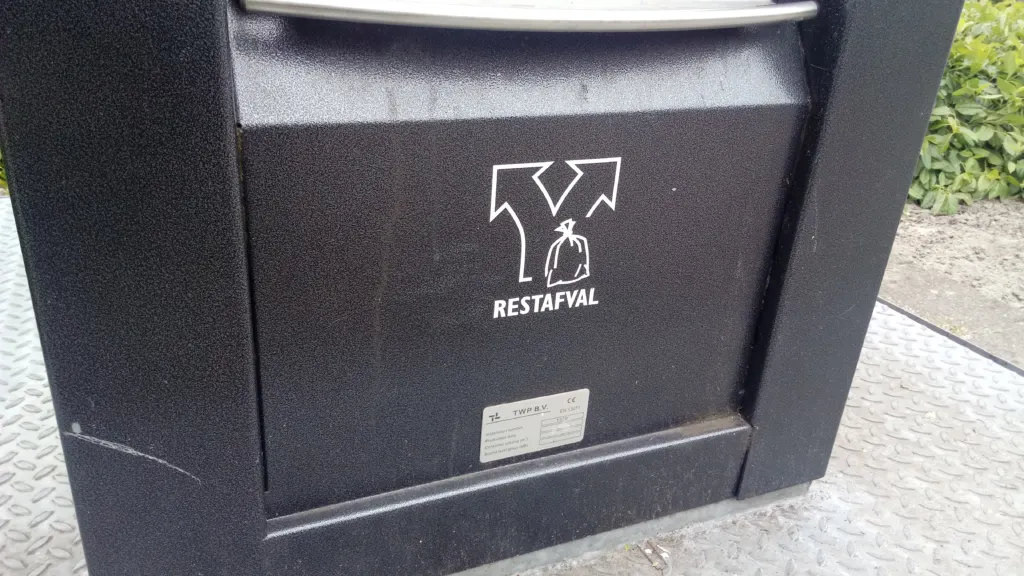
In much of the Netherlands, the trash can on the sidewalk is mostly an illusion. The slim steel post residents drop their bags into is just the mouth of a much bigger container sunk into a concrete pit below the street. A clip titled “How trash gets picked up in the Netherlands” climbed a popular Reddit community on November 16, and the system behind it is stranger and more carefully planned than the video lets on.
The bin is underground
Storing garbage below the receptacle is a common answer in crowded cities, and Dutch municipalities have leaned into it hard. In The Hague, once the underground containers for residual waste arrive in a neighborhood, the city stops picking up loose garbage bags from the curb altogether. Residents walk their trash to the nearest container instead.
How far they walk is written into city policy. The Hague says the distance to a container may be at most 125 meters, unless there is simply no suitable spot within that range. At an ordinary walking pace of about 5 kilometers an hour, 125 meters (roughly 410 feet) takes around 90 seconds, so nobody is meant to be more than a minute and a half from a bin.
Choosing a spot takes six months
Putting a hole in a Dutch street is not quick. The Hague describes a process that takes about six months on average from start to finish:
- The city digs test holes around the neighborhood and checks safety, access for the collection truck, and obstacles such as trees, lampposts and overhead tram wires.
- It also checks for cables, pipes and sewers underground, and tries to keep as many parking spaces as possible.
- Residents get six weeks to react to the proposed locations, and the city holds an information evening in the district.
- After a final decision, anyone who disagrees has six more weeks to appeal to the Council of State, the country’s highest administrative court.
- A contractor then installs the containers, at about one week per container and one to two months for a whole neighborhood.
Bins that report when they are full
The clever part is deciding when a truck should come. The city of Groningen has run a system since January 2004 that counts how many times residents’ waste passes are scanned at each underground container. When the count passes a set threshold, the container is added to a driver’s route for the day. Planners still review the route daily and can add containers after complaints, and the passes are anonymized so the city cannot tell who dumped what. The city’s own register admits the weak spot: the system counts openings, not how full the container actually is.
Utrecht went a step further. Since 2019 its underground containers for residual waste carry sensors that measure how full they are and signal the collection service, so crews can empty them shortly before they overflow. The city says that before this, trucks were emptying containers that were less than half full. Because residents now separate more of their waste, Utrecht says it can manage with fewer residual-waste containers.
Not every experiment survived. The Hague once repurposed an algorithm built to spot unattended luggage so it could recognize garbage left beside underground containers, and Amsterdam tested emptying only containers that weighing and sensor data showed were full. The national algorithm register lists both as no longer in use.
Badiyaa has covered other everyday Dutch surprises, including the Zutphen woman who found 35 Rembrandt etchings in a family drawer, and more city workers who went viral, such as high-rise window cleaners in Turkey handed cake through a window. In The Hague, the city page on placing the containers was last updated on November 12, 2026, and new neighborhoods are still being added to the map.
Further reading
Image: Donald Trung Quoc Don, CC BY-SA 4.0 via Wikimedia Commons
This article was produced with AI assistance and reviewed by our Editorial Desk. How we work.