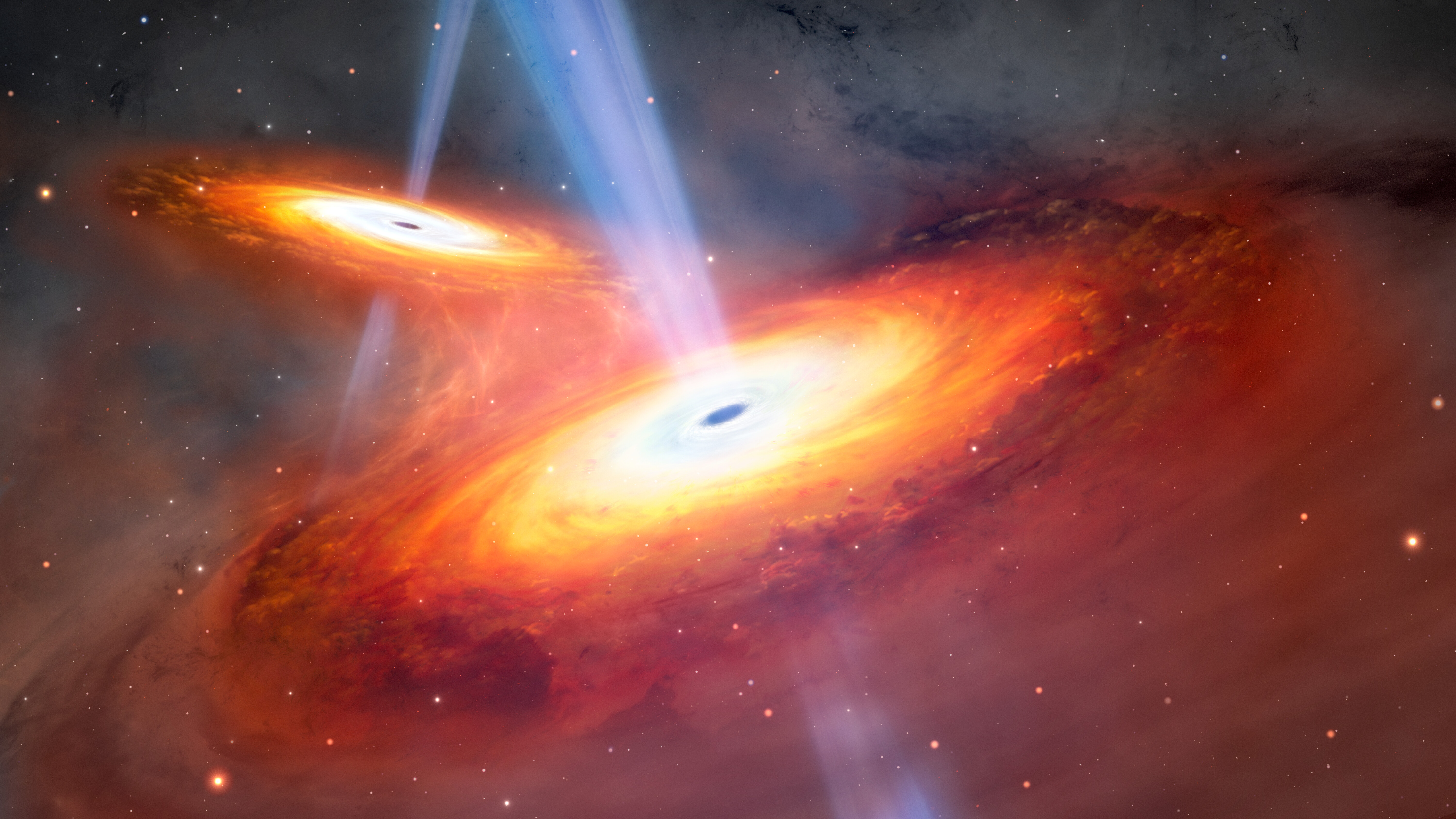
Two monster black holes, one weighing 1.5 billion suns and the other 400 million, were already feeding side by side just 900 million years after the Big Bang, and astronomers say no theory explains how they got that big that fast. The pair, officially J1602+4228AB and given the Hawaiian name Nāpōwawāʻenakaulua, is the oldest compact pair of quasars ever found.
The discovery, led by Silvia Onorato of NSF NOIRLab, was announced on November 10 in NOIRLab's release on the oldest compact quasar pair, alongside the team's paper in The Astrophysical Journal Letters.
"There is no definitive theoretical explanation for how a single one of these giant quasars exists so early in the age of our Universe, much less two," Onorato said. "We observed Nāpōwawāʻenakaulua at a time when the Universe was only a thirteenth of its age and astonishingly, its supermassive black holes are just as massive as those we see today."
How they found it
A quasar is a supermassive black hole swallowing gas and stars so fast that the heated material outshines every star in its galaxy. The two in this pair sit about 18,100 light-years apart, roughly one-fifth of the way across the Milky Way.
The pair turned up in the Aether survey, a James Webb Space Telescope program run by NOIRLab astronomer Emanuele Paolo Farina that gathered spectra of 200 early quasars, 43% of all those known from that era. While inspecting the Webb data, the team spotted that quasar J1602+4228A had a faint neighbor. The Gemini North telescope on Maunakea in Hawaiʻi then split the two apart. "The sky over Maunakea was so clean and sharp that we managed to collect the data in only two nights," Onorato said.
The numbers that make it strange
Put the figures side by side. Together the two black holes hold about 1.9 billion solar masses, and the heavier one outweighs its partner by a factor of nearly four. If the cosmos is about 13.8 billion years old today, one-thirteenth of that is a little over 1 billion years, which matches the 900-million-year mark the team gives. That leaves well under a billion years for both objects to bulk up to sizes typical of black holes in mature galaxies near us now.
The paper's own statistics sharpen the puzzle. Comparing how often such close pairs should show up, the authors report about a 2 to 3 order of magnitude excess over expectations, according to the preprint on arXiv. In plain terms, finding a pair like this is somewhere between 100 and 1,000 times more likely than models predicted.
Why it matters
Astronomers expect galaxy collisions to have been common in the young universe, and colliding galaxies should produce paired quasars. Spotting them has been hard because the quasar phase is brief, the objects are faint, and close pairs blur together. Nāpōwawāʻenakaulua is only the third quasar pair known from cosmic dawn. The team suggests it marks an unusually dense knot of matter where galaxy interactions fed star birth and black hole growth at the same time.
The name, created by Larry Kimura of the University of Hawaiʻi's Hawaiian language college, translates as "Two celestial bodies of fathomless powerful darkness in the brilliance of heat reincarnating energy into the Universe."
Limits of the finding
The paper calls the object a quasar pair candidate. A foreground galaxy could, in principle, act as a gravitational lens and make one quasar look like two. Differences in the two spectra lead the team to favor a real pair, but NOIRLab notes a lens model is still needed to rule lensing out completely.
Badiyaa has followed the race to the early universe, including the Euclid telescope's two earliest known quasars and the question of how supermassive black hole pairs finally merge.
The next step is that lens model; if it confirms two separate objects, the pair becomes a test case for every theory of how the first giant black holes grew.
Sources
- Science release noirlab2627 on the Nāpōwawāʻenakaulua quasar pair, NSF NOIRLab, 2026
- Onorato et al., Nāpōwawāʻenakaulua quasar pair paper, The Astrophysical Journal Letters, 2026
- Preprint arXiv:2609.31835 (Onorato et al.), arXiv, 2026
Image: International Gemini Observatory/NOIRLab/NSF/AURA/M. Garlick, CC BY 4.0 via Wikimedia Commons
This article was produced with AI assistance and reviewed by our Editorial Desk. How we work.