Black holes weighing about 10 solar masses turn up in cosmic collisions far more often than their slightly heavier cousins, and between 12 and 16 solar masses the count all but vanishes. Three Caltech physicists say that lopsided pattern fits a population of black holes born from giant stars that collapsed without ever exploding.
Isaac Legred, Jacob Golomb and Katerina Chatziioannou published the analysis on November 10 in a 2026 paper in Physical Review D. The open preprint, with its full abstract, sits on arXiv as paper 2604.01420.
How they weighed the black holes
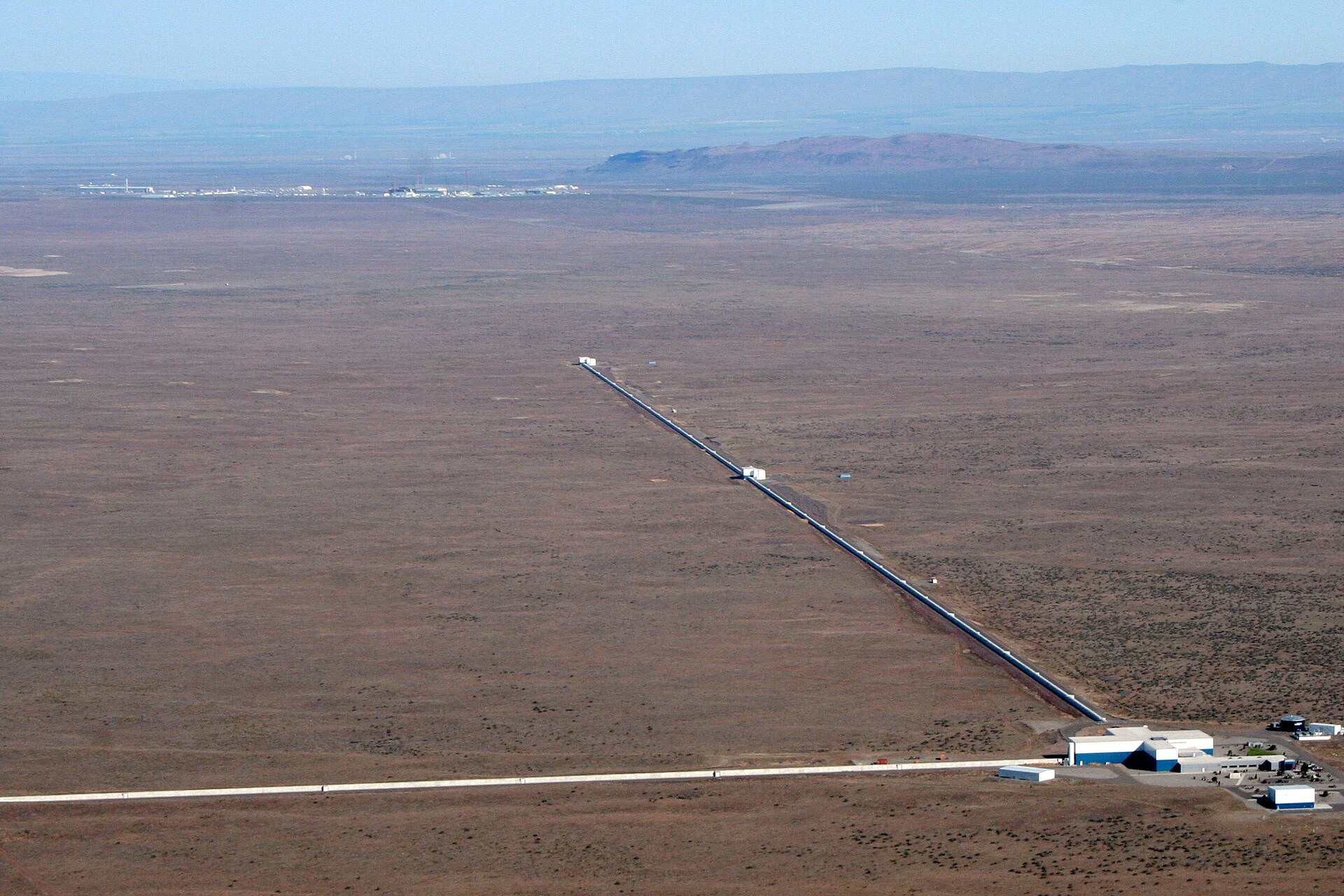
Every time two black holes spiral together, they shake spacetime and send out gravitational waves. The LIGO detectors in Washington state and Louisiana, now working with Virgo in Italy and KAGRA in Japan, catch those ripples and work out the masses involved. LIGO's Wikipedia entry traces the network from its first detection on September 14, 2015, to hundreds of detections since.
The team took 153 of those events from the GWTC-4.0 catalog and asked how often black holes of each mass show up as the heavier partner in a merger.
The pattern
- A sharp peak at 10 solar masses. This is the most common size by a wide margin.
- A steep fall. From about 10 to about 15 solar masses, the merger rate drops by roughly two orders of magnitude.
- A gap. Between 12.0 and 16.1 solar masses, the rate is consistent with zero at the 90% confidence level.
- A rebound. Above about 16 solar masses, mergers become confidently common again, then thin out at higher masses.
The authors add that the same structure holds up in the newer GWTC-5.0 catalog.
What two orders of magnitude means
Two orders of magnitude is a factor of about 100. Put plainly: for roughly every 100 black holes near 10 solar masses that show up in this kind of merger, the analysis expects only about one near 15. The empty stretch between 12.0 and 16.1 is just 4.1 solar masses wide, a narrow window for nature to skip.
Why failed supernovae
Most heavy stars die in a supernova. Some may not. In a failed supernova, a massive star's core collapses straight into a black hole and the star simply disappears from view, with little or no flash, as Wikipedia's failed supernova article explains. Astronomers have watched a few candidates wink out, including a red supergiant in the galaxy NGC 6946 in 2009.
The paper argues that denser stellar cores could help explain the pile-up at 10 solar masses but cannot fully account for the size of the drop. A separate group of black holes formed by direct collapse in a narrow mass range around 10 would fill that gap in the explanation.
Badiyaa has followed other black hole puzzles, from tiny primordial black holes that may have reheated the early universe to giant black hole pairs that should stall a parsec apart.
Limits
The study does not catch a single failed supernova in the act. It shows that the black hole mass pattern is consistent with such a population, which is a statistical argument built on 153 events. The error bars on the peak are wide: the paper puts the peak rate density at 7.36 per solar mass per year per cubic gigaparsec, with a range running from 3.11 below that figure to 6.35 above it.
More data is on the way. LIGO's next stretch of observing, a six-month intermediate run, is planned to start in mid-January 2027.
Sources
- Low-mass failed supernovae and the 10 solar-mass peak in the merging black hole mass distribution, Physical Review D (Caltech), 2026
- arXiv:2604.01420 preprint, arXiv (Caltech), 2026
- LIGO, Wikipedia, 2026
- Failed supernova, Wikipedia, 2026
Image: LIGO Laboratory, Public domain via Wikimedia Commons
This article was produced with AI assistance and reviewed by our Editorial Desk. How we work.