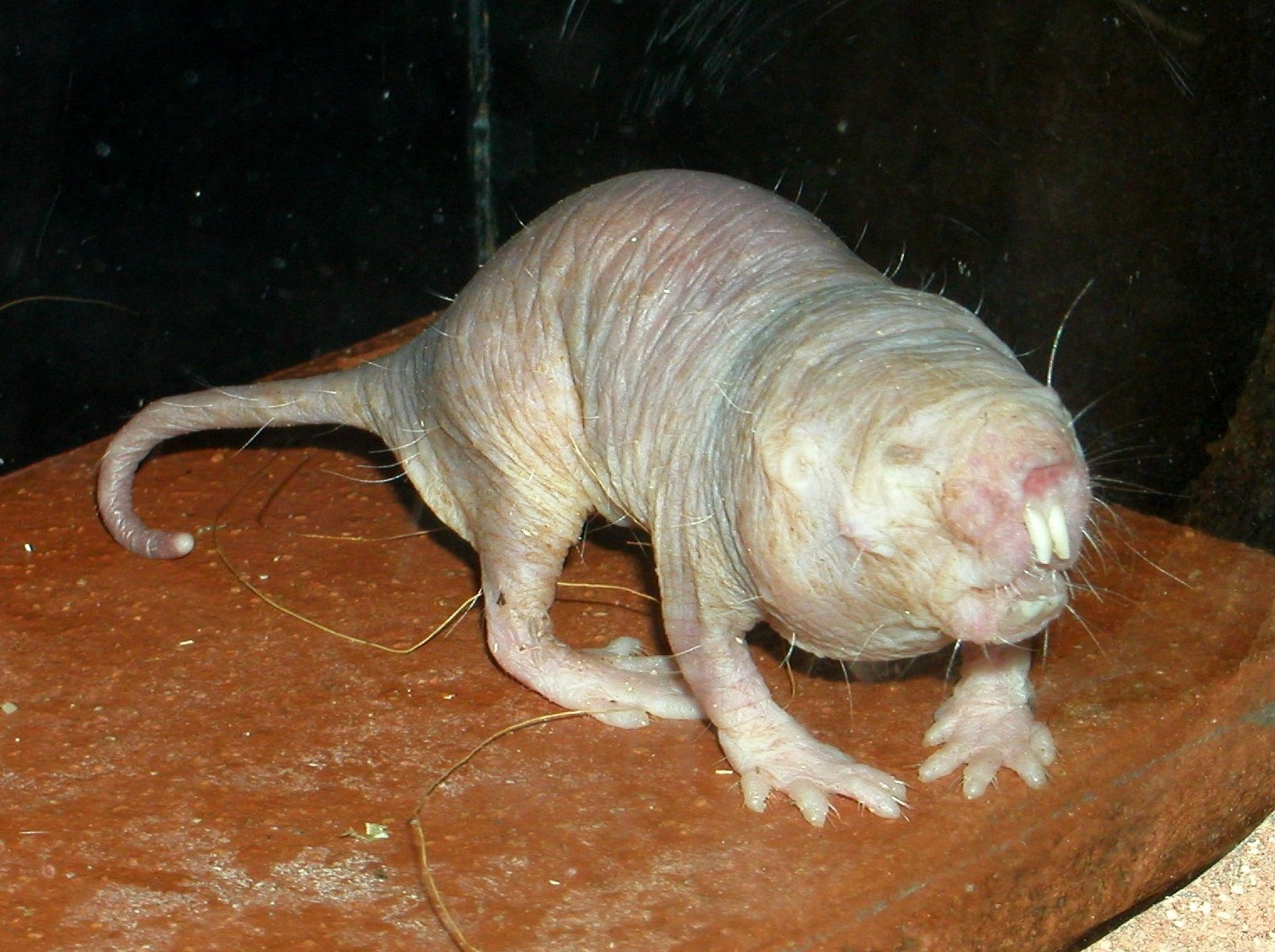
The naked mole-rat looks like a wrinkled pink sausage with buck teeth, and it breaks rules that every other mammal follows. It can survive 18 minutes in air with no oxygen at all, it lives past 30 years, and its risk of dying does not climb as it gets older.
A rodent that refuses to age on schedule
For most mammals, including us, the odds of death rise steeply with every year after adulthood, a pattern known as Gompertz's law. The naked mole-rat ignores it. A 2018 study in eLife by J. Graham Ruby, Megan Smith and Rochelle Buffenstein of Calico Life Sciences combed through more than 3,000 lifespan records and found the animals' hazard of death "did not increase with age, even at ages 25-fold past their time to reproductive maturity." The authors called it "a non-aging mammal."
That makes it the longest-lived rodent on record. According to the species' Wikipedia entry, naked mole-rats can top 37 years; the runner-up, the African porcupine, manages about 28. A typical adult weighs just 30 to 35 grams, or 1.1 to 1.2 ounces.
Eighteen minutes without air
The tunnels these animals dig under East Africa are stuffy and low in oxygen, and their bodies are built for it. In lab tests the rodents carried on normally for at least five hours in air with only 5% oxygen. In zero oxygen they lasted 18 minutes: they passed out, their heart rate fell from about 200 to 50 beats a minute, and they recovered without apparent harm.
How they pull it off was the subject of a 2017 paper in Science led by Thomas Park at the University of Illinois Chicago. The team found that the animals fuel their cells with fructose through a rewired pathway when oxygen runs out, something mammal tissue normally cannot do safely.
A queen, workers and soldiers
The weirdness is social too. Naked mole-rats were the first mammal found to be eusocial, living like ants or bees:
- One queen breeds. Only she and one to three males reproduce; the rest of the colony works. When a new queen takes over, the gaps between her vertebrae widen so her body grows longer.
- Huge litters. Litters average 11 to 12 pups and have reached 28 in the wild, more than the queen's nipple count, so pups take turns.
- Big colonies. Colonies average 75 to 80 animals but can pass 300, with tunnel networks stretching 3 to 5 kilometers.
- Acid-proof skin. Their skin lacks the chemical signals that carry certain pain, so acid and chili-pepper capsaicin do not hurt it.
They also run cold. Unlike almost every other mammal, their body temperature tracks their surroundings, so they huddle to warm up or retreat deeper underground to cool off. And yes, they sometimes eat their own droppings, which helps feed weaned pups and spreads the queen's hormones around the colony.
Why scientists keep watching
Their resistance to cancer and slow aging earned them the title "Vertebrate of the Year" from the journal Science in 2013. They are not endangered; they are simply hard to spot, aside from the little volcanoes of soil they kick up.
For more long-lived and oddball animals, see how Greenland sharks live about 400 years, why platypus fur glows under ultraviolet light, and how the slow loris makes venom by licking its arm.
Sources
- “Naked mole-rat mortality rates defy Gompertzian laws by not increasing with age”, eLife, 2018
- “Fructose-driven glycolysis supports anoxia resistance in the naked mole-rat”, Science, 2017
- “Naked mole-rat”, Wikipedia, 2026
Image: Roman Klementschitz, CC BY-SA 3.0 via Wikimedia Commons
This article was produced with AI assistance and reviewed by our Editorial Desk. How we work.