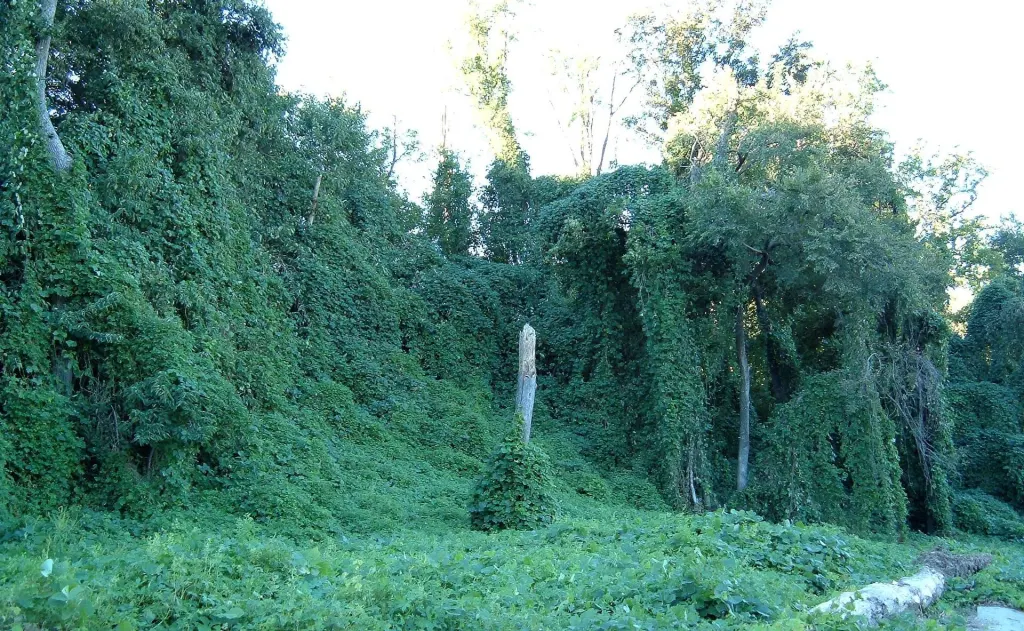
In 1935 the brand-new Soil Conservation Service offered Southern farmers as much as $8 for every acre they planted with kudzu, a Japanese vine it hoped would hold eroding cotton land in place. The vine went on to become a byword for runaway invasion, often described as smothering seven million acres or more. The government’s own forest survey tells a smaller story: about 227,000 acres of Southern forest with any kudzu at all.
That gap, between the kudzu of legend and the kudzu that field crews actually count, is the reason a decades-old farm subsidy keeps resurfacing online.
How the vine was sold
Kudzu reached the United States as an ornamental, shown in the Japanese pavilion at the 1876 Centennial Exposition in Philadelphia and promoted again at a New Orleans exposition in the 1880s, where it caught on as a shady “porch vine.” Its big break came after the drought of 1930 and 1931. Federal nurseries in Virginia, North Carolina, Alabama and Georgia raised between 70 million and 100 million seedlings from 1935 to 1942, depending on which history you read, and handed them to farmers, railroads and highway departments. Planting payments worked out to about $7.99 an acre.
Boosters went further. Channing Cope, an Atlanta newspaper columnist and radio host, founded the Kudzu Club of America, which set a goal of eight million planted acres. Even the planting totals disagree. One account puts the figure at roughly half a million acres by 1945, another at just over a million, and a third at three million by 1946.
The romance faded fast. The USDA dropped kudzu from its suggested cover plants in 1953 and later classed it as a weed; it was on the Federal Noxious Weed List by 1997 and came off again in 2000.
The myth against the measurements
Putting the competing numbers side by side shows how far apart they are. The commonly repeated figure of 7.4 million acres in the Southeast is about 33 times the Forest Service’s 227,000 forest acres (7,400,000 ÷ 227,000 ≈ 32.6). Adding the roughly 500,000 urban and suburban acres that some experts estimate still leaves the popular number about ten times too high. The forest figure itself amounts to about one-tenth of 1 percent of the region’s 200 million wooded acres.
Spread rates diverge even more. A 2006 study claimed kudzu was overtaking the South at 120,000 acres a year and a 2009 USDA estimate went as high as 150,000, while the Forest Service in 2015 projected about 2,500. The high USDA figure is 60 times the Forest Service projection.
Why does kudzu look so much bigger than it is? Biology explains most of it. The vine is largely shade intolerant, so it thrives on sunny edges such as roadsides and old fields, exactly where drivers see it, and its advance slows where it meets the shaded forest interior. At New River Gorge in West Virginia, the National Park Service reports it clinging to open ground around former mining towns rather than pushing deep into the woods. Nancy Loewenstein of Auburn University has called kudzu “a good poster child” for invasive species because it is so visible.
None of this makes kudzu harmless. Estimates of lost forest productivity run from $100 million to $500 million a year, control can cost about $2,000 per acre annually, and the vine now grows in 31 states, with the Park Service noting it is moving north. Asian privet, a quieter invader, covers roughly 3.2 million acres, about 14 times kudzu’s forest footprint.
If kudzu is on your land
Forest Service guidance stresses persistence over any single treatment:
- Spray after late May; applications made while the plant is dormant appear to do little.
- Expect to come back. One application can knock foliage back sharply, but some sites need follow-up for ten years or more.
- Mow about every two weeks to wear down the root crowns; patches younger than ten years can sometimes be cleared this way within three to four years.
- Do not count on fire alone. Burned kudzu resprouts and can be back in charge by the second growing season.
The common mistake is treating one summer’s spraying as a cure. On older stands, the agency’s guidance is to plan on up to a decade of repeat work before the roots, which can weigh more than 400 pounds, finally give out.
Further reading
- Wikipedia: Kudzu in the United States
- USDA Forest Service Fire Effects Information System: Pueraria montana var. lobata
- National Park Service: Kudzu at New River Gorge
- USDA National Invasive Species Information Center: Kudzu
Image: Scott Ehardt, public domain via Wikimedia Commons
This article was produced with AI assistance and reviewed by our Editorial Desk. How we work.