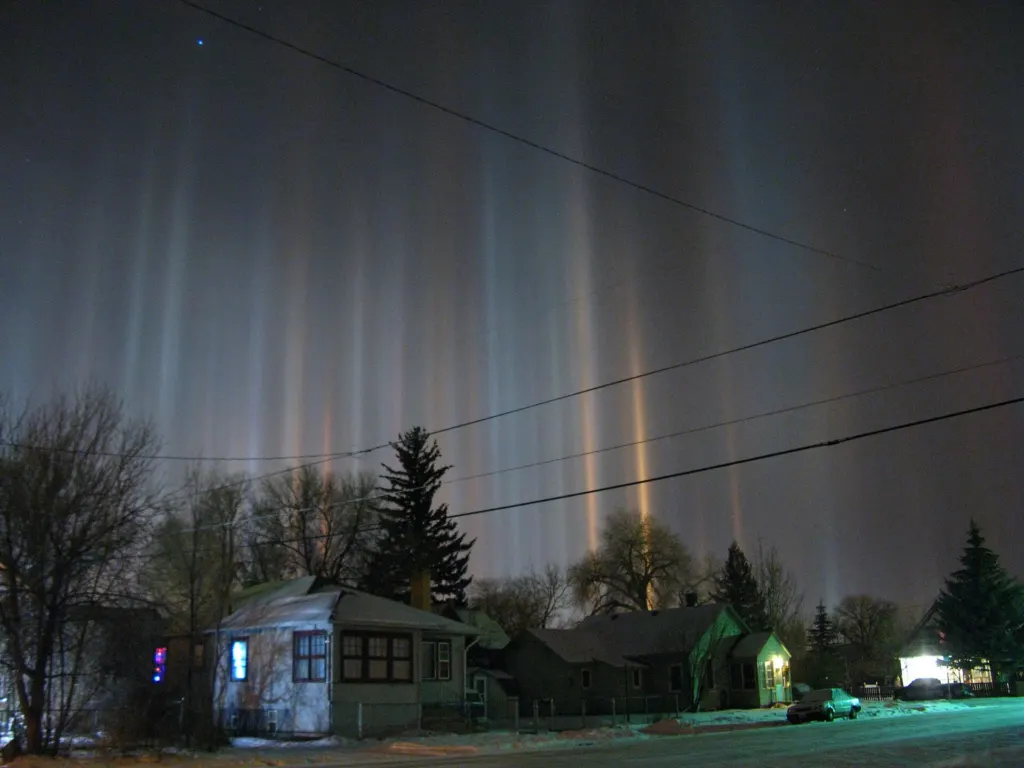
On cold, still nights along Japan’s Sea of Japan coast, columns of light can rise straight up from the dark horizon, one for every lamp-lit fishing boat out at sea. Japanese has a name for them: isaribi kōchū, or “fishing-fire light pillars.” The Japanese-language encyclopedia entry on light pillars notes that these columns turn up at various points along that coast, and that several boats make several separate pillars.
Nothing is shining upward. The beams are reflections, and the mirrors are billions of flat ice crystals hanging in the air.
Flat ice, falling like leaves
A light pillar belongs to the halo family of sky optics, the same broad group as sun dogs. According to the English-language encyclopedia article on light pillars, the usual culprits are thin hexagonal plates of ice. As they drift down through calm air, drag tips them so that they lie close to horizontal, like a sheet of paper settling to the floor.
Each plate then behaves like a tiny mirror. A plate at the right height and angle bounces light from a boat lamp below it toward someone watching from shore. Because crystals sit at many altitudes, the reflections stack into a tall vertical stripe. More crystals, and bigger ones, make the stripe brighter. Pencil-shaped column crystals can do the same job, though less often.
The pillar is an illusion of position. It does not stand above the boat at all; it is the sum of glints from the crystals that happen to share one vertical plane with you and the lamp. The English article compares it to the glittering path a streetlight throws across a rippled lake toward whoever is looking.
Why boat lights make taller pillars than sunlight
The same trick works with sunlight, producing a sun pillar at sunrise or sunset, and with moonlight. The Japanese entry points out a difference: sunlight and moonlight reach us almost parallel, while light from a nearby lamp fans out, so pillars from ground sources tend to look taller than solar ones. Since the effect is plain reflection with no refraction, there is no rainbow splitting either. A pillar takes on the color of whatever made it, orange for a setting sun, white or greenish for a boat’s work lamps.
When the ice floats right at ground level in bitter cold, it is called diamond dust. The Japanese article says this forms in air of roughly minus 10 to minus 20 degrees Celsius (14 to minus 4 degrees Fahrenheit) and can be seen in winter in inland Hokkaido.
How to see one
- Pick a cold, calm night; wind tumbles the plates and spoils their mirror alignment.
- Look toward bright, distant lights: a fishing fleet, a lit stadium or a row of streetlamps.
- Watch for thin icy cloud or haze; the Japanese entry notes pillars often show with cirrostratus or altostratus layers.
- Count the columns against the lights. One pillar per lamp is the giveaway.
Limits of the explanation
Neither source gives figures on how often isaribi pillars appear in a given winter, and the Japanese entry’s own claim that sun pillars may have inspired the glowing “weather-wheel pillar” in Kenji Miyazawa’s novel Night on the Galactic Railroad is offered only as one theory. The physics, though, is settled: flat ice, calm air and a bright source below.
For another everyday sky trick explained by simple optics, read how gaps between tree leaves turn into pinhole cameras during a solar eclipse, or find more sky and weather stories in the Badiyaa science section.
Further reading
Illustrative image. Image: Christoph Geisler, CC BY-SA 3.0 via Wikimedia Commons
This article was produced with AI assistance and reviewed by our Editorial Desk. How we work.