Go back 30 generations, to roughly the High Middle Ages, and your family tree should hold about 1 billion ancestors. There is a snag: that is more people than were alive on Earth at the time. That is the math hiding inside the "most famous person you're related to" game that has been doing the rounds on Bluesky, and it means almost everyone playing is right to claim somebody grand.
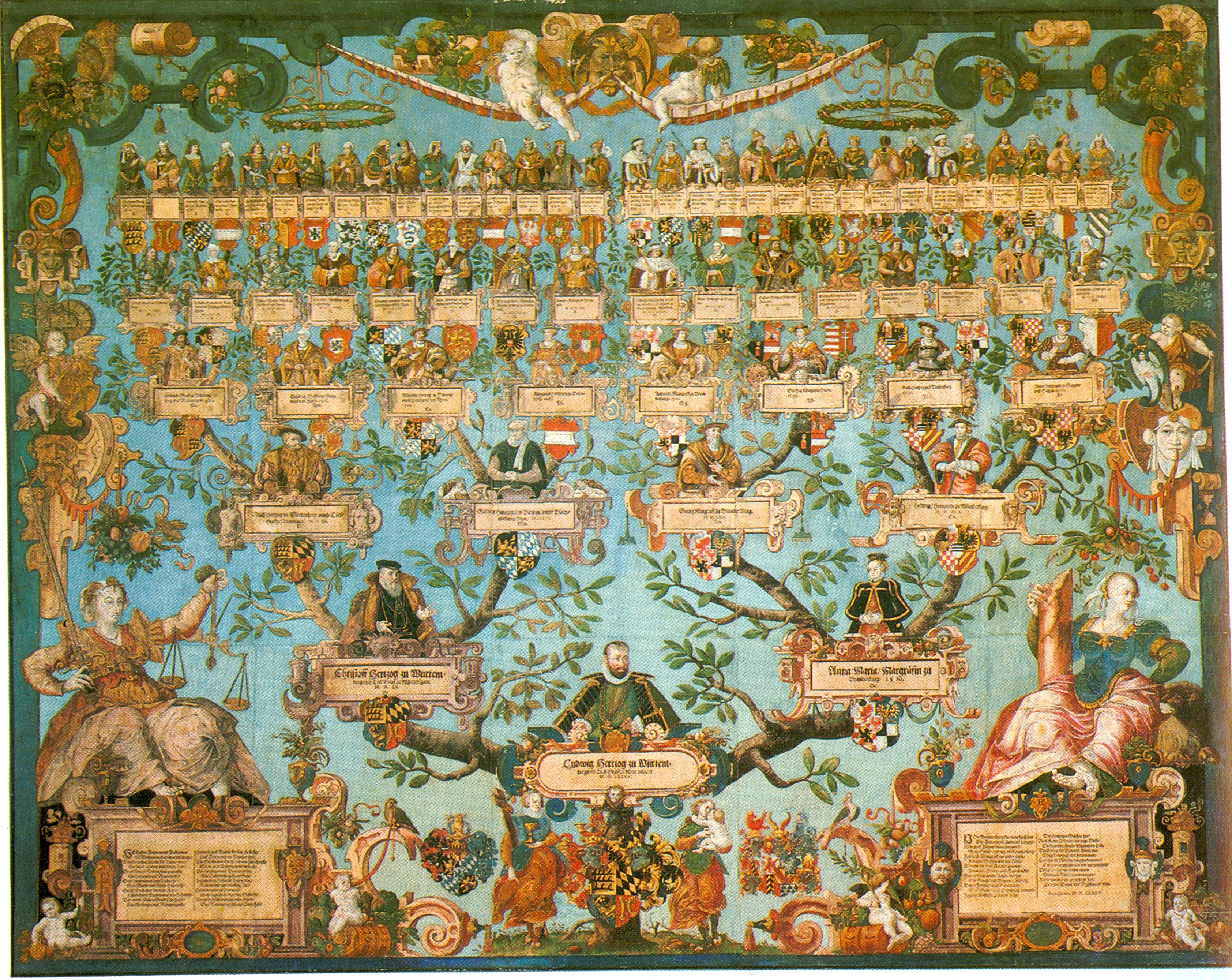
The trick has a name. Genealogists call it pedigree collapse, a term coined by Robert C. Gunderson; the German word is Ahnenschwund, or "loss of ancestors." As Wikipedia's entry on pedigree collapse explains, the binary tree of 2 parents, 4 grandparents and 8 great-grandparents eventually folds in on itself, because the same person turns up in many slots at once.
How one family tree folds in on itself
The simplest case is cousin marriage. A child whose parents are first cousins has six great-grandparents, not eight. Royal families pushed the effect to extremes: Alfonso XII of Spain had just four great-grandparents, and Charles II of Spain, the last Habsburg king, had three uncle-niece weddings among the seven unions in his immediate ancestry.
Ordinary people were not far behind. Before trains and cars, most couples married someone who lived within walking distance, so the typical pair were already distant relatives without knowing it. For most of us, the number of ancestors alive at any one time probably peaked at around 1200 AD.
The 50th-cousin rule
Here is where the famous-relative claims get easy. A 1985 suggestion put everyone on Earth at most 50th cousin to everyone else. Later computer models went further. In a 2004 Nature paper, Douglas Rohde, Steve Olson and Joseph Chang simulated human ancestry and, under an assumption of random mating with no geographic barriers, put the point at which all living people share exactly the same set of ancestors at only 2,000 to 5,000 years ago.
That moment is called the identical ancestors point. Allowing for geography and less random mating, the 2004 simulations put the most recent common ancestor of everyone alive perhaps 76 generations back, and Wikipedia's article on the identical ancestors point notes that researchers now place the European isopoint closer to 1000 AD. In other words, if any medieval European left living descendants, most people with European roots probably count that person as an ancestor.
Badiyaa's back-of-envelope check
The numbers run away fast. Thirty generations gives 2 to the power of 30, or 1,073,741,824 slots. Forty generations gives 1,099,511,627,776 slots, more than a trillion, for a world that held only a few hundred million people at the time. Only massive overlap makes the math work.
The catch for bragging rights
Sharing an ancestor is not the same as sharing their DNA. The 2003 simulation work found a modern Norwegian might trace only 0.00044% of their ancestry to Japan, even with the same set of distant ancestors on paper. A person can be a genealogical ancestor while passing on no genetic material at all.
So the cousin claim that tops the Bluesky thread may well be true, just shared with a few billion others. Badiyaa has dug into deep human ancestry before, from the 3-million-year-old Taung Child fossil to a Monash proposal to fold Lucy's kind into our own genus.
Sources
- Pedigree collapse, Wikipedia, 2026
- Identical ancestors point, Wikipedia, 2026
- Modelling the recent common ancestry of all living humans (Rohde, Olson and Chang), Nature, 2004
Image: Unknown artist, Public domain via Wikimedia Commons
This article was produced with AI assistance and reviewed by our Editorial Desk. How we work.