Somewhere in the Dubrovnik State Archives sits a register with four inky cat paw prints stamped across a page of careful notarial script. The animal apparently stepped in the scribe’s ink, then strolled over the open book, and the marks have stayed put for more than five centuries.
The photo of those prints keeps resurfacing online, usually captioned with the year 1445. It was taken by Emir O. Filipović, then a doctoral researcher, while he was working through the archive’s medieval books for his PhD.
How a research snapshot became a meme
Filipović told the story himself in a March 2013 essay. He said he photographed the stained pages the way he snaps anything odd he finds in an old volume, then went back to work. He had planned only to show the picture to colleagues for a laugh.
That changed when the book historian Erik Kwakkel tweeted a medieval illumination of an angry cat. Filipović replied with his own photo, Kwakkel shared it, and a well-known veterinarian later reposted it on Facebook. Within days, Filipović wrote, strangers were emailing him about the manuscript’s provenance, and the story had been retold in English, Russian, Japanese, Greek, Romanian, French and Hebrew.
His reconstruction of the accident is the part people quote. He pictured a cat, “presumably owned by the scribe,” that “pounced first on the ink container and then on the book.” With the damage done, he wrote, the writer had little choice but to turn to a fresh leaf and keep going.
What we know, and what we do not
- The place: the Dubrovnik State Archives, which Filipović names as the home of the register.
- The finder: Filipović, who took the photograph during PhD research.
- The date: 1445 is the year attached to the image in most reposts, but Filipović’s own essay never prints a year, and some early write-ups called the book 14th-century. Treat 1445 as the popular caption rather than a catalog-confirmed date.
- The cat: nobody knows its name, color or owner. “Presumably owned by the scribe” is Filipović’s guess, and he framed it as one.
Why Dubrovnik kept the evidence
Few medieval towns could hold onto a page like this for 500-plus years. Dubrovnik, known in Latin and Italian as Ragusa, ran its own affairs as the Republic of Ragusa from 1358 until Napoleon’s forces took it in 1806, with formal annexation by the Napoleonic Kingdom of Italy following in 1808. A government that never fell to a sack had no reason to scatter its paperwork.
Filipović described a commune run by local aristocrats whose wealth came from sea trade, with a notary and archive set up in the second half of the 13th century to record deals and disputes. He quoted the historian Fernand Braudel calling the Dubrovnik records “far and away the most valuable for our knowledge of the Mediterranean.”
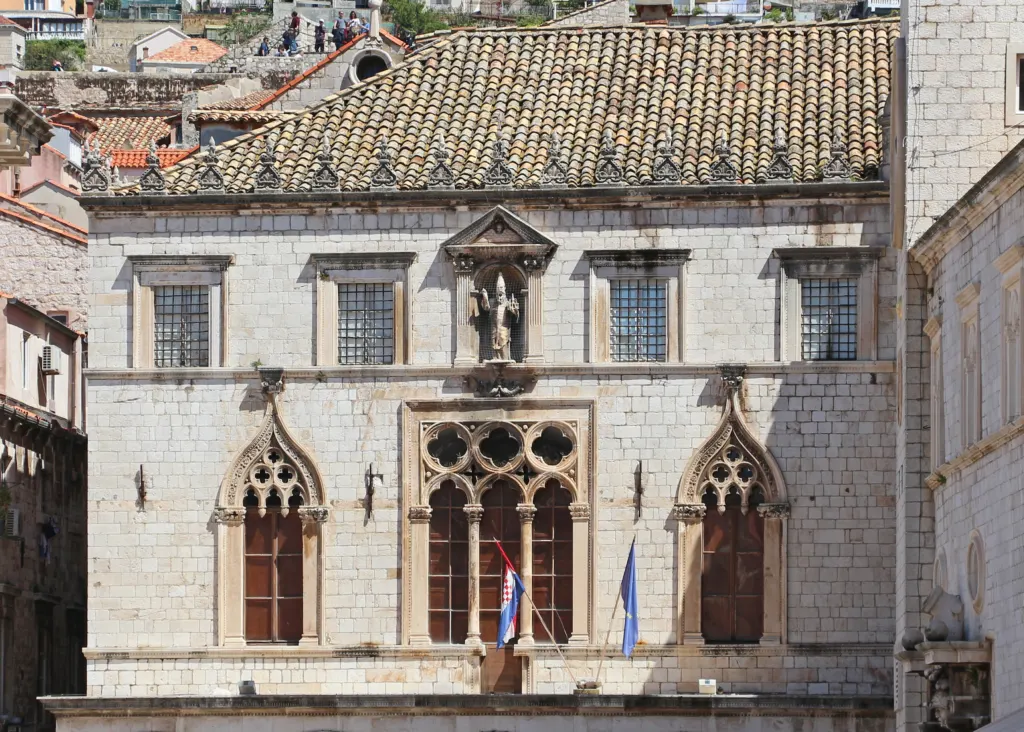
Today the collection lives in the Sponza Palace, a Gothic and Renaissance building finished in 1522 that once served as the republic’s customs house, mint and treasury. The archive there holds more than 7,000 volumes of manuscripts and about 100,000 individual documents, with the earliest dated 1022.
A scale for the find
Put those numbers together and the paw prints look even luckier. If 1445 is right, the page is about 581 years old in 2026, and it is one stained leaf among roughly 7,000 bound volumes. A cat crossing a desk was ordinary; the city’s long independence is what turned a scribe’s bad afternoon into a record anyone can now study.
Filipović’s photos show other human traces in the same archive: a bored notary’s doodles, bookworm tunnels, and a natural hole in the vellum that a scribe wrote around.
Cats still find their way onto keyboards and notebooks, as anyone who has read about why cats knead with alternating paws will recognize. For another medieval oddity that outlived its makers, see Bern’s 480-year-old Child Eater Fountain, and browse more strange-but-true stories in Offbeat.
Filipović said the document was set to join the Interactive Album of Mediaeval Palaeography, a teaching site run from Lyon, France, so students could practice reading the script the cat walked across.
Further reading
Image: Bernard Gagnon, CC BY-SA 4.0 via Wikimedia Commons
This article was produced with AI assistance and reviewed by our Editorial Desk. How we work.