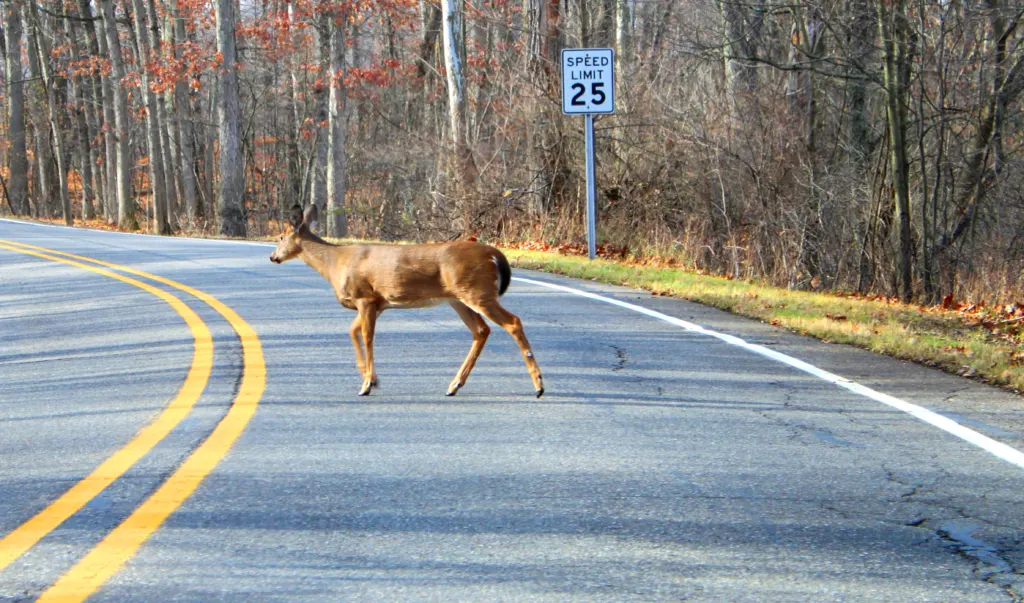
A deer that freezes in the road is not being foolish. It is waiting for a clear sign of danger that standard headlights fail to give it. In experiments with free-roaming white-tailed deer, US Department of Agriculture researchers found that dangerous encounters fell from 35% of vehicle approaches to just 10% when a car also lit up its own front end, largely because the deer froze less often.
Why a deer locks up
Prey animals judge a threat partly by “looming”: an object that grows quickly larger in view is coming at you, and that triggers the urge to run. A car at night shows a deer little more than two bright points of light. The body of the vehicle, the part that should loom, stays dark behind the glare.
The USDA team, at the Wildlife Services program’s National Wildlife Research Center, tested a rear-facing LED light bar that shines back onto the front surface of the vehicle. Lead author Travis DeVault explained the idea: “We predicted that light reflected from the front surface of the vehicle would provide a more reliable looming image to deer, thus encouraging the deer to move out of the path of the approaching vehicle.”
It worked in the trials, and the agency applied for a patent on the design, which could be fitted like a bumper accessory or built in at the factory. The study appeared in the journal Ecosphere.
What 35% versus 10% means
Picture 100 nighttime approaches toward a deer. With headlights alone, about 35 turned into dangerous interactions. With headlights plus the light bar, about 10 did. That is 25 fewer close calls per 100 approaches, a drop of roughly 71% from where it started.
Built for dusk, not for high beams
Deer eyes are tuned for the hours when collisions are likeliest. White-tailed deer are crepuscular, most active at dawn and dusk, and rest on and off through the day and night. Their horizontally slit pupils give them good night vision, and they process images faster than people do and pick up motion in low light better than we can.
They see color differently, too. Deer have two-color vision built on blue and yellow, while most humans have three. Oranges and reds that leap out at us look dull to a deer, which is why hunters can wear bright orange for safety.
Why November is peak season
White-tailed deer breed in autumn, with does usually coming into season in late October or early November as the days shorten. Bucks travel widely during the rut and rarely stop to eat or rest. Collisions with deer are a known problem across much of their range, especially at night and during the rutting season. Studies across the US also find that most deer collisions happen between May and November.
Habitat plays its part as well. Roads built through woodland, or along the rivers and lakes deer use for food and cover, cut straight across the animals’ daily routes. Deer cause the majority of animal-related road collisions that injure people in the US and Canada, which is why the USDA is looking for a licensing partner to build and sell the light bar.
For more on how eye shape matches lifestyle, read why grazers get horizontal pupils and ambush hunters vertical slits. Badiyaa has also reported how a Texas Panhandle antler rule changed the age of mule deer bucks.
Further reading
Image: Dwight Burdette, CC BY 3.0 via Wikimedia Commons
This article was produced with AI assistance and reviewed by our Editorial Desk. How we work.