In 1966 a University of Chicago paleontologist showed that almost any coiled shell, from a garden snail to a fossil ammonite, could be drawn by a computer from a handful of numbers. David Raup’s model then exposed something stranger: most of the shell shapes his math allowed have never turned up in nature.
The idea traces to his paper “Geometric analysis of shell coiling: general problems,” published in the Journal of Paleontology in 1966, which built on an earlier 1962 paper in Science on using a computer to describe snail shells, both listed among Raup’s selected publications.
How the model works
Picture squeezing modeling clay through a shaped nozzle. The outline of that nozzle is the first ingredient, which Raup called the generating curve. It can be round, oval or ridged, and it sets the cross-section of the shell tube.
Then the tube is wound around an imaginary axis, and three numbers control how it winds:
- W, the whorl expansion rate: how fast the tube widens with each turn.
- D, the distance from the axis: how far the tube sits from the center line. At zero the coils press together; larger values leave an open gap in the middle.
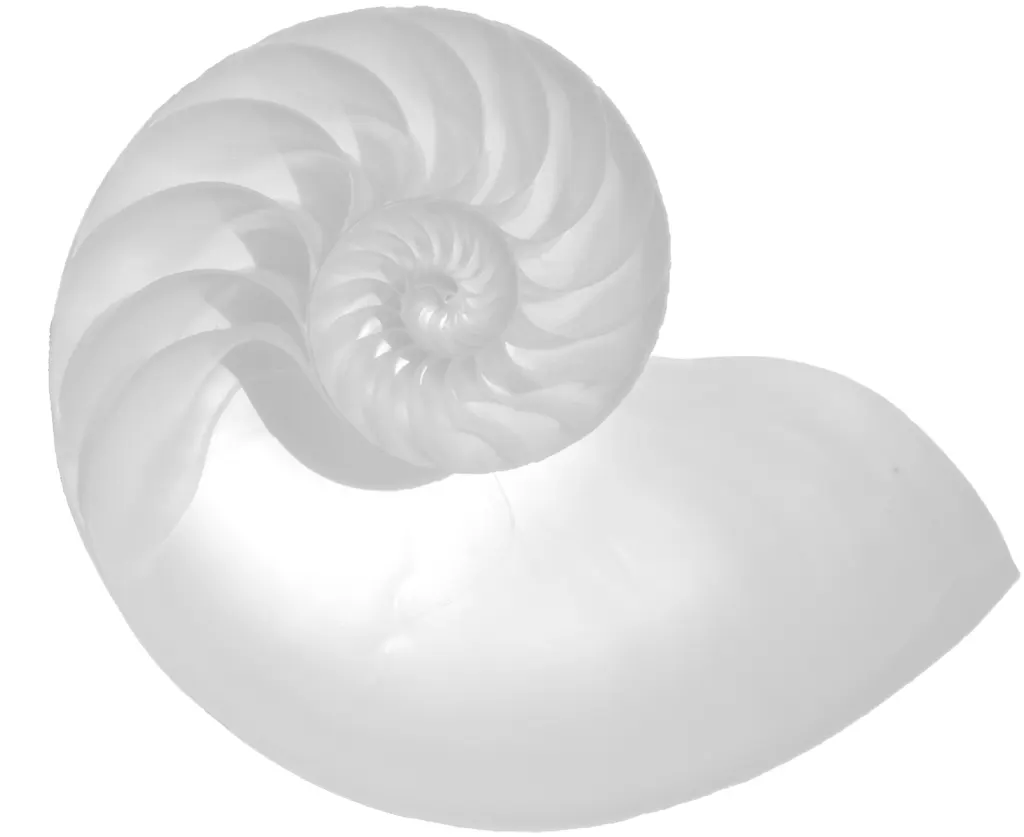
- T, the translation rate: how far the coil slides down the axis with each turn. At zero the shell stays flat, like a nautilus or a ram’s horn; a high value stretches it into a tall spire, like a turret snail.
Plug in values, and the computer draws the shell. Since every species gets its own W, D and T, each one becomes a single point in a three-dimensional box with those numbers on its axes.
The empty space
That box is what made the model famous. When real shells were plotted inside it, they did not spread evenly. They bunched into distinct pockets, and large regions stayed empty. Raup asked whether those unused regions held shapes that are physically impossible for an animal to build, or whether evolution simply had not gotten there yet.
Biologists now call such a box a morphospace, a map of every form that could exist set against the forms that actually do. Snail shells remain the classic example: studies of them found that only a small slice of all possible shell shapes is realized in nature. Some empty zones make practical sense. A shell with a large D and a fast-expanding W would be a loose spiral of tube barely touching itself, fragile and awkward to carry.
The approach spread well beyond snails. Researchers have used Raup-style models to track how crinoids, the sea lilies, filled their own morphospace through time, to model coral growth, and to study how ammonoid shapes recovered after mass extinctions.
The man behind the math
Raup was born in Boston in 1933, studied at the University of Chicago and Harvard, and later served as curator and dean of science at the Field Museum in Chicago. He is better known outside paleontology for his work with Jack Sepkoski suggesting that mass extinctions, including the one that ended the dinosaurs 66 million years ago, may have recurred on a cycle of about 26 million years. He died in 2015, and the asteroid 9165 Raup carries his name.
Shell geometry is a recurring theme in nature’s math. Badiyaa recently looked at how often sunflower spirals really follow Fibonacci numbers, and at the long debate over what wiped out the mammoths, a puzzle in the same extinction field Raup helped shape.
Limits
Raup’s model treats a shell as perfect, steady growth. Real snails change their coiling as they age, add spines and ribs, and thicken their lips at maturity, details three numbers cannot capture. Later researchers built more complex versions for exactly that reason. The model’s power was never in copying any single shell; it lay in laying every possible shell side by side, gaps included.
Further reading
Image: Roberto Segnali all'Indiano, after Antonov, CC BY-SA 3.0 via Wikimedia Commons
This article was produced with AI assistance and reviewed by our Editorial Desk. How we work.