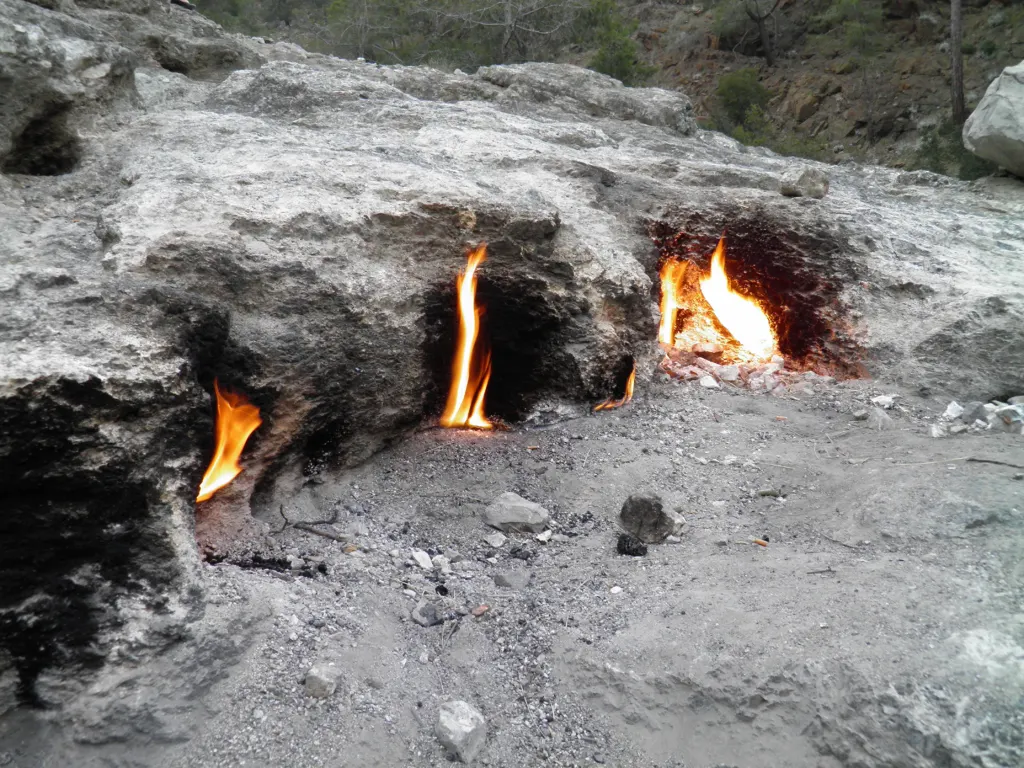
On a mountainside in southwestern Turkey, dozens of small fires flicker straight out of cracks in the rock, and they have done so for at least 2,500 years. Nobody lights them and nobody puts them out. A clip of flames burning out of the ground from seeping natural gas rose up a popular Reddit community for interesting things on November 16, and the most famous real-world example sits above a Turkish beach village.
The place is called Yanartaş, Turkish for “flaming stone.” It lies near the Olympos valley in Antalya Province, roughly 80 kilometers (50 miles) southwest of the city of Antalya and close to the village of Çıralı. In ancient times it was known as Mount Chimaera.
What is actually burning
The fuel is gas leaking out of the rock, mostly methane. Measurements put methane at about 87% of the mix, with hydrogen making up roughly 7.5% to 11%, plus small amounts of nitrogen, light hydrocarbons, carbon dioxide and a trace of helium.
That gas comes from two sources in roughly equal parts. Half is ordinary thermogenic gas, cooked out of organic-rich sedimentary rocks over millions of years, the same broad process that makes commercial natural gas. The other half is abiogenic, meaning it formed without living matter at all, through a low-temperature reaction between water and rock called serpentinization.
That second half is the scientific prize. Methane made without biology usually needs far more heat than the rocks at Yanartaş can supply. Researchers believe ruthenium in the igneous rock under the flames acts as a catalyst, letting methane form below 100°C (212°F). The vents are described as the largest emission of abiogenic methane yet found on land, and they are not volcanic.
Flames that change with the seasons
The fires are spread across about 5,000 square meters (some 54,000 square feet), roughly 70% of a full-size 105-by-68-meter soccer field, and they are not constant in strength. The vents tend to burn more vigorously in winter. At seeps like this, the flow of gas is pushed around by groundwater refilling the rock and by shifts in air pressure.
Most visitors make the easy one-kilometer climb at night, when the flames look their best. The ruins of a temple to Hephaistos, the Greek god of fire and the forge, stand directly below them. Sailors once used the glow to navigate; these days, people are more likely to brew tea over it.
The monster in the mountain
Ancient writers tied the fires to the Chimera of Greek myth, a fire-breathing beast that was part lion, part goat and part serpent. Pliny the Elder placed the Chimera at permanent gas vents near the Lycian city of Phaselis and wrote that the mountain “indeed burned with a flame that does not die by day or night.” The British naval officer Francis Beaufort surveyed the coast in 1811 and identified Yanartaş as the ancient Mount Chimaera, though not every scholar accepts the match.
How it compares with the Door to Hell
The better-known burning pit is the Darvaza gas crater in Turkmenistan, a collapsed gas field that has burned since around 1971. If Yanartaş has been alight for 2,500 years, it has been burning about 45 times longer. Darvaza is also fading: infrared images from 2026 show its fires on the decline, after wells were drilled around it to capture methane.
For more of the planet’s odd corners, Badiyaa has looked at Australia’s bubble gum pink Lake Hillier and at Turkish history in how the fez became the Ottoman Empire’s official hat in 1829. At Yanartaş, the winter months now arriving are when the vents usually burn brightest.
Further reading
Image: Carole Raddato, CC BY-SA 2.0 via Wikimedia Commons
This article was produced with AI assistance and reviewed by our Editorial Desk. How we work.