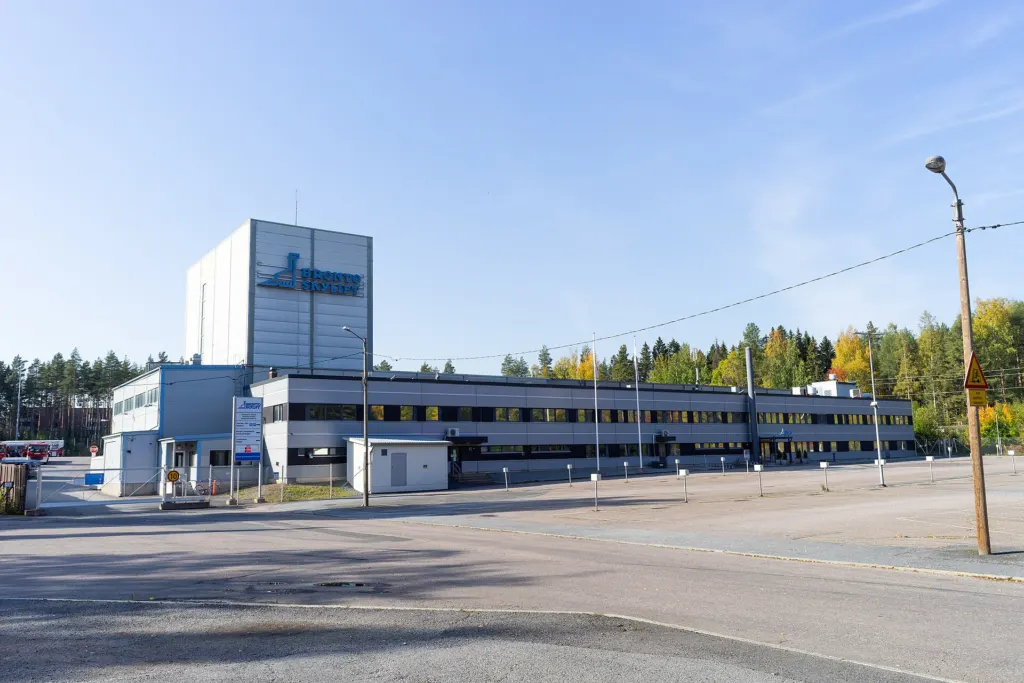
A truck that fits under a 4-meter bridge unfolds into a steel arm 112 meters (367 feet) tall. That is the Bronto Skylift 112 HLA, the platform the aerial-lift maker unveiled in 2010 as the tallest of its kind in the world, and its firefighting version, the F112HLA, still appears in Bronto’s own photos, raised beside the Cirrus tower in Helsinki that same year.
Folded down, it travels like a heavy truck. Raised, it can put a rescue cage beside the upper floors of a tower block.
How tall is 112 meters, really?
Bronto gives its own yardstick. In a 2022 release, the company said a 70-meter working height equals about 20 floors and that 40 meters corresponds to about 11. Both work out to roughly 3.5 meters per floor. Using the same ratio, 112 meters divided by 3.5 meters gives 32 floors. In other words, the F112HLA could put a rescue cage level with roughly the 32nd story of an office or apartment tower.
For comparison, Bronto said North American fire departments had long worked with aerials of about 30 to 40 meters, mostly ladders. The 112-meter machine reached nearly three times higher than a 40-meter ladder truck.
The machine behind the record
The 112-meter platform extended Bronto’s HLA family, short for High Level Articulated. The S 112 HLA, the industrial model, beat the company’s previous tallest machine, the 104-meter S104 HLA, by 8 meters and was set for display at the Bauma trade fair in Munich, according to a 2010 trade report. The same report gave these figures:
- Maximum working height of 112 meters, with 25 meters of sideways outreach at a height of 90 meters.
- A Mercedes-Benz 76.60 all-wheel-drive truck chassis with five steered axles and four driven ones.
- A transport height under 4 meters and a total length of 19 meters.
The F prefix marks Bronto’s fire and rescue versions. On its current F-HLA page, Bronto pitches the range at cities full of high-rises and at industrial sites, where crews need to spray water or foam horizontally more than 100 meters. The trucks level themselves on automatic jacks in 40 seconds, carry an integrated corrosion-resistant waterway rated at 3,800 liters per minute and offer breathing air, electricity and hydraulics in the cage.
Where the line stands now
Bronto’s current spec tables stop short of 112. The firefighting F-HLA range lists the F81HLA, F90HLA and F104HLA, with working heights of 81, 90 and 104 meters and a 500-kilogram cage load, while the industrial S-HLA range lists the S90HLA and S104HLA. The 104-meter fire model weighs about 62 tonnes, depending on the chassis.
That makes the 112-meter build a high-water mark rather than a catalog item. Bronto’s naming makes the numbers easy to read: the digits after the letter are the working height in meters, so the F104HLA reaches 104 meters and the F112HLA reached 112.
Height alone is not the only engineering problem. A longer boom means a heavier truck, and heavier trucks struggle on ordinary city streets, a trade-off Bronto itself flagged when explaining why fire aerials above 60 meters stayed rare in North America.
For more record-breaking oddities, read how English town crier Brenda Willison set the loudest-shout record, or why only a few certified pilots may land at Bhutan’s Paro airport.
Image: Antti Makkonen, CC BY-SA 4.0 via Wikimedia Commons
This article was produced with AI assistance and reviewed by our Editorial Desk. How we work.