Franz Liszt’s La Campanella asks the left hand to jump just one half-step short of three full octaves in the time of a single sixteenth note. Many toy pianos do not have three octaves in total. That is why squeezing the famous “little bell” étude onto a children’s instrument sounds like a joke and plays like an engineering problem.
La Campanella is an obvious pick for a toy piano cover: the tune is instantly recognizable, and the piece is built on bell-like high notes that a toy piano’s metal rods already imitate. The trouble starts with the keyboard.
What La Campanella actually is
La Campanella, Italian for “the little bell,” is the third of Liszt’s six Grandes études de Paganini, published in 1851 and catalogued as S. 141. It is in G-sharp minor. Liszt had already made an earlier version in 1838, and he took the melody from the last movement of Niccolò Paganini’s Violin Concerto No. 2, where a small handbell doubled the tune.
On a concert grand, the difficulty is distance. The right hand keeps leaping between notes two octaves apart, and twice reaches two octaves and a second. Near the end, the left hand covers an even wider span. There are also four bars of trills for the weakest fingers, the fourth and fifth, and fast chromatic scales.
The toy piano problem, in numbers
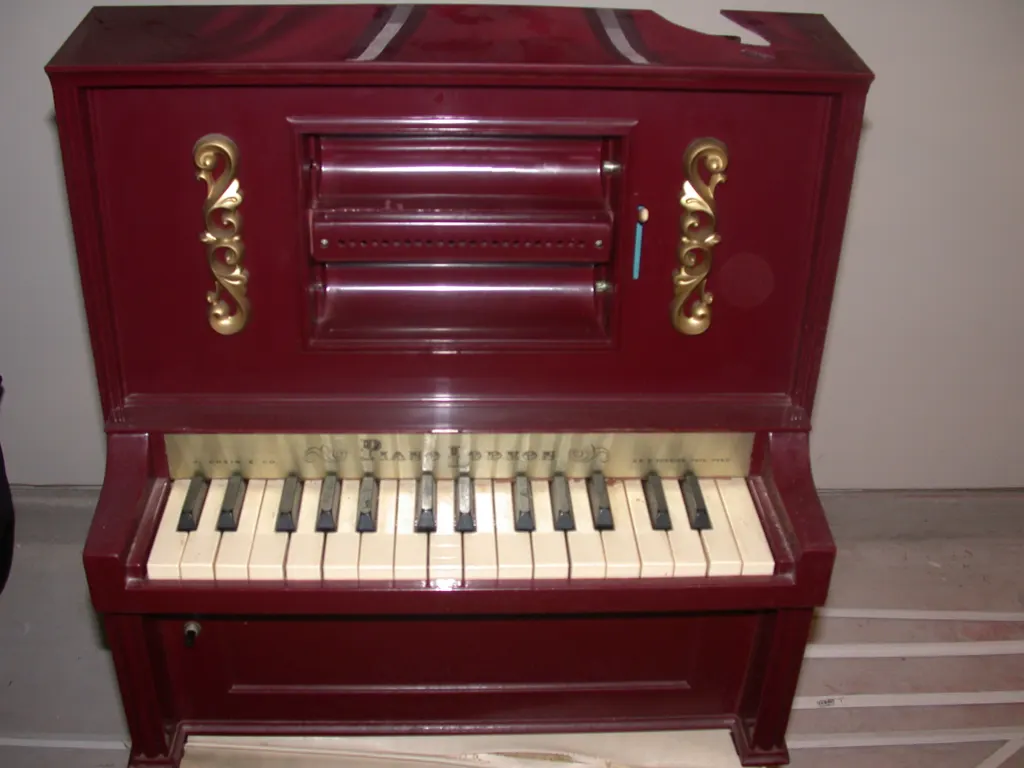
A toy piano is not a small piano. Instead of hammers hitting strings, its hammers strike metal rods or bars fixed at one end, much like the action of a celesta. Most are no wider than 50 centimeters, and a typical model covers between one and three octaves. The math a would-be performer faces:
- Three octaves equal 36 half-steps. The left-hand leap in bar 101 is 35 half-steps, so it uses almost every key on a large three-octave toy and is simply impossible on a smaller one.
- On a full-size piano, a 35 half-step stretch measures about 46 centimeters, nearly the full width of a whole toy piano.
- The piece sits in G-sharp minor, a key full of black notes. The cheapest toy pianos have no black keys, or have them painted on, and can only play one diatonic scale.
- Toy tuning is usually rough, and the pitch rarely sits at the 440 Hz standard for the A above middle C.
In practice, that means anyone who pulls it off is arranging, not just playing: folding octaves inward, dropping the left hand’s widest leaps and choosing a toy with a full chromatic keyboard. The trade-off is the payoff, because the clangy, slightly out-of-tune ring of struck rods lands close to the handbell Paganini wrote into the original.
Serious music for a toy
The toy piano has a longer classical career than its looks suggest. Albert Schoenhut, from a German toy-making family, replaced fragile glass bars with metal ones and founded the Schoenhut Piano Company in Philadelphia in 1872. John Cage wrote his Suite for Toy Piano in 1948, and George Crumb used the instrument in Ancient Voices of Children.
A Toy Piano Festival has run at the University of California, San Diego, since 2000, and in 2001 the Library of Congress gave toy piano music its own subject heading and call number: Toy Piano Scores, M175 T69.
For another musician’s quick thinking on stage, see how Ray Chen’s violin string snapped at the Royal Albert Hall. And for more music measured in hertz, read why bumblebees buzz flowers near C-sharp above middle C.
Further reading
Image: Bill Jacobus, CC BY 2.0 via Wikimedia Commons
This article was produced with AI assistance and reviewed by our Editorial Desk. How we work.