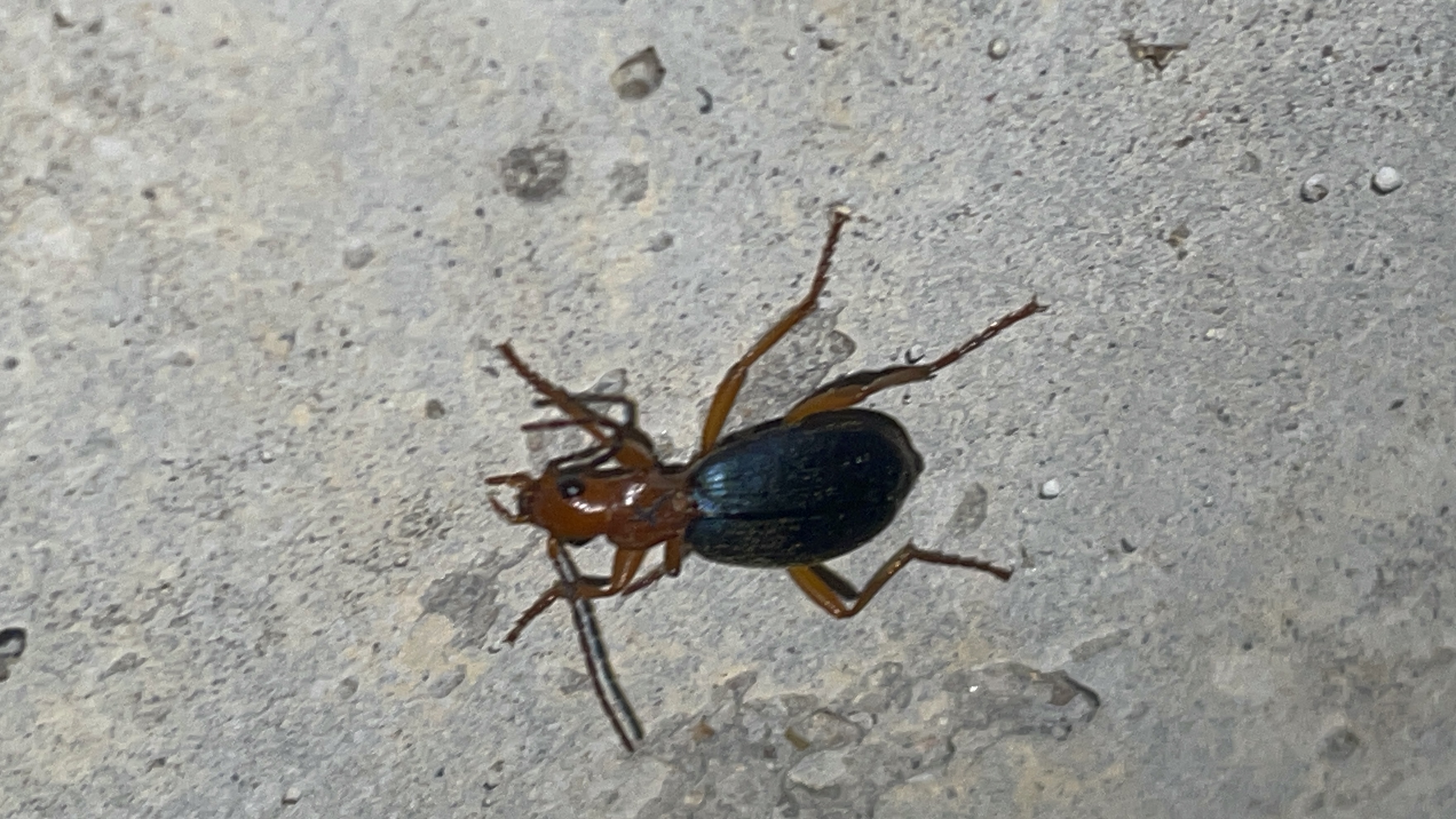
A toad snaps up a beetle, swallows it whole, and then, up to an hour and three quarters later, throws it back up. The beetle walks away. That is the bombardier beetle's party trick: it can fire a near-boiling chemical blast even from inside a predator's stomach.
Japanese researchers watched exactly that scene play out in the lab, and it is just one chapter in the story of one of the most explosive insects on Earth.
A chemical cannon in the abdomen
Bombardier beetles are ground beetles, more than 500 species of them, found on every continent except Antarctica. When disturbed, they blast a hot, foul spray from glands at the tip of the abdomen, with an audible pop, according to Wikipedia's overview of the group.
The beetle stores two ingredients, hydroquinone and hydrogen peroxide, in a reservoir. When threatened, it opens a valve and lets them into a thick-walled reaction chamber lined with enzymes. There, the peroxide breaks down and the hydroquinone is oxidized, releasing so much heat that the mixture approaches 100°C, the boiling point of water. The gas pressure drives the spray out.
The main weapon in the jet is 1,4-benzoquinone, a compound that irritates eyes and airways and can stain skin dark brown. Each beetle carries enough ingredients for roughly 20 shots, and some African species can swivel the nozzle through 270 degrees to aim between their own legs.
Machine-gun pulses, filmed by X-ray
The spray is not one squirt but a rapid burst. A single discharge comes as about 70 pulses at around 500 per second. To see how the beetle manages that without blowing itself apart, a team from MIT, the University of Arizona and Brookhaven National Laboratory filmed live beetles with synchrotron X-rays.
Their 2015 study in Science found that a flexible membrane in the chamber expands and relaxes with each tiny explosion, cycling the valve so fresh reactants enter, react and fire in a repeating rhythm. The pulsing also lets cool new liquid in between blasts, which helps protect the enzymes from being cooked.
Much of the original chemistry was worked out by Cornell entomologist Thomas Eisner, often called the father of chemical ecology, who showed the beetle runs a chemical reaction inside its body to shoot a boiling liquid from a nozzle.
Swallowed alive, and still fighting
The most gross-out finding came in 2018. Shinji Sugiura and Takuya Sato of Kobe University fed the bombardier beetle Pheropsophus jessoensis to two species of Japanese toads. Their paper in Biology Letters reports that every toad swallowed its beetle, but 43% of them vomited it back up between 12 and 107 minutes later.
All of the vomited beetles were alive and active. The researchers concluded the beetles had fired their hot chemicals inside the toads, forcing them to retch. Bigger beetles escaped more often than small ones, and small toads gave up their meal more often than large ones.
In other words, size matters on both sides of the dinner table.
The bombardier beetle joins a gallery of animal chemistry Badiyaa has explored, from the vulture stomach acid that kills anthrax to the mantis shrimp's 51 mph punch. Few, though, can claim to have fought their way out of a predator's gut and lived.
Sources
- “Successful escape of bombardier beetles from predator digestive systems”, Biology Letters (Kobe University), 2018
- “Mechanistic origins of bombardier beetle (Brachinini) explosion-induced defensive spray pulsation”, Science (MIT, University of Arizona, Brookhaven National Laboratory), 2015
- “Bombardier beetle”, Wikipedia, 2026
- “Thomas Eisner”, Wikipedia, 2026
- “1,4-Benzoquinone”, Wikipedia, 2026
Image: VPaleontologist, CC BY-SA 4.0 via Wikimedia Commons
This article was produced with AI assistance and reviewed by our Editorial Desk. How we work.