One second is officially the time it takes for 9,192,631,770 cycles of the light that makes a cesium atom flip between two energy states. Atomic clocks count those cycles, and they now keep the time on phones, steer GPS receivers and stamp stock trades.
The idea is simple even if the hardware is not. As the National Institute of Standards and Technology's guide to atomic clocks explains, every clock needs two parts: something that ticks at a steady rate, and something that counts the ticks. A grandfather clock uses a pendulum, a wristwatch uses a quartz crystal. No two pendulums or crystals are identical, and all of them drift. Atoms of the same type are identical, and they do not wear out.
How an atom becomes a clock
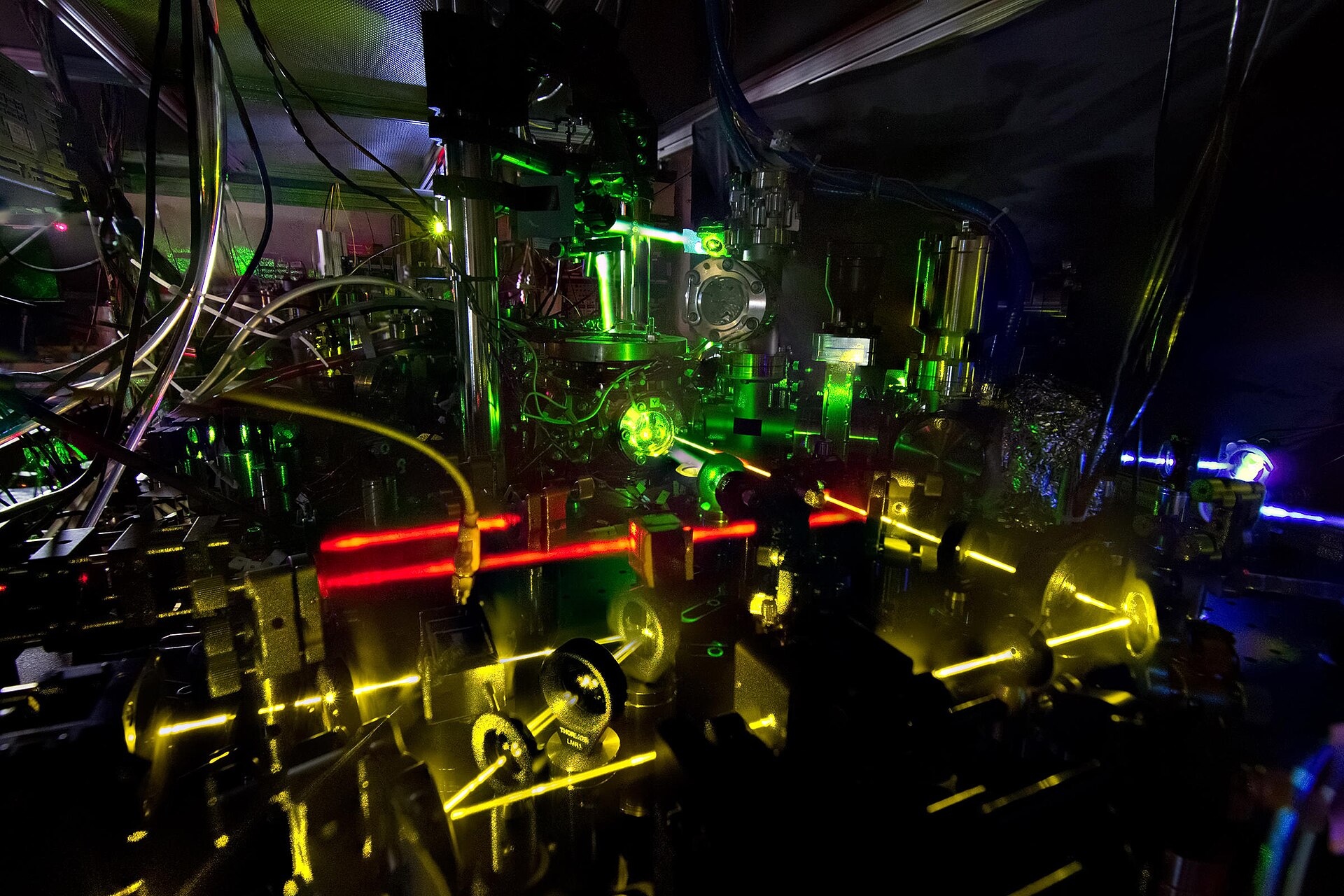
Atoms absorb light only at very specific frequencies. In a clock, scientists isolate atoms and bathe them in light or microwaves, then tune the frequency. When it hits the atoms' resonant frequency, many of them absorb energy and jump to a higher state. Counting how many atoms jumped tells the system it is on target. The clock then counts the wave's crests and troughs and turns that count into seconds.
NIST compares it to pushing a child on a swing: push at the swing's natural rhythm and it climbs higher, push at random and it stalls.
The numbers behind the tick
- 794 trillion cycles a day: by Badiyaa's math, 9,192,631,770 cycles a second times 86,400 seconds is about 794 trillion cesium cycles in every day.
- 30 centimeters per nanosecond: Wikipedia's atomic clock entry notes that a timing error of one billionth of a second works out to roughly 30 centimeters of position error for satellite navigation. An error of one millionth of a second would put you about 300 meters off.
- 50 picoseconds a day: the best cesium fountain clocks carry an uncertainty equal to about 50 trillionths of a second per day. Over a year that adds up to roughly 18 nanoseconds, or about 5.5 meters of navigation error if nothing corrected it.
- Less than a second since the Big Bang: NIST says today's best atomic clocks would have gained or lost under one second had they been running for all 13.8 billion years.
A short history of atomic time
- 1873: James Clerk Maxwell suggests timing with the vibrations of light waves.
- 1949: The US National Bureau of Standards, now NIST, builds the first atomic clock prototype, using ammonia molecules.
- 1955: Louis Essen and Jack Parry build the first practical cesium clock at Britain's National Physical Laboratory.
- 1967: The world's timekeepers redefine the second using the cesium frequency.
- 2004: NIST shows a chip-scale atomic clock about the size of a grain of rice.
- 2021: A strontium clock at JILA measures time running at different rates in two layers of atoms just one millimeter apart, an effect of gravity.
- June 2026: The first experimental optical nuclear clocks are announced.
Why the second may change again
Newer optical clocks tick at around a quadrillion cycles a second, roughly 100,000 times faster than cesium's microwaves, which makes them more stable. Metrologists are preparing to redefine the second around 2030 or 2034 once those clocks can be compared reliably across countries.
That gravity effect is the one Einstein predicted, as covered in our story on Einstein's field equations of November 1915. And the element at the heart of the second has its own origin story: read how Bunsen and Kirchhoff found cesium in spa water in 1860.
Sources
- How Do Atomic Clocks Work?, National Institute of Standards and Technology, 2026
- Atomic clock, Wikipedia, 2026
- Louis Essen, Wikipedia, 2026
Image: N. Phillips/NIST, Public domain via Wikimedia Commons
This article was produced with AI assistance and reviewed by our Editorial Desk. How we work.