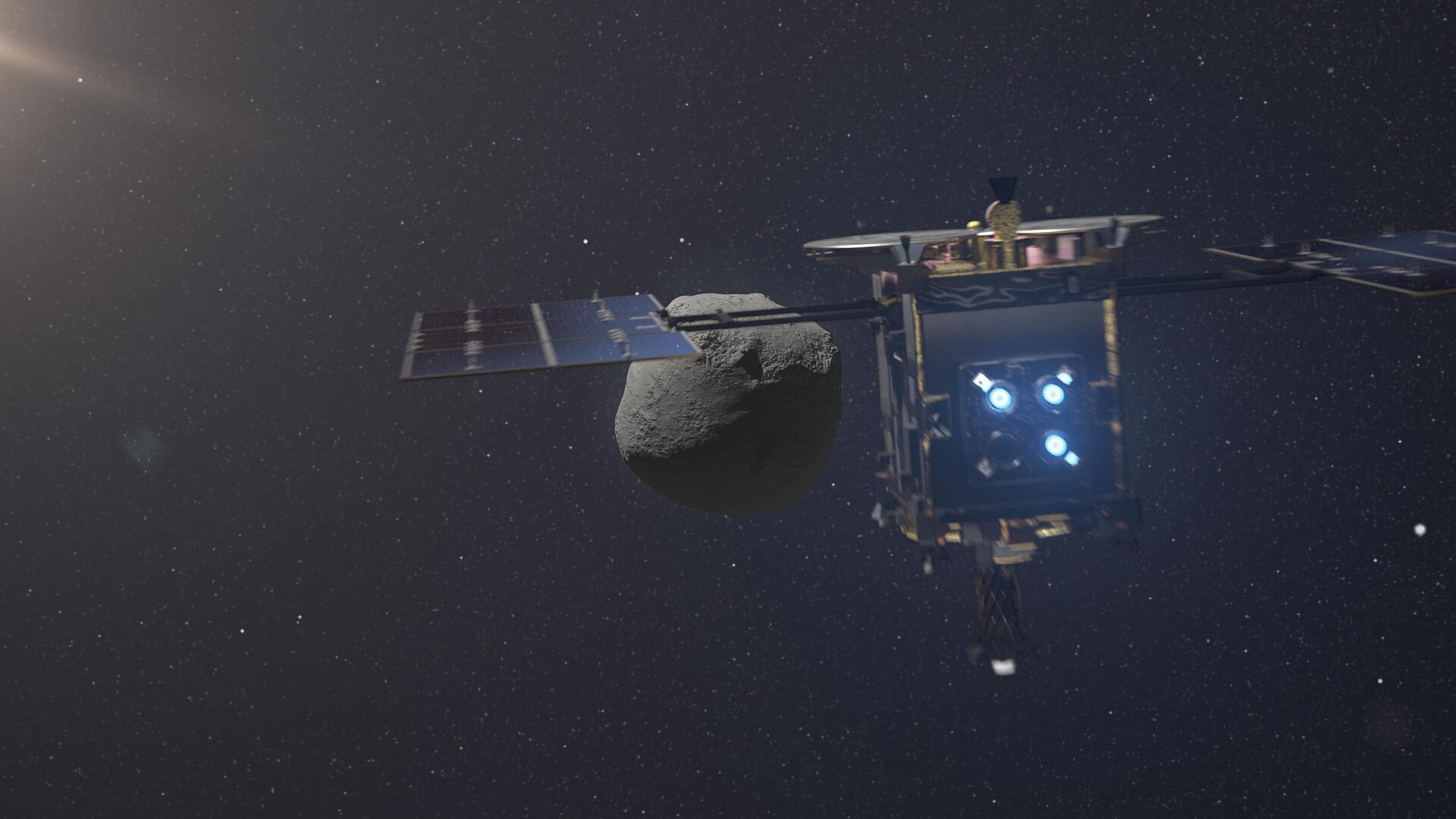
Japan's Hayabusa2 will never land on its last asteroid. JAXA has scrapped the spacecraft's planned 2031 touchdown on the tiny space rock 1998 KY26 after engine problems left it unable to make the critical trajectory changes the trip needed, and is sending it instead past a different asteroid, 2015 BM510, in April 2028.
The new date sits on the Hayabusa2 project's own event calendar at JAXA, which lists the 2015 BM510 flyby for April 2028, right under the July 5, 2026, pass of asteroid Torifune. The November 2026 decision and the reason for it are summarized on the mission's Wikipedia entry; JAXA's Institute of Space and Astronautical Science held a press briefing on the extended mission on November 17.
What Hayabusa2 loses: a landing on an 11-meter rock
The original target was one of the strangest objects ever picked for a probe. 1998 KY26 is just 11 meters (36 feet) across and spins once every 5.35 minutes, according to its Wikipedia entry. At that speed, the pull of spin beats gravity at its equator, so loose boulders get flung away.
The plan had been brutal on hardware: two Earth swing-bys, in December 2027 and June 2028, then a rendezvous in July 2031, a crater shot with the craft's last projectile and an attempted landing near a pole, where spin forces are weakest. Visiting it would have made KY26 the smallest asteroid any spacecraft has reached. That chance is gone.
What it gets instead: a 49-minute spinner
2015 BM510 is bigger, estimated at 17 to 74 meters (56 to 243 feet). NASA JPL's Small-Body Database record lists a rotation period of 0.806 hours, about 48 minutes, though the entry warns that figure rests on partial coverage and could be off by around 30%. The same record puts it on a 337-day orbit, inside Earth's year, in the Aten group of near-Earth asteroids, first observed in November 2002.
A flyby is a quick look rather than a stay. Still, it carries two firsts: 2015 BM510 would be the first D-type near-Earth asteroid, a dark, reddish class thought to be rich in primitive material, and the first fast-spinning asteroid visited by a spacecraft.
Why the engines matter so much
Hayabusa2 flies on four small μ10 ion engines, one of them a spare. They turn xenon into plasma and push it out with electricity from the solar panels, producing a combined 28 millinewtons at most, about the weight of a few paper clips. That tiny push, kept up for months, is what lets the craft reshape its orbit.
After it dropped its Ryugu samples in Australia on December 5, 2020 (UTC), the probe had roughly 30 kilograms (66 pounds) of xenon left from the 66 kilograms (146 pounds) it launched with. A rendezvous needs long, precise burns to match an asteroid's speed. A flyby does not, which is why a crippled engine set can still reach 2015 BM510 but not KY26.
A probe that keeps beating its warranty
Hayabusa2 was planned as a six-year mission when it left Tanegashima on December 3, 2014. It has now flown for almost 12 years. In July 2026 it shot past Torifune at about 5 kilometers per second (3.1 miles per second) and still imaged the asteroid in enough detail to show a boulder-strewn rubble pile made of two lobes.
Japan's next small-body sample run is already underway: Badiyaa covered the launch of the MMX probe heading for the Mars moon Phobos. For another asteroid encounter happening now, see ESA's Hera arriving at the asteroid NASA hit in 2022. The next date for Hayabusa2 is April 2028.
Sources
- JAXA Hayabusa2 Project (event calendar), JAXA, 2026
- Hayabusa2, Wikipedia, 2026
- Small-Body Database record: 2015 BM510, NASA Jet Propulsion Laboratory, 2026
- 1998 KY26, Wikipedia, 2026
Image: DLR German Aerospace Center, CC BY 2.0 via Wikimedia Commons
This article was produced with AI assistance and reviewed by our Editorial Desk. How we work.