US farms will raise 199 million turkeys in 2026, up 3 percent on last year, and Minnesota alone accounts for 34 million of them. That forecast comes from the USDA National Agricultural Statistics Service’s Turkeys Raised report, released on September 25, and it shows how much of the country’s farming is built around one bird and one Thursday in November.
North Carolina is second at 29.5 million, then Arkansas at 21 million, Indiana at 20 million, Missouri at 16 million and Virginia at 14.5 million. The six states together raise 68 percent of the nation’s turkeys, the USDA says.
The flock, by the numbers
Run the USDA’s state table and a few patterns stand out. The six leaders add up to 135 million birds. Minnesota’s 34 million is about 17 percent of the national flock on its own, and it has held the top spot even as North Carolina grew faster this year, up 5 percent against Minnesota’s 1 percent. Missouri posted the biggest jump among the leaders at 9 percent, while Virginia fell 5 percent.
The flock is also much smaller than it was. In 2006, American growers were expected to raise 270 million turkeys, according to the Wikipedia history of Thanksgiving dinner. This year’s 199 million is about 26 percent below that mark.
So why turkey at all?
The bird on the table is a Mexican native that made a round trip. Ancient Mesoamericans domesticated a southern Mexican wild turkey; Spanish ships carried it to Europe in the 1500s; and English colonists shipped domestic turkeys back across the Atlantic to Jamestown, Virginia, in 1608, as the Wikipedia article on the domestic turkey explains. We traced that journey in more detail in our story on how turkey became America’s Thanksgiving bird.
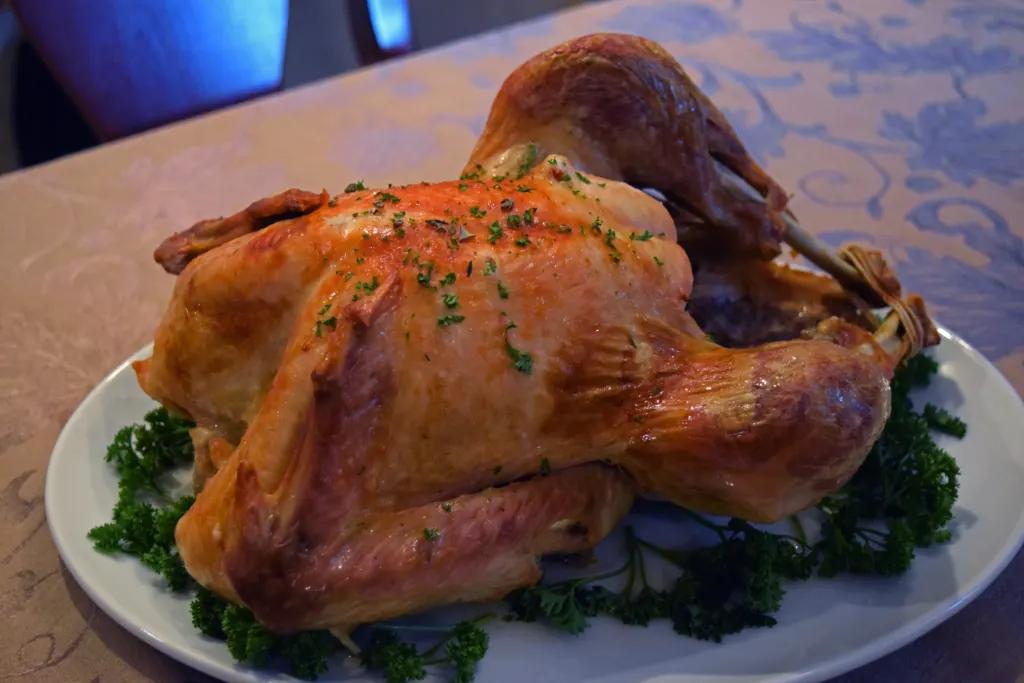
The habit of serving it in November came later. Turkey was an easy, practical food for harvest celebrations, and historians think the classic Thanksgiving foods reflect what later Americans could afford more than what the Pilgrims ate. Sarah Josepha Hale’s 1827 novel Northwood put a roast turkey at the head of the table; as the holiday spread in the 1800s, turkey went with it, and by 1857 it was part of the standard New England dinner.
Today’s bird is a farm creation. More than 99 percent of turkeys Americans eat are Broad Breasted Whites, a heavy breed that cannot mate naturally and is bred by artificial insemination. Hens go to market at about 14 to 16 weeks and toms at 18 to 20 weeks, when they can top 44 pounds, more than four times a mature wild tom’s typical 24.
How the USDA counts them
The forecast is not a sample. NASS contacts about 250 turkey grow-out operations in September and again in February, covering every known farm that raises 1,000 or more birds a year. Final numbers come out in April, and over the past decade the September estimate has missed the final figure by about 1.9 percent on average.
Wild turkeys are a different story; our guide to how wild turkeys fly at up to 50 mph covers the birds farms do not raise. The USDA’s final 2026 turkey count is due next April.
Sources
- Turkeys Raised (September 25, 2026), USDA National Agricultural Statistics Service, 2026
- Thanksgiving dinner, Wikipedia, 2026
- Domestic turkey, Wikipedia, 2026
Image: Mark Miller, CC BY-SA 4.0 via Wikimedia Commons
This article was produced with AI assistance and reviewed by our Editorial Desk. How we work.