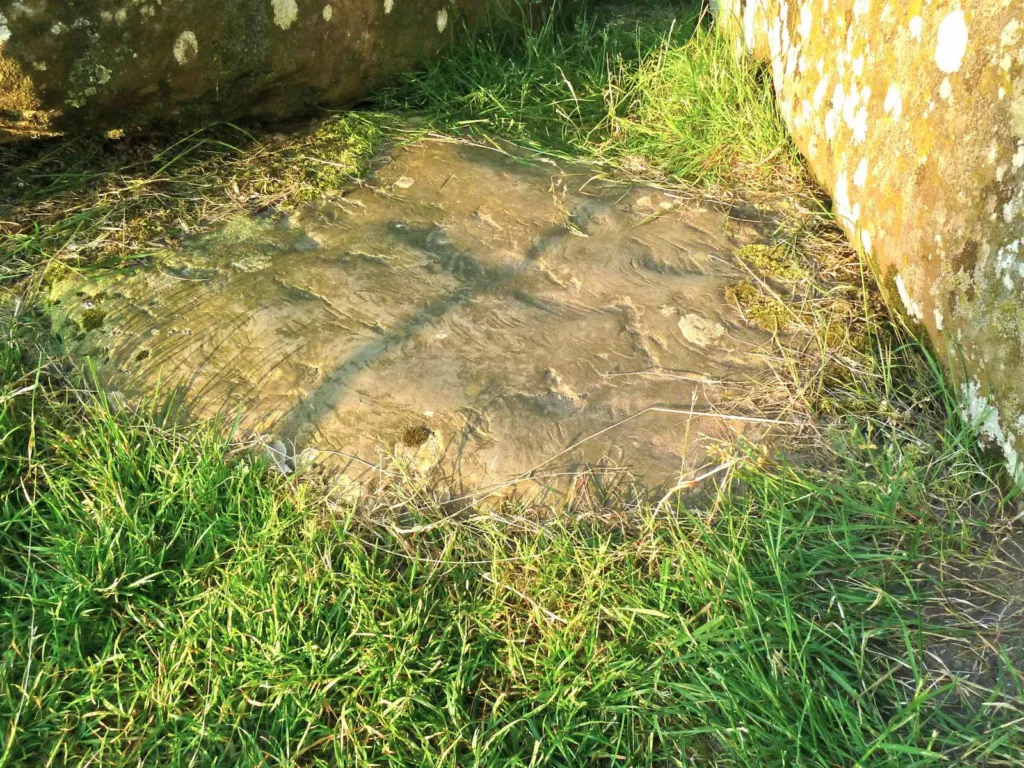
Stonehenge’s six-ton Altar Stone probably did not come from northeast Scotland after all. A team led by Duncan Pirrie of the University of South Wales compared the slab with sandstone outcrops across Britain and found that none of the places examined match its full set of mineral and chemical traits. The work appears in a new paper in the Journal of the Geological Society.
That reverses the headline result of 2024, when the stone’s origin seemed solved. The search is not back to zero, though. The new study narrows where geologists should look next.
A short history of a moving target
The Altar Stone, catalogued as Stone 80, is a purplish-green sandstone slab about 4.9 meters long, 1 meter wide and 0.5 meters thick. According to Wikipedia’s entry on the Altar Stone, it lies flat at the center of the monument with a fallen sarsen, Stone 55, across it. Its name probably traces to the architect Inigo Jones, who wrote in 1620 that he would leave it “to the judgment of others” whether it might be an altar.
- For most of the 20th century, geologists placed its source in West Wales, like the smaller bluestones.
- In 2020 and 2023, studies co-authored by Richard Bevins of Aberystwyth University argued it did not come from the Anglo-Welsh Basin.
- In 2024, a study in Nature led by Anthony Clarke of Curtin University dated tiny zircon, apatite and rutile grains in fragments of the stone and tied them to Old Red Sandstone rocks of Scotland’s northeastern Orcadian Basin, at least 750 kilometers from Salisbury Plain.
- In November 2026, the Pirrie team concluded that many Orcadian Basin outcrops could not have supplied it.
How the new study tested the stone
The Altar Stone cannot be sampled directly, so the team worked from eight museum fragments confidently tied to it, plus portable X-ray measurements of the three small patches still exposed at the monument. They then studied its sedimentology, heavy minerals, clays and geochemistry.
Several details proved telling. The stone carries a scatter of baryte, a barium mineral, which gives it unusually high barium readings. It also contains chrome spinel, a heavy mineral that turns up only rarely in the Old Red Sandstone of Orkney, Caithness, Shetland and the Moray Firth area. Its clay holds about 20% expandable layers, a sign the rock was never deeply buried or heated, while rocks in Caithness and Orkney show values below 10%.
The paper does not throw out the 2024 grain ages. In the abstract’s words, “the previously published detrital grain dating supports a Laurentian source for the heavy minerals present in the Altar Stone.” Laurentian here means ancient crust linked to the Scottish Highlands. But the authors conclude that “the exact provenance of the Altar Stone is as yet unknown.”
Where the search goes next
Read together, the two papers suggest a stone whose sand grains were eroded from Highland-type crust but deposited somewhere not yet sampled. Wikipedia’s summary of the 2026 study notes the researchers think the source may lie elsewhere in Scotland, in northern England or in Ireland, and not in southern Britain. Badiyaa has followed other long-distance stories from deep prehistory, from 11,300-year-old fired pottery at Çemka Höyük to hippos at an ancient lake in Saudi Arabia’s Empty Quarter.
Limits
Every conclusion rests on a handful of museum fragments and three exposed patches, since the stone itself is off-limits. Strontium isotope data for the Old Red Sandstone are incomplete, which weakens some comparisons. And the stone was last excavated in the 1950s, with no surviving written records of that dig.
Sources
- “Searching for the origin of the Stonehenge Altar Stone: new sedimentological, petrographical, mineralogical, geochemical and isotopic constraints”, Journal of the Geological Society (Pirrie et al.), 2026
- “A Scottish provenance for the Altar Stone of Stonehenge”, Nature (Clarke et al.), 2024
- “Altar Stone (Stonehenge)”, Wikipedia, 2026
Image: The Stones of Stonehenge, CC BY 4.0 via Wikimedia Commons
This article was produced with AI assistance and reviewed by our Editorial Desk. How we work.