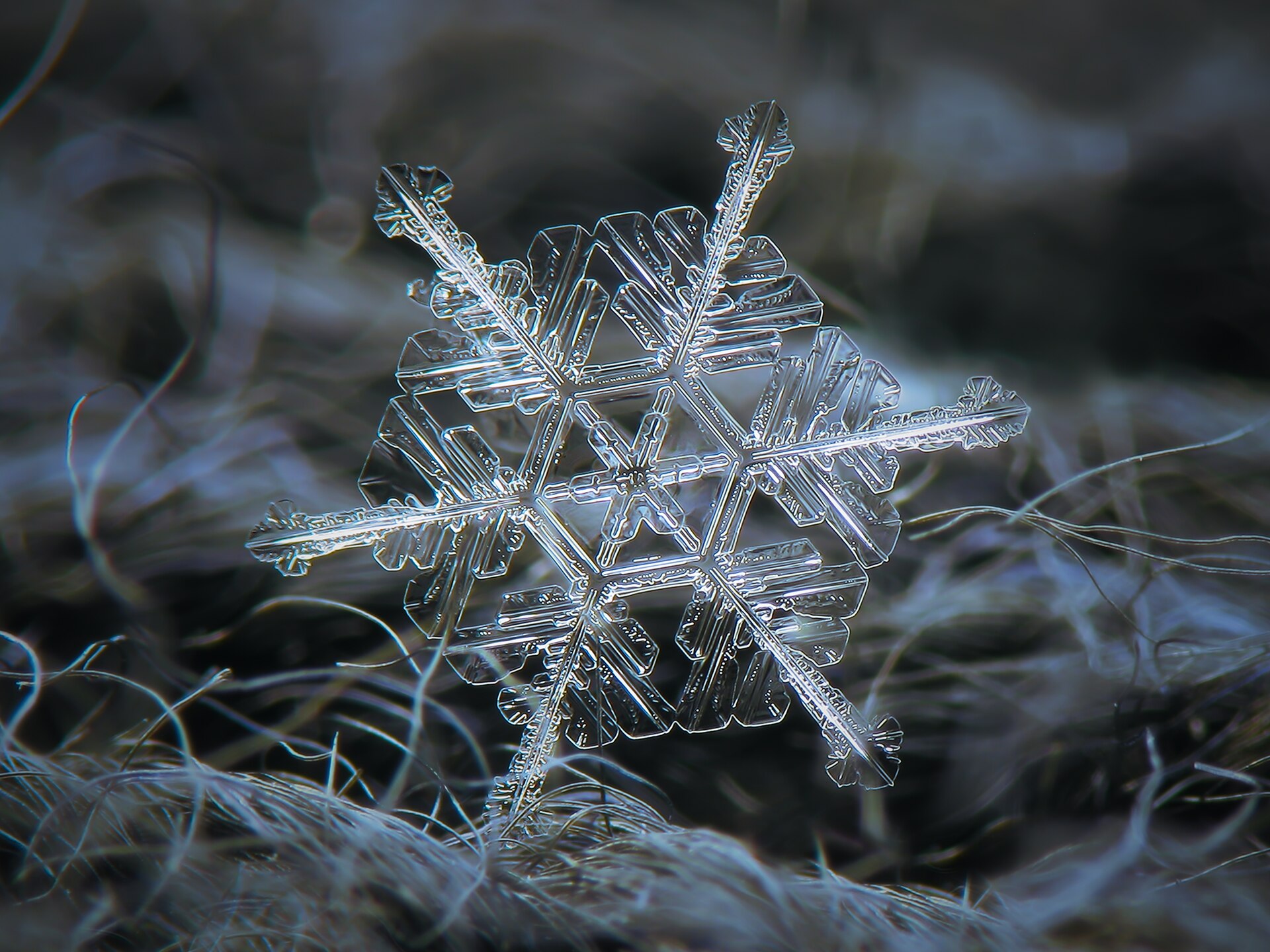
A small snow crystal holds roughly a billion billion water molecules, and about a thousand trillion of them are chemically unusual. That detail, from Caltech physicist Kenneth Libbrecht, is one reason the old saying holds up: no two complex snowflakes are exactly alike.
How a snowflake starts
Snow is not frozen rain. A snowflake begins when water vapor in a cloud turns straight to ice on a tiny particle and then keeps growing as it drifts, as NOAA's satellite service explains in its guide to snowflake formation. The seed can be clay, desert dust or even a biological particle. Without one, cloud droplets do not freeze on their own until about minus 31 degrees Fahrenheit (minus 35 Celsius), according to Wikipedia's snowflake article.
Ice molecules lock together in a hexagon, so the young crystal is a tiny six-sided prism. From there it grows two ways. Flat faces, or facets, keep the shape neat. Branches sprout when a bump on the surface catches more vapor than its surroundings and keeps getting bigger. The tug-of-war between the two produces everything from plain plates to feathery stars.
Temperature decides the shape
Japanese physicist Ukichiro Nakaya mapped how shape tracks the weather inside the cloud. Roughly:
- Down to about 27°F (minus 3°C): thin, flat plates.
- Down to about 18°F (minus 8°C): hollow columns, prisms and needles.
- Around minus 8°F (minus 22°C): plates again, often with branching arms.
Moist air pushes crystals toward lacy, ornate forms, while drier air keeps them compact. A crystal that starts as a column and then falls into plate weather can grow a flat cap on each end. Libbrecht set out the physics behind these rules in his 2005 review "The physics of snow crystals" in Reports on Progress in Physics.
Why no two look alike
Each arm of a flake feels nearly the same conditions at the same moment, which is why the six arms often match each other. But every flake takes its own path through a cloud of shifting temperature and moisture, so no two flakes share the same history.
Libbrecht answers the question directly on his Caltech page on whether any two snowflakes are alike. About one water molecule in 5,000 carries heavy hydrogen and about one in 500 carries a heavier oxygen atom, and those odd molecules scatter randomly through every crystal. Simple hexagonal prisms can look identical under a microscope, he writes, but a complex flake is another matter.
He uses a bookshelf to show why. Fifteen books can be lined up 15 x 14 x 13 and so on down to 1 ways, which works out to 1,307,674,368,000, or about 1.3 trillion arrangements. With 100 books the count is close to 10 to the power 158. A complex snow crystal has around 100 features that could each grow differently, so the number of possible flakes is similarly vast.
The farmer who started it
The idea reached the public through Wilson Bentley, the Vermont farmer known as Snowflake Bentley, who photographed his first snowflake on January 15, 1885, and captured more than 5,000. His 1931 book Snow Crystals, written with William J. Humphreys of the US Weather Bureau, carried 2,500 photographs. Perfect six-sided beauty is rarer than his pictures suggest: fewer than 0.1% of snowflakes show the ideal symmetry.
Snow can also be made on purpose, as Badiyaa found in the story of Vincent Schaefer's 1946 dry-ice snowfall. The record claim for size goes to flakes at Fort Keogh, Montana, in January 1887, reported as 15 inches wide. More winter science lives in our Science section.
Sources
- How Do Snowflakes Form?, NOAA NESDIS, 2025
- Snowflake, Wikipedia, 2026
- The physics of snow crystals, Reports on Progress in Physics (Kenneth G. Libbrecht, Caltech), 2005
- Is it really true that no two snowflakes are alike?, Kenneth G. Libbrecht, California Institute of Technology, undated
- Wilson Bentley, Wikipedia, 2026
Image: Alexey Kljatov, CC BY 2.0 via Wikimedia Commons
This article was produced with AI assistance and reviewed by our Editorial Desk. How we work.