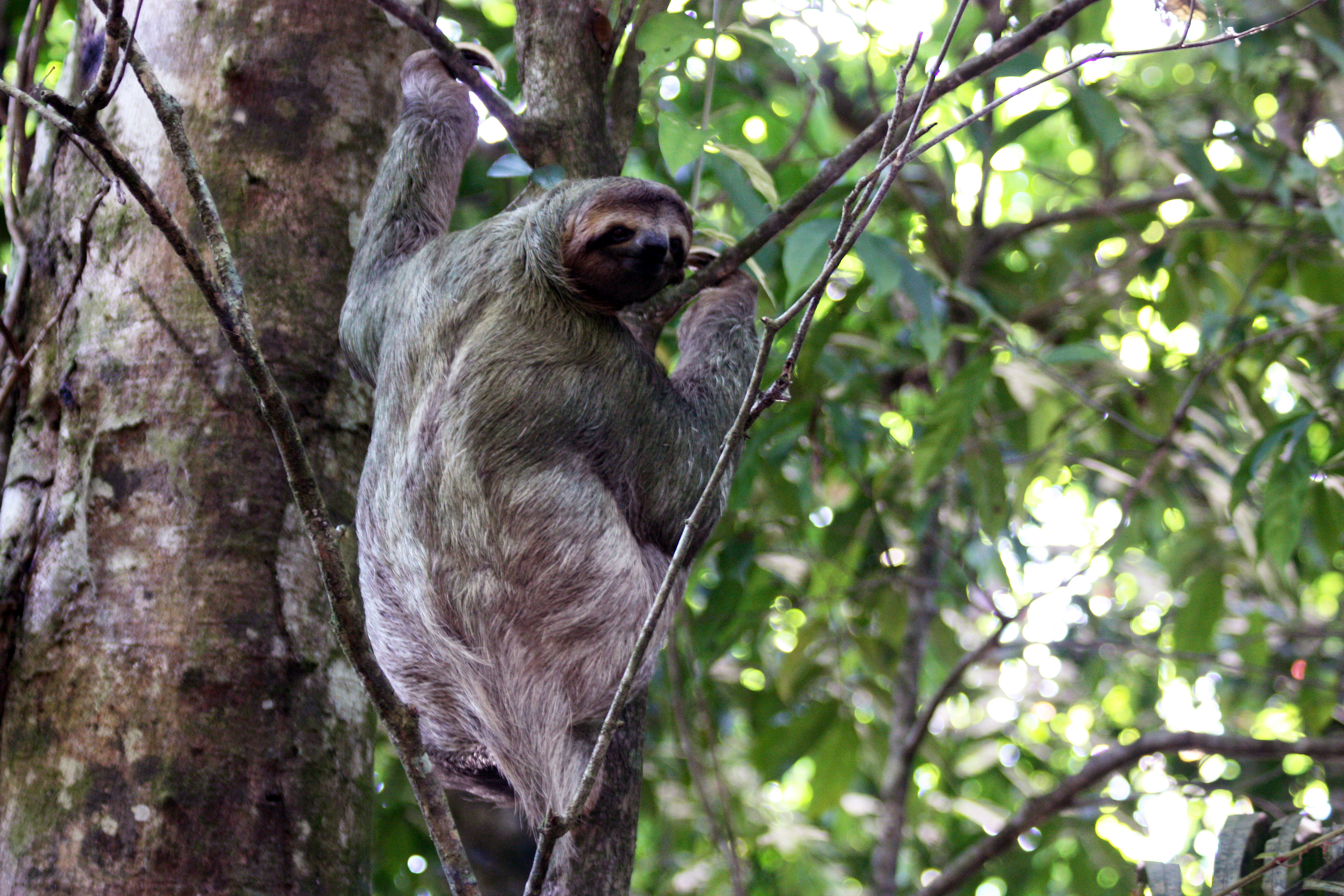
Famously slow in the treetops, sloths turn into respectable swimmers the moment they hit a river. Sloths paddle at about 13.5 meters (44 feet) a minute, roughly four and a half times their top speed on the ground, and they can stay underwater for as long as 40 minutes on a single breath.
Those figures, gathered in Wikipedia's sloth entry, flip the usual picture of an animal whose name in English, German, French, Spanish and Portuguese all boil down to "lazy."
How a sloth holds its breath for 40 minutes
The trick is the same one that makes sloths slow on land: a metabolism running at half the rate expected for a placental mammal of their size. In the water, a sloth can turn that already low rate down further and drop its heart rate to under a third of normal, which stretches one gulp of air across a dive of up to 40 minutes.
The long arms that hook over branches double as paddles. Sloths use them to cross rivers and even to swim between islands.
The smallest of them all is an island specialist. Wikipedia's entry on the pygmy three-toed sloth says it lives only on Isla Escudo de Veraguas, a small island off Panama's Caribbean coast, weighs just 2.5 to 3.5 kilograms and was described as a separate species only in 2001. Its scientific name, pygmaeus, comes from a Greek word meaning "as small as a fist."
Speed on land, in trees and in water
Put the numbers side by side and the water wins easily:
- On the ground: about 3 meters (9.8 feet) a minute at best. Sloths cannot walk and drag themselves forward with their claws.
- In the trees: an average of 4 meters (13 feet) a minute, rising to around 4.5 meters when a predator is close.
- In the water: about 13.5 meters (44 feet) a minute.
That works out to a swim roughly 4.5 times faster than a ground crawl and about 3.4 times faster than ordinary tree travel. Even so, at 13.5 meters a minute a sloth would need around seven and a half minutes to cross a 100-meter river.
Built for hanging, not hurrying
Sloth bodies are designed around energy saving. The Smithsonian's National Zoo profile of the two-toed sloth puts their metabolic rate at only 40 to 45 percent of what their body weight would predict, with body temperatures of 86 to 93 degrees Fahrenheit that dip at night and in wet weather. Their muscles are about half the relative weight of most land mammals, so they cannot shiver to stay warm and instead shuffle in and out of the sun.
Their fur is its own small habitat. Each hair carries grooves where two species of blue-green algae grow, tinting the animal green in the canopy, and moths, ticks and beetles live among the strands. The hair also runs from belly toward back, the reverse of most mammals, so rain sheds off a sloth that spends its life upside down.
Two-toed sloths sleep around 15 hours during the day and feed at night, according to the zoo. Food can sit in their gut for about a month, and they climb down only about once a week to relieve themselves at the base of a favorite tree.
A 49-year-old record holder
Slow living can mean long living. The zoo puts median life expectancy for two-toed sloths in human care at about 16 years, but its last two-toed sloth in the Amazonia exhibit reached roughly 49, which the zoo calls the oldest living sloth on record. Its current resident is a male named Vlad.
For more odd animal engineering, see Badiyaa's stories on the slow loris and its venom gland, how gecko feet grip walls and how elephants drink through their trunks.
Seven sloth species survive today, split between two genera, and the island-bound pygmy three-toed sloth is rated critically endangered.
Sources
- Sloth, Wikipedia, 2026
- Pygmy three-toed sloth, Wikipedia, 2026
- Two-toed sloth, Smithsonian's National Zoo and Conservation Biology Institute, 2026
Image: Charles J. Sharp, CC BY-SA 3.0 via Wikimedia Commons
This article was produced with AI assistance and reviewed by our Editorial Desk. How we work.