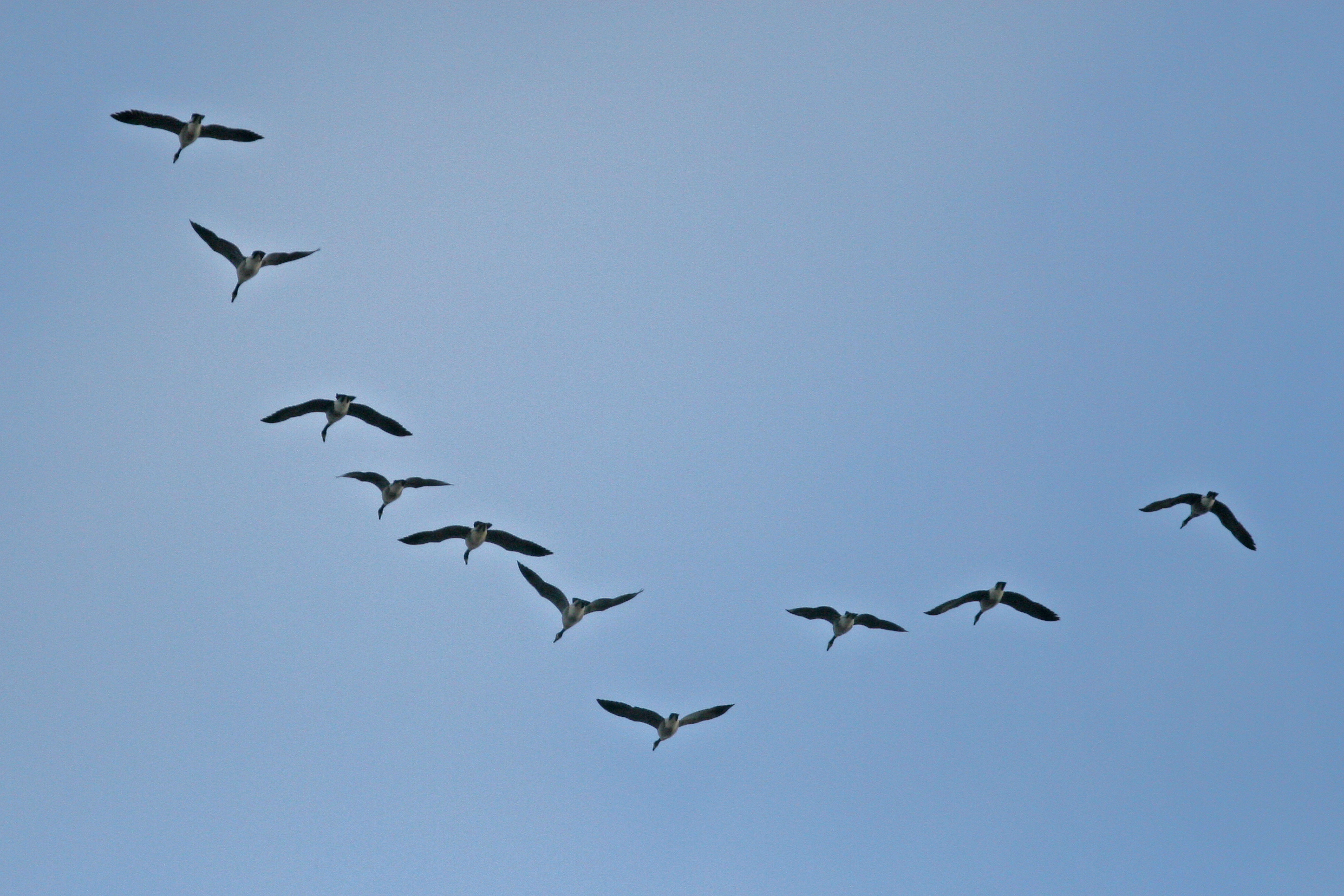
Geese, swans, cranes and pelicans fly in a V for a simple reason: each bird can ride the air kicked upward by the wingtip of the bird in front. A classic 1970 calculation suggested that a flock of 25 birds sharing that lift could fly about 70 percent farther than a lone bird.
That number comes from Caltech engineers P. B. S. Lissaman and Carl Shollenberger, whose short paper Formation Flight of Birds in the journal Science argued that a V spreads the drag savings evenly through the flock. It also challenged the old idea that the leader does the hardest work, noting that the lead bird does not necessarily have the most strenuous position.
How the upwash works
Every flapping wing leaves a swirling vortex off its tip. Just outside that tip the air rises, a zone called upwash, while directly behind the bird it sinks. A bird that slots in slightly behind and to the side of its neighbor gets a free boost, much as a glider rises on a thermal. Line up a whole flock that way and the shape you get is a V, as Wikipedia's V formation entry explains.
The idea is older than airplanes as we know them. German aerodynamicist Carl Wieselsberger first suggested in 1914 that birds might save energy this way.
Pelicans with heart monitors
Testing it on real birds took decades. In a 2001 study titled Energy saving in flight formation, published in Nature, researchers fitted trackers to pelicans that had been trained to fly behind a motorboat. Pelicans flying alone had higher heart rates and flapped more often than birds flying the same speed in formation.
Ibises time their wingbeats
The biggest surprise came in 2014. A team led by Steven Portugal reported in a Nature paper titled “Upwash exploitation and downwash avoidance by flap phasing in ibis formation flight” that position is only half the trick. Birds in the V matched the timing of their flaps to catch the leader's upwash, and a bird directly behind another flapped out of step to dodge the sinking air.
The V by the numbers
- 1914: Wieselsberger proposes the energy-saving idea.
- 1970: 25 birds, about 70 percent more range, in theory, at a slower speed.
- 2001: pelicans in formation show lower heart rates.
- 2007: a modeling study credits well-timed flapping with up to 20 percent energy savings.
- 2014: ibises shown syncing their wingbeats in flight.
Put the 1970 and 2007 figures side by side and the gap is the lesson: the dramatic 70 percent figure was a best-case range estimate for a big flock, while the more recent 20 percent estimate looks at the energy one bird can save with good timing.
Pilots copy the birds
Engineers have borrowed the trick. NASA's Autonomous Formation Flight program aimed for sustained fuel savings of 10 percent, and Airbus's fello'fly project found that a trailing aircraft could burn 5 to 10 percent less fuel in helicopter tests, according to the same Wikipedia entry.
Badiyaa has followed other long-haul flyers, including Arthur the cuckoo's flight to Gabon and the monarch butterflies that winter in Mexico's fir forests.
Look up during the next migration flight overhead and watch the back of the V: the birds there are the ones riding the most borrowed lift.
Sources
- Formation Flight of Birds (Science, vol. 168), California Institute of Technology, 1970
- Energy saving in flight formation (Nature, vol. 413), Weimerskirch et al., 2001
- “Upwash exploitation and downwash avoidance by flap phasing in ibis formation flight” (Nature, vol. 505), Portugal et al., 2014
- V formation, Wikipedia, 2026
Image: John Benson, CC BY 2.0 via Wikimedia Commons
This article was produced with AI assistance and reviewed by our Editorial Desk. How we work.