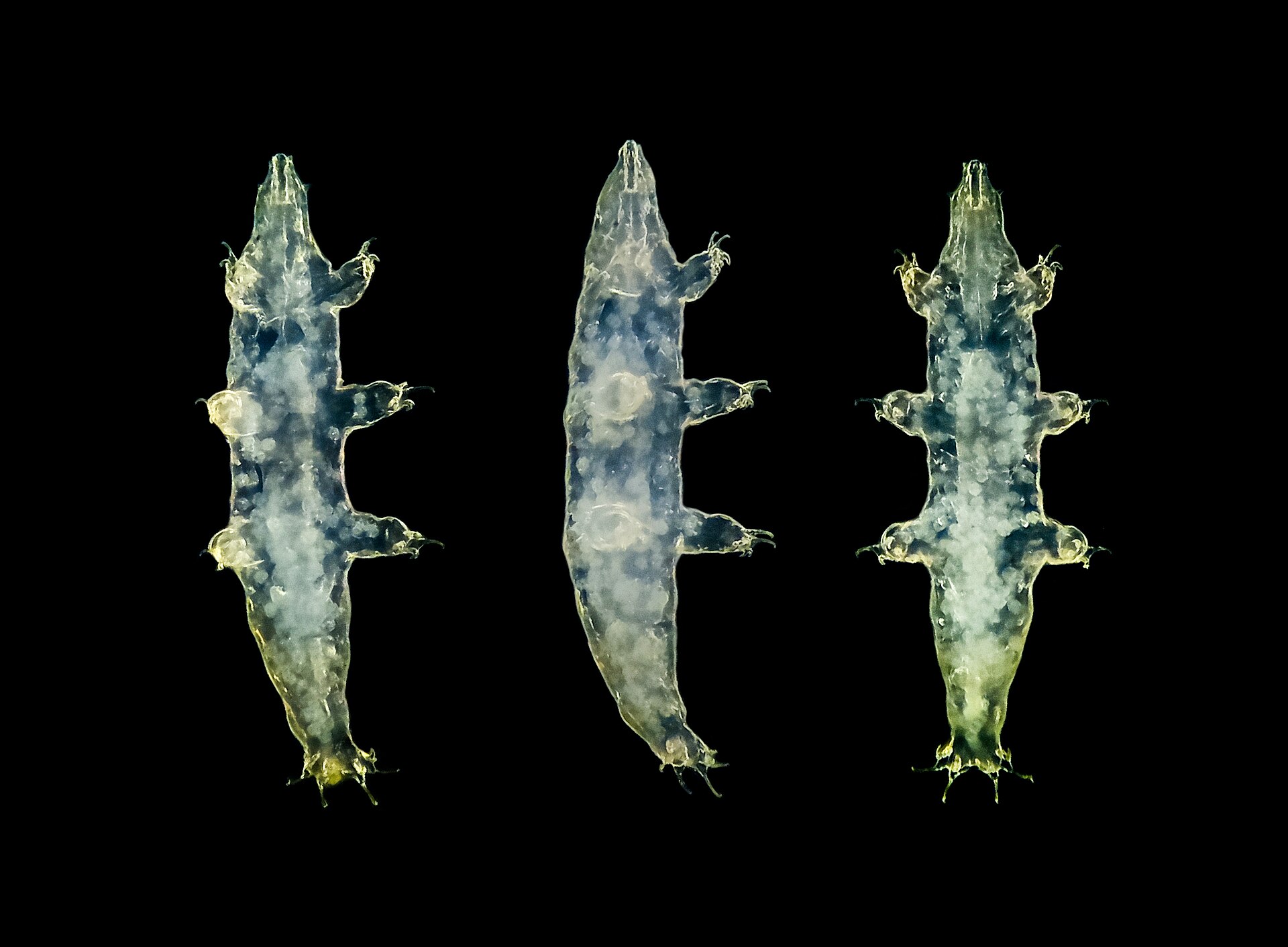
Two species of armored water bear that nobody had ever named turned up in sand scooped from the top of Senghor Seamount, an underwater mountain in the Atlantic off Cape Verde. The pair, Megastygarctides hekatae and Parastygarctus potercha, are described in a ZooKeys paper published on October 27, 2026 by researchers from the Netherlands, Germany, Denmark and Ukraine.
The bigger surprise is the crowd they were found in. The seamount summit produced 212 tardigrades from 20 different taxa. A deep-sea reference site roughly 100 km (about 60 miles) to the north produced just seven animals from two taxa.
Seventeen years in a sample jar
The sand was not collected this year. It came up in September 2009, when the German research ship Meteor ran cruise M79/3 around the Cape Verde islands and lowered a multiple corer onto the flat summit. The team kept only the top 5 cm (2 inches) of each core, preserved it, then spun the tiny animals out of the sediment in a centrifuge and picked them out under microscopes at the Senckenberg am Meer institute in Wilhelmshaven, Germany.
That means these two species waited 17 years between leaving the seafloor and getting names. That gap is normal in taxonomy, where a handful of specialists work through a mountain of stored samples.
The summit itself is coarse sand made from broken coral, sea urchins, moss animals and shells. The reference site is fine ooze. Lead author Roman Trokhymchuk of Naturalis Biodiversity Center in Leiden and his colleagues say the contrast backs the idea that seamounts work as hotspots for marine tardigrades.
What makes these two different
Both belong to Stygarctidae, a family of armored marine tardigrades that live between sand grains. The paper flags M. hekatae for its rare genital spines. P. potercha stands out for a paedomorphic look, meaning the adult keeps features that normally belong to younger animals. Together the two new species made up 6.7% of the tardigrades counted on the summit.
For scale, most tardigrades are 0.05 to 0.5 mm long, according to Wikipedia's tardigrade entry, which puts the phylum at about 1,500 known species. These eight-legged animals are famous for surviving drying out, freezing and even space, a record Badiyaa looked at in its piece on what tardigrades cannot survive.
The numbers behind the hotspot claim
Run the paper's own counts and the gap is stark. The summit held about 30 times as many tardigrades as the reference site (212 against 7) and 10 times as many taxa (20 against 2). The authors note that their samples came from one seamount and one reference site, so this is a single snapshot rather than a survey of the whole region.
Seamounts are mostly extinct volcanoes, and more than 14,500 have been identified worldwide, yet only a few have been studied closely, according to Wikipedia's seamount article. Currents bend around them and carry food, which is one reason they collect life. Badiyaa has covered another seafloor oddity in its report on tiny animals living in deep-sea nodules.
If you want to see a tardigrade yourself, you do not need a research ship. Land species live in moss and lichen, and soaking a dry clump in water and checking it under a basic low-power microscope often turns up a few.
Sources
- Marine tardigrades from Senghor Seamount, with two new Stygarctidae species (Trokhymchuk et al.), ZooKeys (Pensoft), 2026
- Tardigrade, Wikipedia, 2026
- Seamount, Wikipedia, 2026
Image: Brandon Antonio Segura Torres and Priscilla Vieto Bonilla, CC BY-SA 4.0 via Wikimedia Commons
This article was produced with AI assistance and reviewed by our Editorial Desk. How we work.