Three hundred years ago this week, the surgeon to King George I stood before his monarch and argued that a Surrey farm worker was giving birth to rabbits. Eleven days later she confessed it was all a trick, and the hoax of Mary Toft became one of the most embarrassing episodes in British medical history.
The man who staked his career on rabbits
The biggest loser was Nathaniel St. André. His Wikipedia biography says George I made the Swiss-born surgeon and anatomist to the royal household in May 1723, partly because his fluent German pleased courtiers who spoke little English. Earlier in 1726 he had treated the king himself, who handed over his own sword in thanks.
Then came Toft. On November 26, 1726, St. André gave the king an anatomical demonstration to prove the rabbit births were possible, and on December 3 he published a 40-page pamphlet defending her. Within days the story collapsed. He lost his royal duties and his salary, was refused an audience with the king, and died in 1776, aged 96, having refused to eat rabbit for fifty years.
Eleven days that fooled London
Counted from the king's demonstration to the confession, the hoax survived just 11 days at the heart of the court. On November 29, Toft was lodged in Lacey's Bagnio in Leicester Fields, London, so the capital's top doctors could watch for the next "delivery," according to Wikipedia's detailed account of the Toft affair.
London went mad for it. Rabbit stew and jugged hare vanished from dinner tables, and the courtier John Hervey wrote that "Every creature in town, both men and women, have been to see and feel her."
The end came fast. On December 4, Lord Onslow learned that Toft's husband had spent the past month buying young rabbits, and a porter at the bagnio admitted Toft's sister-in-law had bribed him to sneak one into her room. On December 7, pressed by the obstetrician Richard Manningham and the anatomist James Douglas, Toft admitted the births had been staged with animal parts supplied by accomplices. She was sent to Tothill Fields Bridewell as a "vile cheat and impostor," then quietly freed in April 1727.
How a Godalming rumour reached the palace
Toft, baptised in February 1703 and married to a journeyman clothier, lived in Godalming, Surrey. After a troubled pregnancy in 1726, she claimed to be producing animal parts. John Howard, a Guildford man-midwife with 30 years' experience, took up the case and wrote excitedly to contacts in London.
St. André and Samuel Molyneux, secretary to the Prince of Wales, came to see for themselves in mid-November and went home convinced; St. André even dropped a scrap of rabbit lung in water, watched it float, and took that as proof. A second royal surgeon, Cyriacus Ahlers, was not fooled. He pretended to believe, carried specimens back to London and found what looked like cuts from a blade, plus straw and grain in the droppings. No womb-grown animal eats grain.
A 300-year timeline
- November 15, 1726: the king's surgeon arrives in Guildford.
- November 26, 1726: the demonstration before George I.
- December 7, 1726: Toft confesses in London.
- 1961: the physician S. A. Seligman revisits the case in a paper in the journal Medical History.
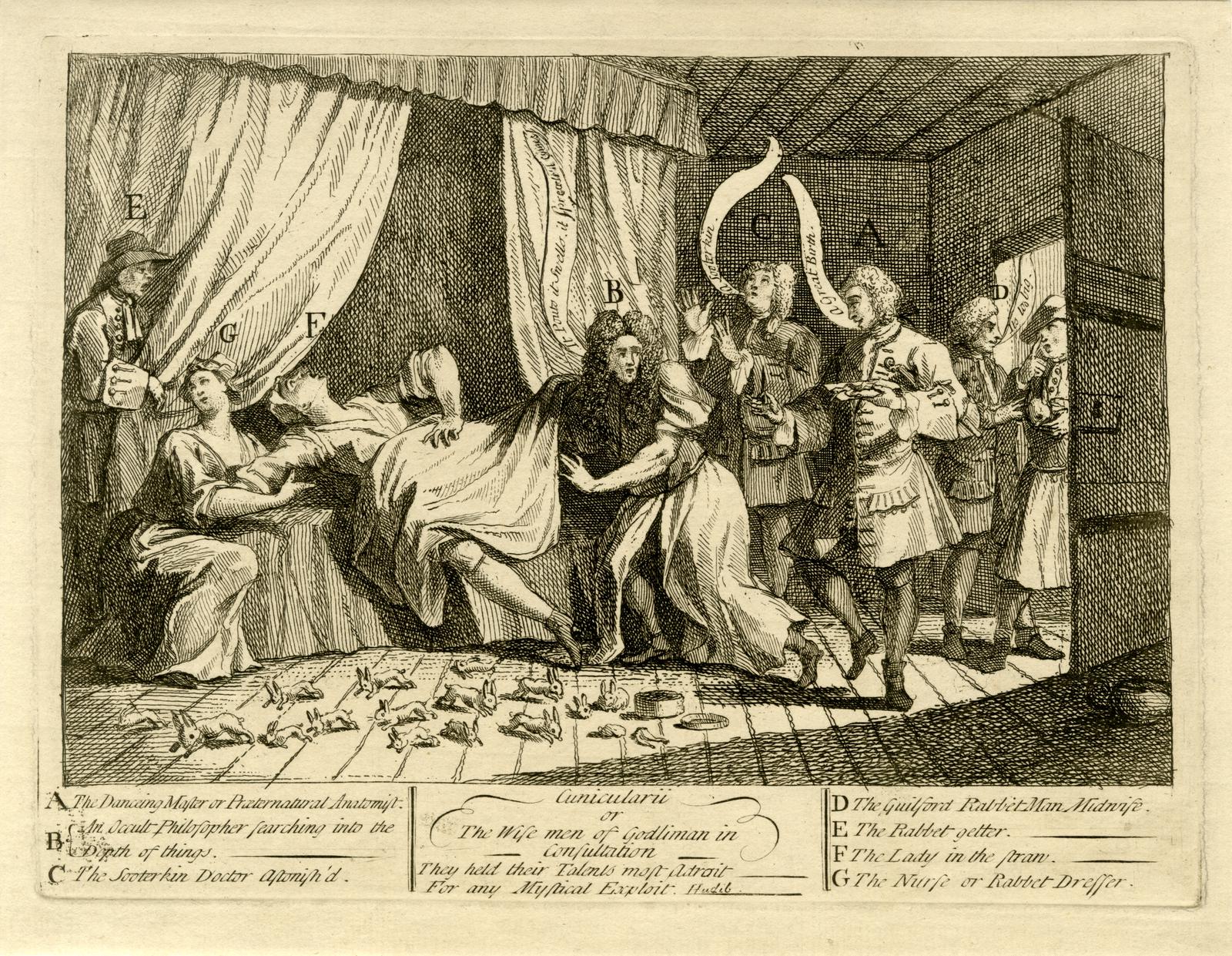
William Hogarth mocked the gullible doctors in his 1726 print Cunicularii, and the scandal fed pamphlets and ballads for months. Badiyaa has chronicled other famous deceptions, from the radiocarbon verdict on the Shroud of Turin to the 1977 Vrillon broadcast hijack, and the real 18th-century push to train midwives properly, led by Angélique du Coudray and her birthing mannequin.
Sources
- Mary Toft, Wikipedia, 2026
- Nathaniel St André, Wikipedia, 2026
- Mary Toft: The Rabbit Breeder (S. A. Seligman), Medical History, Cambridge University Press, 1961
Image: William Hogarth, Public domain via Wikimedia Commons
This article was produced with AI assistance and reviewed by our Editorial Desk. How we work.