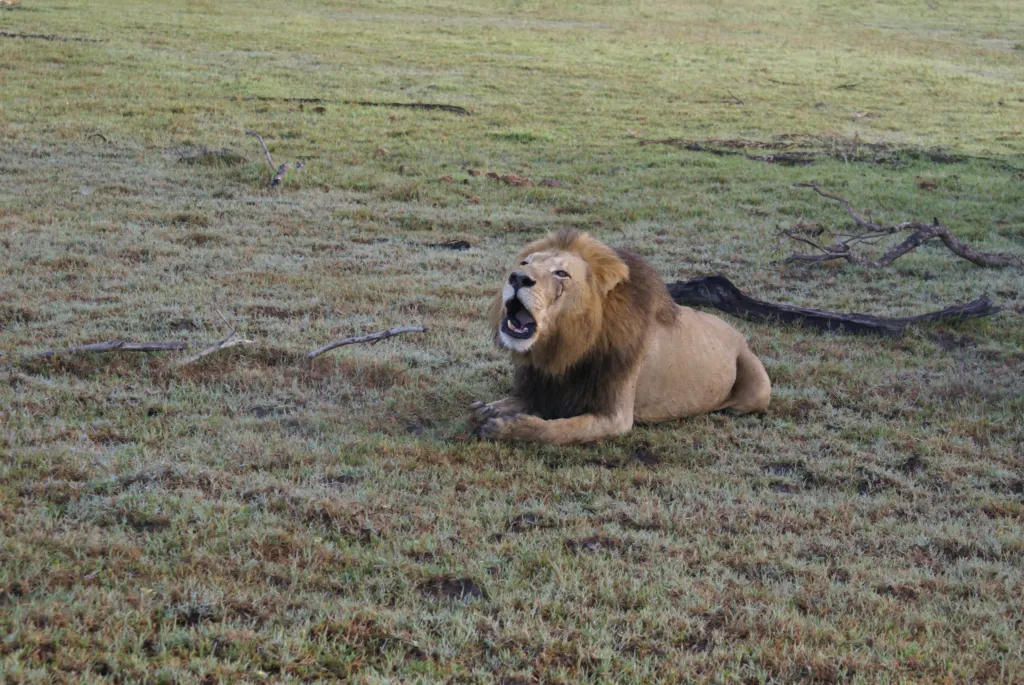
Of the 41 recognized living cat species on Earth, only four can produce a true roar: the lion, the tiger, the leopard and the jaguar. The cheetah, the puma and even the snow leopard, a close cousin of the tiger, cannot.
That fact keeps resurfacing online as a surprise, because so many big, fierce-looking cats are left off the list. The answer sits in the throat, in the shape of the vocal folds and in a small bone most people have never heard of.
The roaring kit: a flexible hyoid and square vocal folds
Every cat in the genus Panthera has a hyoid apparatus, the chain of bones that anchors the tongue and larynx, that is only partly turned to bone. That leaves it springy. Paired with an enlarged, specially adapted larynx, it lets the voice box drop lower in the throat and stretch the vocal tract, which deepens the sound.
The vocal folds matter too. A 2011 study in the journal PLoS ONE, by a team including Tobias Riede of the University of Utah, examined tiger and lion tissue and found folds with an unusual square profile rather than the triangular shape seen in most mammals. That shape “makes it easier for the tissue to respond to the passing airflow,” Riede said in the journal’s release, so the cats can roar loudly without pushing hard from the lungs.
The same research rejected an older idea that lions sound deep simply because their vocal folds are heavy with fat. The authors suggested the fat helps give the folds their square shape and may cushion them.
Why the snow leopard misses out
The snow leopard is the odd one out. It belongs to Panthera and shares the flexible hyoid, yet it cannot roar. Its vocal folds are short, about 9 millimeters, and offer too little resistance to the air rushing past. Its loudest mews can sound roar-like, but the call lacks the structure of a real roar.
This quirk once led some zoologists to keep it in a separate genus, Uncia. Genetic work later placed it inside Panthera as the tiger’s sister species, a move the IUCN Red List accepted in 2008.
Cheetahs chirp, pumas purr
Cheetahs and pumas belong to a different branch, the Felinae, alongside house cats, lynxes and ocelots. Their hyoid is more rigid and more fully turned to bone than in the big cats, and their voices run to a different set of sounds.
- Cheetah: a short, bird-like chirp when excited, a churring call, and a purr much louder than a house cat’s.
- Puma (cougar): the largest cat that can purr. Females in heat give loud yowls and caterwauls; mothers keep in touch with cubs through whistles, chirps and mews.
- Clouded leopard: a pantherine cat that can neither purr nor roar.
The trade-off runs the other way as well. Roaring cats appear to purr only in limited situations, such as when cubs suckle or during mating, while the small cats purr on both the in-breath and the out-breath.
How far a roar carries
A lion’s roar can be heard by people up to five miles away, roughly 8 kilometers, and lions probably hear it farther. Both males and females roar, using the sound to space themselves out and warn rival prides off their territory.
Put another way, a roar heard 8 kilometers off covers a circle of about 200 square kilometers (3.14 x 8 x 8), enough to announce a pride across a large slice of savanna.
For more on these cats, see the five cheetah cubs born at the Smithsonian’s Virginia campus and Fort Worth Zoo’s first Sumatran tiger cubs, Barani and Malu.
Even the most famous roar in cinema is not quite what it seems: the sound designer Mark Mangini built the modern MGM lion’s roar in 1982 from tiger growls.
Further reading
Image: Justin Hall, CC BY 2.0 via Wikimedia Commons
This article was produced with AI assistance and reviewed by our Editorial Desk. How we work.