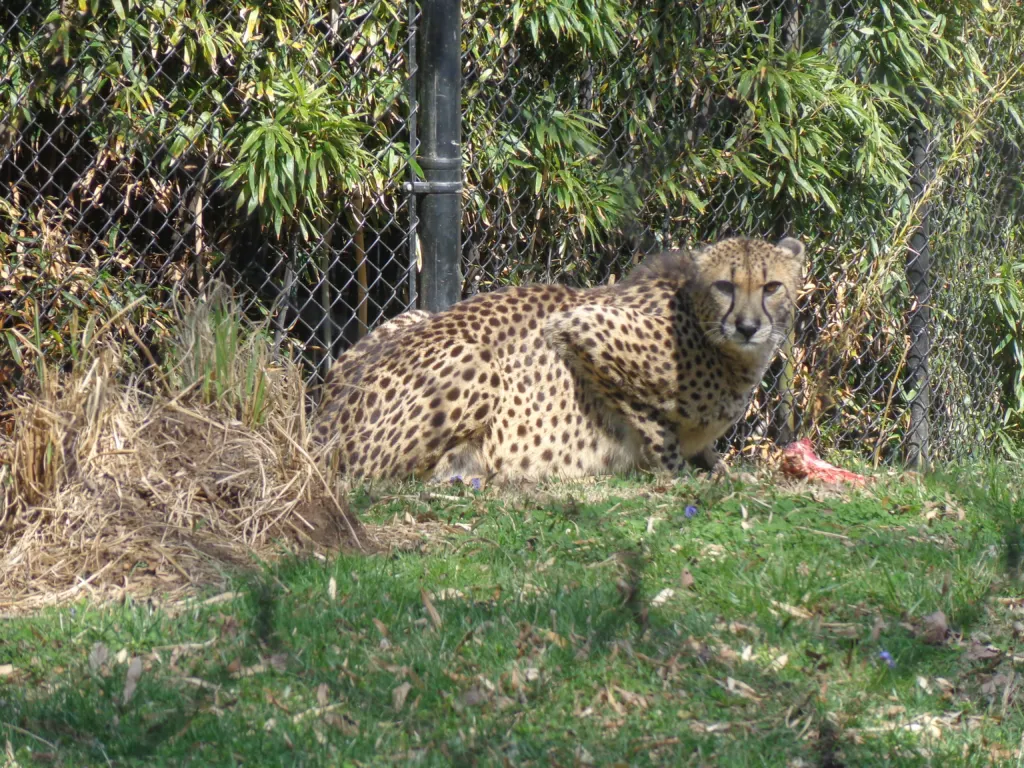
Five cheetah cubs born on October 5 at the Smithsonian Conservation Biology Institute in Front Royal, Virginia, can now be watched around the clock on a live den camera, while keepers stay almost entirely out of the way. Their mother, 5-year-old Zura, is a first-time parent, and the litter means four generations of one cheetah family now share the institute, counting Zura, her mother Rosalie, 11, and her grandmother Sanurra, 16.
“With these cubs, we now have four generations of the same cheetah family with us,” Adrienne Crosier, the institute’s carnivore curator, said in the zoo’s announcement.
Why you can see them only on camera
The cubs will not go on public view. Front Royal is the off-site research campus of the Smithsonian’s National Zoo, about an hour’s drive from Washington, D.C., and its cheetah program is designed to keep human contact low in the first weeks, when cubs bond with their mother. So far keepers have kept contact to a minimum and describe Zura as careful and attentive. The Cheetah Cub Cam covers two dens and runs 24 hours a day.
The preparation started months earlier. Through Zura’s roughly four-month pregnancy, staff ran regular checks, and she had been trained to sit calmly for blood draws, ultrasounds and X-rays with minimal stress. The father is 9-year-old Flash, who has now sired three litters for the program. As with cheetahs in the wild, he plays no part in raising them.
What the numbers say about a hard-to-breed cat
- 21 litters since 2007: that is about one litter a year over 19 years, at a facility that keeps roughly 30 breeding cheetahs.
- A coin flip, or worse: only about 40% to 50% of cheetah pairings in human care produce cubs, according to the institute.
- From 100,000 to under 7,000: that is a drop of more than 93% in the wild population since the start of the 20th century, and the species now holds just 9% of its historic range.
- Five at once: Zura’s own birth litter in 2021 was also five cubs; her four siblings now live in breeding programs elsewhere in the US.
The trouble is partly behavioral and partly ancient. Females can conceive only during short, irregular windows and tend to prefer a choice of males. And cheetahs went through a population crash around the end of the last Ice Age, which left survivors mating with relatives. Modern cheetahs still carry the marks of that inbreeding: low sperm motility, very similar genes and less room to adapt.
That is why the father matters here. Flash’s family line is thinly represented among North American cheetahs, so his cubs widen the gene pool of the managed population, Crosier said. The births are coordinated through the Cheetah Breeding Coalition, which links 10 accredited cheetah facilities across the United States.
What to look for on the cub cam
These first weeks are the bonding period keepers are protecting, so expect a mother and cubs in the den rather than action. Later, the cubs will likely spend another year or two at Front Royal before moving to partner facilities to breed, as Zura’s siblings did. Researchers at the institute are meanwhile studying the microbes in cheetahs’ reproductive tracts, to see whether they help explain the species’ breeding problems.
Keepers expect the camera to show the litter for about six to seven months, until the cubs naturally stop sleeping together in one den. Counting from October 5, that puts the last weeks of the cub cam around April or May 2027.
Further reading
Image: Mint0ri, CC BY-SA 4.0 via Wikimedia Commons
This article was produced with AI assistance and reviewed by our Editorial Desk. How we work.
Spot an error? Help verify this story
The story in 5 slides