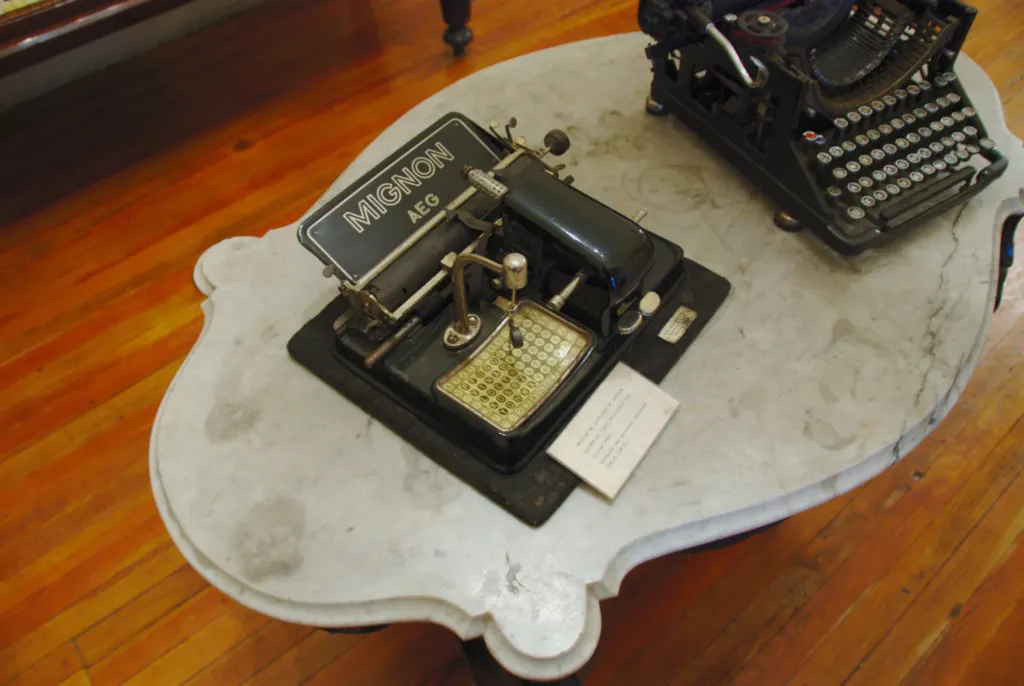
One typewriter of the 1880s had no keyboard at all, and one maker sold its version for 1/40 the price of a Remington. It was called the index typewriter, and you worked it by pointing.
The idea was almost absurdly plain. A printed chart of letters sat on the machine. The typist moved a pointer to the character wanted, then worked a lever, and a mechanical link between pointer and type put that character on the page. Point, press, repeat, for every letter of every word.
Why anyone bought one
Speed was never the selling point. Index machines ran slower than keyboard models, and everybody knew it. What they offered was fewer parts, less weight and a far smaller bill.
That made two customers. Travelers wanted something light enough to carry. People who wrote only a handful of letters wanted typed correspondence without paying for an office machine. The Simplex Typewriter Company aimed squarely at the second group, and its 1/40 price point shows how wide the gap could be.
Put that fraction into plain arithmetic: 100 divided by 40 is 2.5, so for every $100 a buyer would have spent on a Remington, a Simplex cost $2.50. The $100 is only a round number to show the ratio, not a historical price tag.
The machine that could change languages
The best of the breed came from the German electrical company AEG. Its Mignon let owners swap the index, the type, the fonts and even the whole character set. Keyboard typewriters could rarely manage that trick, and those that could charged heavily for it.
For anyone writing in more than one alphabet, the supposedly primitive option was the flexible one.
A short life in four dates
- 1874: The first commercial typewriters go on sale.
- 1881: The Hall 1 arrives, listed as the first index typewriter.
- Early 1880s onward: Index machines find their niche among travelers and light users.
- 1934: The Mignon, the last widely available Western index machine, ends production.
What finished it off
Two squeezes closed in together. Keyboard typewriters shed weight and became portable, which took away the travelers. Refurbished second-hand keyboard machines reached the market, which took away the budget buyers. Once a used keyboard model was within reach, a slow pointer had very little left to argue with.
Keyboards did not win everywhere, though. Successful Japanese and Chinese typewriters were built on the index principle, with a far bigger chart and far more type elements.
You have probably used one
The design never really died. Dial a letter on an embossing tape label maker, squeeze the handle, and you have just operated an index typewriter. Those label makers are the most common index typewriters around today, and they are also the most common typewriters of any kind still being manufactured.
The Mignon stopped in 1934. Its method is still in production.
Further reading
Image: Karora, Public domain via Wikimedia Commons
This article was produced with AI assistance and reviewed by our Editorial Desk. How we work.