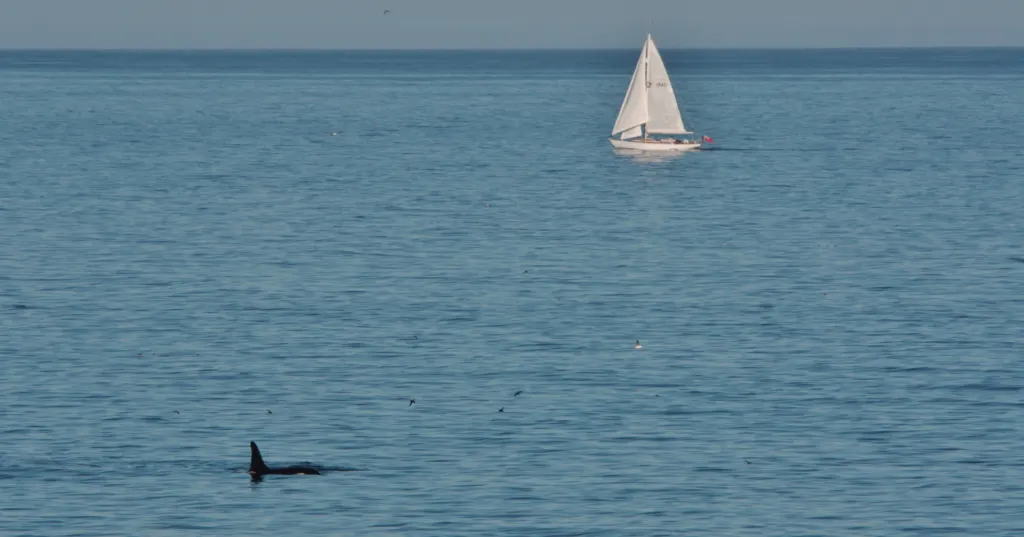
A small group of orcas off Spain and Portugal has spent six years doing something no other killer whales are known to do on this scale: grabbing the rudders of sailing yachts. More than 500 such encounters have been reported since 2020, and researchers have traced them to about fifteen individual whales.
The animals belong to the Iberian orca subpopulation, a tiny, critically endangered group. A full census in 2011 counted just 39 orcas in five pods, and the IUCN Red List moved them to critically endangered in 2019. They shadow Atlantic bluefin tuna, gathering in the Strait of Gibraltar each spring, staying through summer, then moving north past Portugal to Galicia before heading to deeper water in the fall.
What an encounter looks like
The pattern is consistent. Orcas approach quietly from behind, then push, nudge or bite the rudder. Some lever the blade with their bodies until the boat swings around, in a few cases almost a full circle. Inspections afterward have found tooth marks on hulls and keels, and rudders bent, split or snapped away.
The targets are specific. Reported boats average about 12 meters (39 feet) long and were moving at roughly 6 knots, a pace an orca matches with ease. Monohull sailboats with spade rudders top the list. Most encounters happen in daylight, peak around midday and end within half an hour.
A timeline of the rudder encounters
- May 2020: first reported encounter, in the Strait of Gibraltar
- August 2020: encounters reach Galicia in northern Spain, and Spanish and Portuguese researchers form the Atlantic Orca Working Group
- 2020 to 2022: 52, then 197, then 207 reported interactions per season
- 2022: a study of photos and crew accounts names nine whales that touched boats, each given the label “Gladis”
- 2023: the count of Gladises reaches 15
- 2025: sinkings off Portugal show the behavior has not faded
The nickname comes from Orcinus gladiator, an old scientific name for the species that translates roughly as whale-fighter. The best known is an adult female called Gladis Blanca.
Play, frustration or fashion
Nobody knows for sure why the orcas do it, and researchers have offered several competing ideas. Whale researcher Deborah Giles has suggested the animals are “incredibly curious and playful animals and so this might be more of a play thing as opposed to an aggressive thing.” Another idea holds that a single bad collision with a boat taught one orca to see rudders as a threat, and the reaction spread. A third treats it as a cultural fad, like the southern resident orcas of the Pacific Northwest that were seen wearing dead salmon on their heads in 1987.
Orcas learn from one another, passing skills to peers and from mothers to calves, which helps explain how a quirk could move between pods.
What sailors are told to do
Damage is real but limited. Of more than 250 damaged boats, only a handful have sunk, and researchers noted that the orcas could have sunk far more if that were the aim. No one has been hurt in any of the encounters, and no wild orca has ever killed a person.
Spain’s environment ministry and its merchant navy authority now publish joint advice. Sailors should avoid a marked zone in the Gulf of Cádiz and the Strait from April to August, and high-risk areas off western Galicia from July to October, keeping as close to shore as is safe. If orcas make contact, the guidance says not to stop but to head for the coast and shallower water, keep everyone away from the sides of the boat, avoid anything that could harm the whales, and report the encounter by VHF radio on channel 16. The ministry also had six of the orcas fitted with satellite tags and shared weekly maps of their movements with mariners.
For more on how orcas use their teeth, see our report on captive orcas wearing their teeth down on concrete tank walls, and browse more Pets & Animals stories. The tuna, and the orcas with them, return to the Strait of Gibraltar each spring.
Further reading
Image: Ronnie Robertson, CC BY-SA 2.0 via Wikimedia Commons
This article was produced with AI assistance and reviewed by our Editorial Desk. How we work.