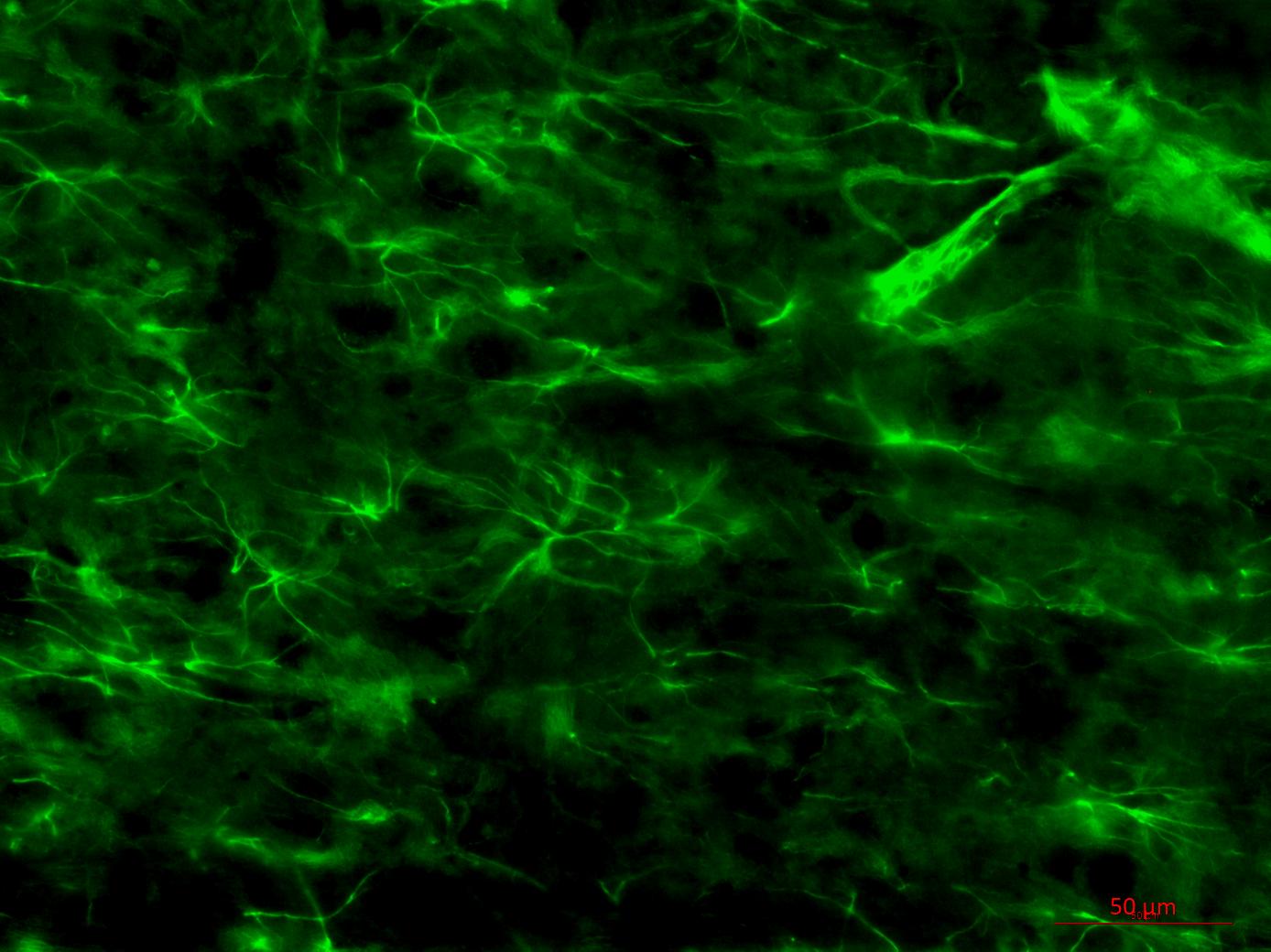
Human consciousness may depend on brain chemistry that computers simply do not have, two researchers argue in a 2026 review. Gerard Marx and Chaim Gilon propose that memories are written into the gel-like matrix that surrounds brain cells, steered by star-shaped support cells called astrocytes, and tagged with emotion by chemical messengers. If they are right, piling more computing power onto AI would not, by itself, produce a mind like ours.
It is an argument, not an experiment. The paper, "Consciousness, Memory and Intelligence: A Mechanistic Perspective," in the International Journal of Psychiatry Research, published June 30, 2026, reviews earlier theories and sets out the authors' own model. It reports no new lab data.
The three-part memory code at the center of the review
The authors call their model a tripartite mechanism of memory. Its three parts are brain cells, especially astrocytes working with neurons; the molecular mesh around those cells, which the paper labels nECM/PNN, meaning the neural extracellular matrix and perineuronal nets; and what they call "dopants," a mix of metal ions, neurotransmitters and gliotransmitters (signaling chemicals released by glial cells).
"The central proposition is that memory is encoded in the matrix (nECM/PNN) surrounding brain cells," they write in the abstract. Emotional context, in their account, rides along as neurotransmitters, which is why a smell or a song can drag a feeling back with a memory. They compare the resulting chemical code to the physical memory of a computer, while arguing that the brain's version runs on living chemistry that electronics lack.
They are also blunt about rival theories. Many, they say, lean on words like "map," "structure" or "framework" but "provide no graphic equivalent or physiologically credible mechanism."
Why astrocytes are a serious place to look
Astrocytes are not a fringe idea. Wikipedia's astrocyte article notes that a single human astrocyte can interact with up to two million synapses, and that human astrocytes are more than twenty times larger than those in rodents. Neuroscientists already use the term "tripartite synapse" for the close partnership between two neurons and an astrocyte at a junction. What is new here is the leap from those cells to memory storage and to consciousness itself.
That leap lands on what philosophers call the hard problem of consciousness: why physical processes come with inner experience at all. The phrase was coined by philosopher David Chalmers in a 1994 talk in Tucson, Arizona, as Wikipedia's summary of the hard problem explains. Marx and Gilon do not claim to have solved it. Their abstract ends: "We may have recognized a fragment from the entangled mysteries of consciousness, memory, and intelligence, but the eternal enigma of Life remains."
How strong the evidence is: one review, no new data
Readers should weigh this as a hypothesis paper. It builds on the pair's earlier work, including a 2020 paper on "neural intelligence" versus artificial intelligence and a 2022 paper, "The Dimension of Neural Memory and Consciousness", in the same journal. The model has not yet been tested by experiments that could prove it wrong, and the review had no citations in Crossref's index when we checked on November 27, 2026.
The authors also do not say AI cannot become very capable. Their narrower claim is that intelligent behavior and the chemistry of a feeling, remembering brain are different things. Badiyaa has covered harder evidence on memory, such as mRNA nose drops that restored memory in aged mice and a Tokyo brain-scan study of paper planners versus phones.
The useful next step would be a test: if memories sit in the matrix around cells, disrupting that matrix in a lab animal should erase specific memories in predictable ways.
Sources
- "Consciousness, Memory and Intelligence: A Mechanistic Perspective", International Journal of Psychiatry Research (Marx and Gilon), 2026
- "Astrocyte", Wikipedia, 2026
- "Hard problem of consciousness", Wikipedia, 2026
- "The Dimension of Neural Memory and Consciousness", International Journal of Psychiatry Research (Marx and Gilon), 2022
Image: NurislamScheich, CC BY-SA 4.0 via Wikimedia Commons
This article was produced with AI assistance and reviewed by our Editorial Desk. How we work.