Astronomers hunting for a galaxy almost nobody could see found it by following four tiny clumps of stars. The object, Candidate Dark Galaxy-2 or CDG-2, sits in the Perseus galaxy cluster and may be more than 99.9% dark matter, according to a 2025 paper in The Astrophysical Journal Letters.
That would put it among the most dark matter-dominated galaxies ever found. The European Space Agency, which helped confirm it with its Euclid space telescope, rounded the figure to 99% in ESA's February 2026 announcement.
A galaxy found by its star clusters
Dark matter gives off no light, so a galaxy made mostly of it is close to invisible. Wikipedia's dark galaxy entry notes that astronomers have long theorized such objects but still count no confirmed example, and that many past candidates turned out to be stray gas clouds. The team led by David Li of the University of Toronto went looking instead for globular clusters, dense balls of stars that usually orbit normal galaxies. A statistical search of Hubble Space Telescope images turned up a tight group of four of them in Perseus.
Then came the confirmation. Using the same Hubble images plus new data from Euclid and Japan's ground-based Subaru Telescope, the researchers detected a very faint, diffuse glow wrapped around the four clusters: the galaxy itself.
"This is the first galaxy detected solely through its globular cluster population," Li said in ESA's release.
The numbers behind the shadow
The paper's abstract puts the total starlight of CDG-2 at about 6.2 million solar luminosities, give or take 3 million. At least about 16.6% of that light comes from the four globular clusters alone. If known links between cluster counts and dark matter halos hold, the galaxy's mass would be somewhere between 99.94% and 99.98% dark matter.
For scale, the Milky Way has more than 150 globular clusters, ESA notes. CDG-2's four amount to under 3% of that count, a skeleton crew for an entire galaxy.
Why so few stars? ESA says much of the hydrogen gas needed to build stars was likely stripped away by gravitational tugs from other galaxies in the crowded cluster. Wikipedia's Perseus Cluster entry describes the cluster as one of the most massive objects known, packed with thousands of galaxies inside a huge cloud of multimillion-degree gas.
Why astronomers care
Francine Marleau of the University of Innsbruck, a co-author, said: "The Euclid data clearly confirm the presence of the extremely faint, diffuse light of CDG-2, revealing the galaxy behind the globular clusters for the first time." Because globular clusters are tightly bound, they survive tidal tearing well, which makes them reliable markers for ghostly galaxies like this one.
Limits
- The dark matter share is inferred from cluster-to-halo relations seen in other galaxies, not weighed directly.
- The team assumed the four clusters are the galaxy's entire set; the abstract itself calls that a conservative assumption.
- The luminosity estimate carries an uncertainty of nearly half its value.
Euclid keeps turning up oddities, from its first comet on a steeply tilted orbit to the emptiness of the Bootes Void, the 'Great Nothing'. The researchers say the same cluster-hunting method found two more dark galaxy candidates, and those are next in line for follow-up.
Sources
- "Candidate Dark Galaxy-2: Validation and Analysis of an Almost Dark Galaxy in the Perseus Cluster", The Astrophysical Journal Letters, 2025
- "Hubble, Euclid and Subaru uncover dark galaxy", European Space Agency, 2026
- "Perseus Cluster", Wikipedia, 2026
- "Dark galaxy", Wikipedia, 2026
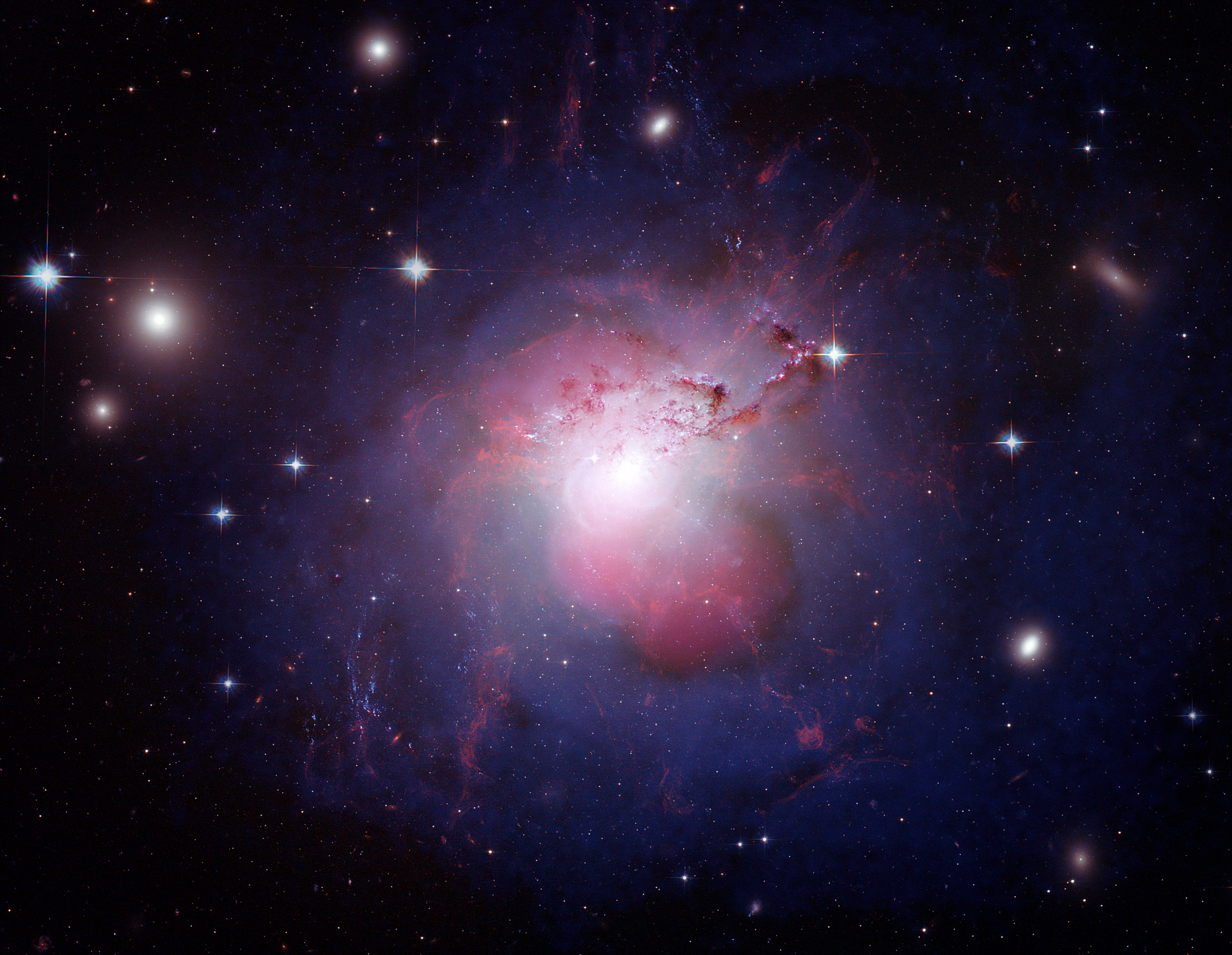
Image: NASA/CXC/IoA/A. Fabian et al.; NRAO/VLA/G. Taylor; NASA/ESA/Hubble Heritage (STScI/AURA), Public domain via Wikimedia Commons
This article was produced with AI assistance and reviewed by our Editorial Desk. How we work.