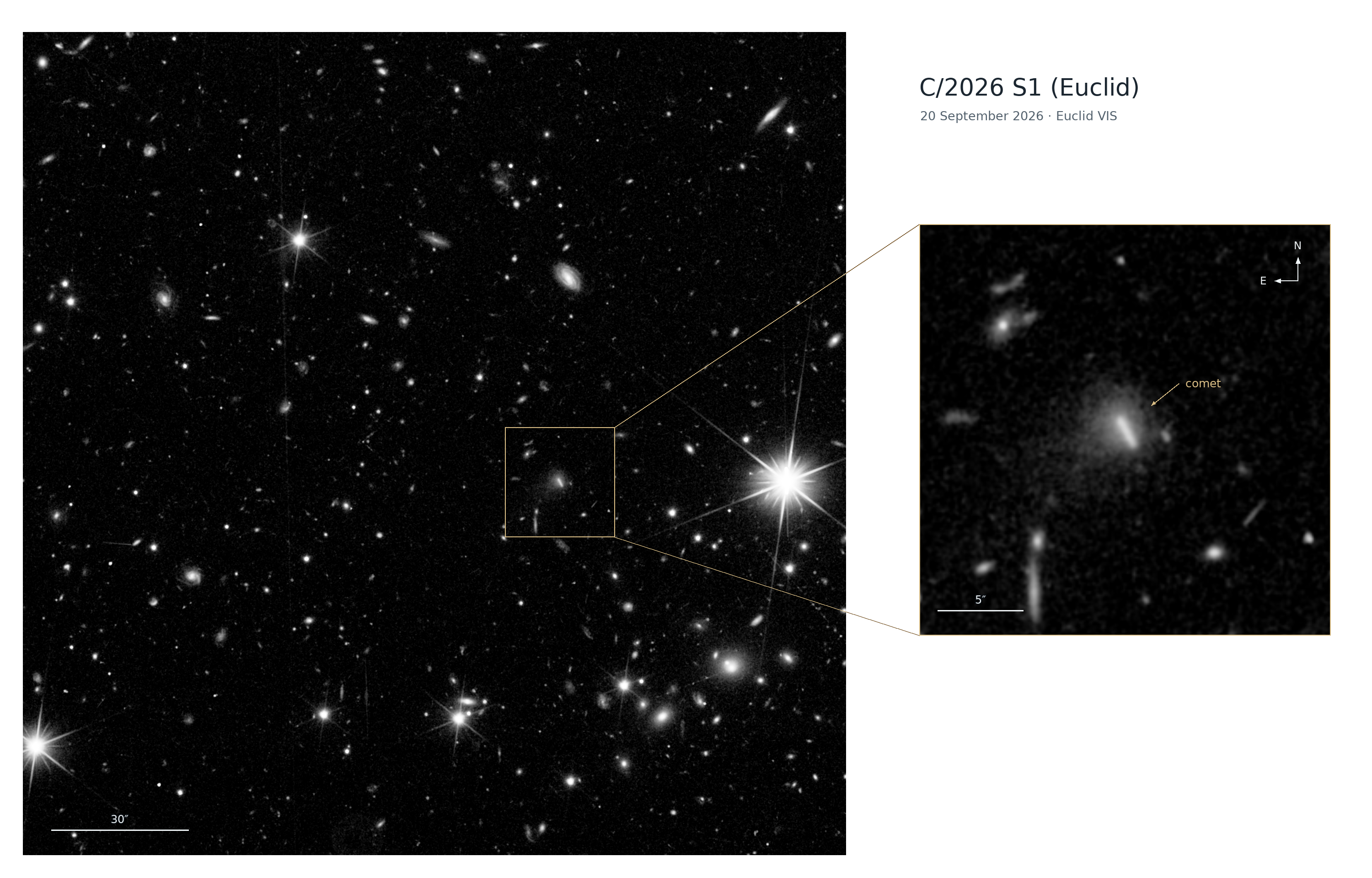
Euclid was built to map dark matter and dark energy across billions of light-years. Instead, Europe's space telescope has just bagged something from our own cosmic backyard: a brand-new comet, now named C/2026 S1 (Euclid), on a looping orbit that tips almost straight up out of the plane of the planets.
It is the first previously unknown comet the telescope has ever discovered, according to the European Space Agency's image release from October 18.
A dark-matter telescope that looked the other way
Euclid launched on July 1, 2023, and sits about 1.5 million kilometers beyond Earth, circling the Sun-Earth L2 point. Its Wikipedia entry explains that its main job is to measure the shapes of galaxies and how gravity from unseen dark matter bends their light, so scientists can track how the universe's expansion speeds up. Its camera holds 600 million pixels behind a 1.2-meter mirror.
Comets are not on that to-do list. But a telescope that stares at faint galaxies for minutes at a time also catches anything that drifts through the frame. ESA says the comet turned up in a 560.52-second exposure taken on September 20, 2026, during the Euclid Deep Field North survey. Because the comet moved during the long exposure, it shows up as a short streak wrapped in a fuzzy coma of dust and gas.
Found by software, confirmed from the ground
The record kept by the British Astronomical Association's comet section, hosted by the University of Cambridge, gives the discovery date as September 16, when Euclid spotted a faint, 21st-magnitude object. Purpose-written software that hunts for moving objects in Euclid's data stream flagged it. The Minor Planet Center then announced the comet on October 8.
At 21st magnitude, the comet is roughly a million times too faint to see with the naked eye, so do not go looking for it in your backyard.
An orbit that runs almost upright
The strangest thing about the newcomer is its path. NASA JPL's Small-Body Database orbit solution, updated on November 23 from 63 observations, puts its tilt at 85.2 degrees to the plane where Earth and the other planets orbit. In other words, it plunges through the solar system at close to a right angle.
It never comes close to us. Its nearest point to the Sun is about 8.74 astronomical units, nearly nine times Earth's distance, and JPL's numbers put that perihelion in September 2027.
The far end of the orbit is where it gets wild. JPL's current best fit sends the comet out to about 7,470 astronomical units, with an orbital period near 8.35 million days. Our calculation turns that into about 229,000 years for one lap. JPL attaches an uncertainty larger than the value itself, so treat that number as a first sketch: the true period could be far longer or shorter once more observations come in.
A visitor from the deep freeze
Long, steep orbits like this one are the calling card of the Oort cloud. The Oort cloud overview on Wikipedia describes it as a theorized shell of icy bodies between about 2,000 and 200,000 astronomical units from the Sun, and the likely source of most long-period comets, which can arrive from any direction in the sky.
Euclid's comet is not its only surprise this month. Badiyaa covered how Euclid found the two earliest known quasars, and looked back at the telescope's first images of the dark universe, where one frame held 100,000 hidden galaxies.
The next milestone for C/2026 S1 is its closest pass to the Sun in September 2027, when observers will get their best shot at nailing down just how long it has been away.
Sources
- “Comet C/2026 S1 (Euclid) observations in context”, European Space Agency, 2026
- “Comets discovered in 2026”, British Astronomical Association Comet Section, University of Cambridge, 2026
- “Small-Body Database: C/2026 S1 (Euclid)”, NASA Jet Propulsion Laboratory, 2026
- “Euclid (space telescope)”, Wikipedia, 2026
- “Oort cloud”, Wikipedia, 2026
Image: ESA/Euclid/Euclid Consortium/NASA, M. Pöntinen et al. 2026, CC BY-SA 3.0 IGO via Wikimedia Commons
This article was produced with AI assistance and reviewed by our Editorial Desk. How we work.