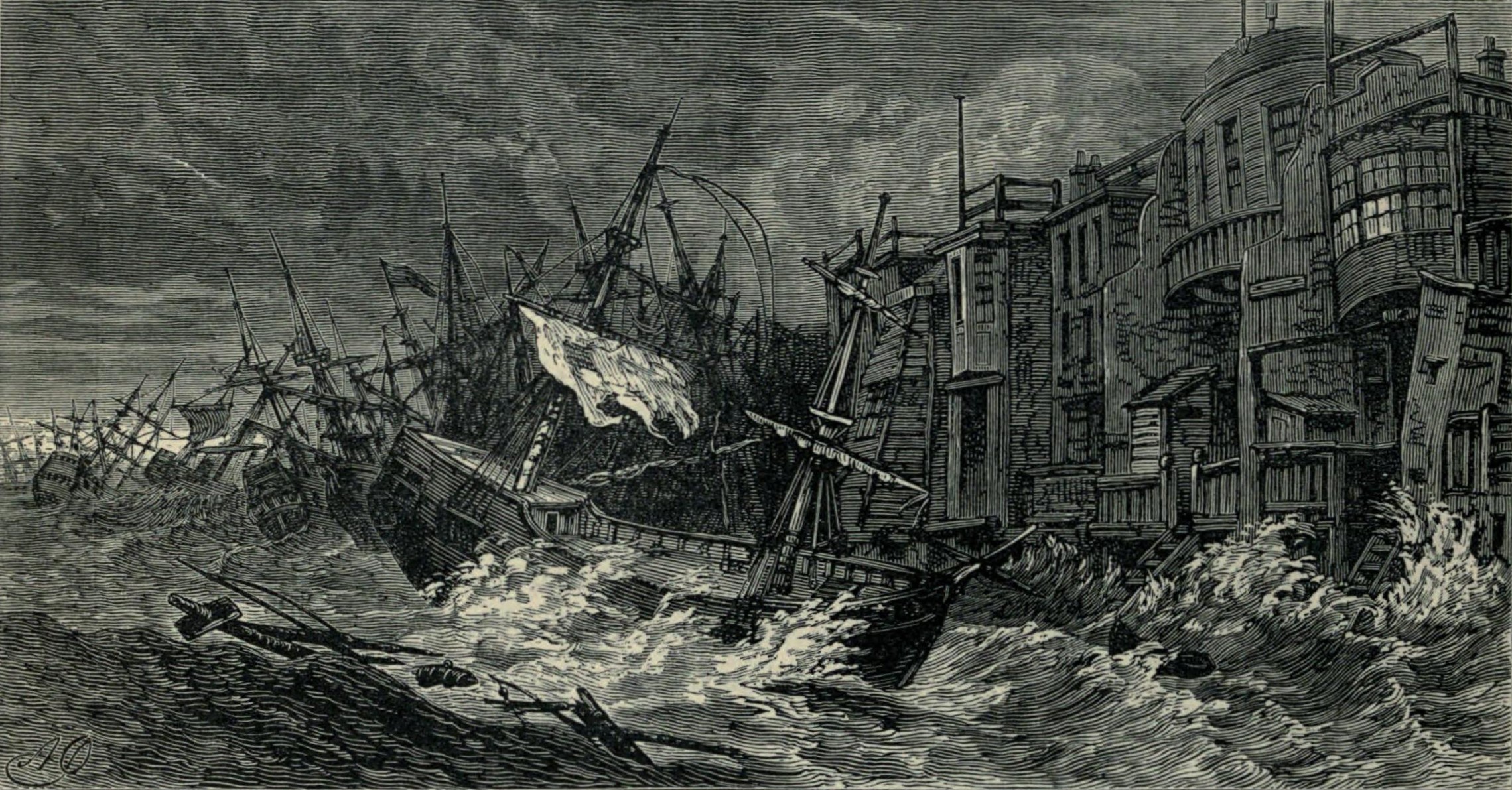
On the night of November 26, 1703, a storm tore across southern England so hard that Queen Anne ducked into a cellar at St James's Palace while chimneys and part of the roof came down. The lead peeled off Westminster Abbey. In London alone, about 2,000 chimney stacks fell, according to Wikipedia's account of the Great Storm of 1703.
Then the writer Daniel Defoe did something new. He asked the public to tell him what they saw.
The damage, by the numbers
The figures still sound unreal. The New Forest lost 4,000 oaks. Water on the Thames rose six feet higher than ever recorded in London, and some 700 ships were piled together in the Pool of London. One ship turned up 15 miles inland on the Somerset Levels. A modern reanalysis found repeating sting jets with winds of up to 110 mph.
The Royal Navy took a beating. Thirteen ships went down, many on the Goodwin Sands off Kent, and upwards of 1,500 seamen drowned. At least 8,000 people were said to have died across the storm's path.
Off Plymouth, the storm erased the first Eddystone Lighthouse, a wooden tower lit with 60 candles at a time. Its builder, Henry Winstanley, was on the rock making improvements and was never found, the lighthouse's Wikipedia history records. Winstanley had once been seized by a French privateer during construction, and Louis XIV ordered him freed with the line "France is at war with England, not with humanity."
Defoe's crowdsourced bestseller that wasn't
Within days Defoe placed an advertisement in the London Gazette of December 2–6, 1703, asking readers to send in signed accounts of "the most remarkable Disasters" of the tempest. Royal Museums Greenwich, which holds a copy of the book in its Caird Library, quotes the notice asking writers to set their names to what they sent.
About sixty letters made the cut for The Storm, published in mid-1704. That method, building a story from named eyewitnesses, is why the book's Wikipedia entry notes it has been called the first substantial work of modern journalism. It was not a hit, and a planned sequel never appeared.
Defoe did not hold back on the drama. "No pen could describe it, nor tongue express it, nor thought conceive it unless by one in the extremity of it," he wrote. He also reported that sails on some windmills spun so fast the friction set the wooden brakes on fire.
The book has its heroes. Thomas Powell, a shopkeeper in Deal, was so disgusted when neighbors would not help sailors stranded on a sand bank that he paid five shillings for each man rescued; Defoe credited him with saving 200 lives.
Why the date moves
England still ran on the Julian calendar in 1703. The storm's peak on the night of November 26–27 falls on December 7–8 in the modern Gregorian calendar, which is why some anniversaries land in December.
The bill was enormous too. Royal Museums Greenwich notes estimates that the storm cost more in property damage than the Great Fire of London in 1666. The government declared January 19, 1704, a national day of fasting, calling the storm a sign that "loudly calls for the deepest and most solemn humiliation of our people."
Defoe is best remembered today for Robinson Crusoe; Badiyaa traced the islands behind that castaway legend in the story of Chile's Juan Fernández Islands and Alexander Selkirk. For another London disaster that changed the city, see the Great Stink of 1858.
The Eddystone rock did not stay dark for long: a second lighthouse, John Rudyard's, was first lit in 1708.
Sources
- Great storm of 1703, Wikipedia, 2026
- Eddystone Lighthouse, Wikipedia, 2026
- The Great Storm of 1703, Royal Museums Greenwich, 2016
- The Storm (Daniel Defoe), Wikipedia, 2026
Image: Unknown artist, Public domain via Wikimedia Commons
This article was produced with AI assistance and reviewed by our Editorial Desk. How we work.