A free choice and a forced one look almost identical in the brain’s electrical signals. When 49 adults either picked freely between two options or simply took the only option offered, the same evidence-gathering signal climbed to the same peak just before they acted, a University of Melbourne team reports.
The work was published in 2026 in a study in the journal Imaging Neuroscience by Lauren Fong, Daniel Feuerriegel and colleagues at the Melbourne School of Psychological Sciences, with Stefan Bode of New York University Abu Dhabi. It adds a twist to the long-running argument over whether free will is an illusion.
How the experiment worked
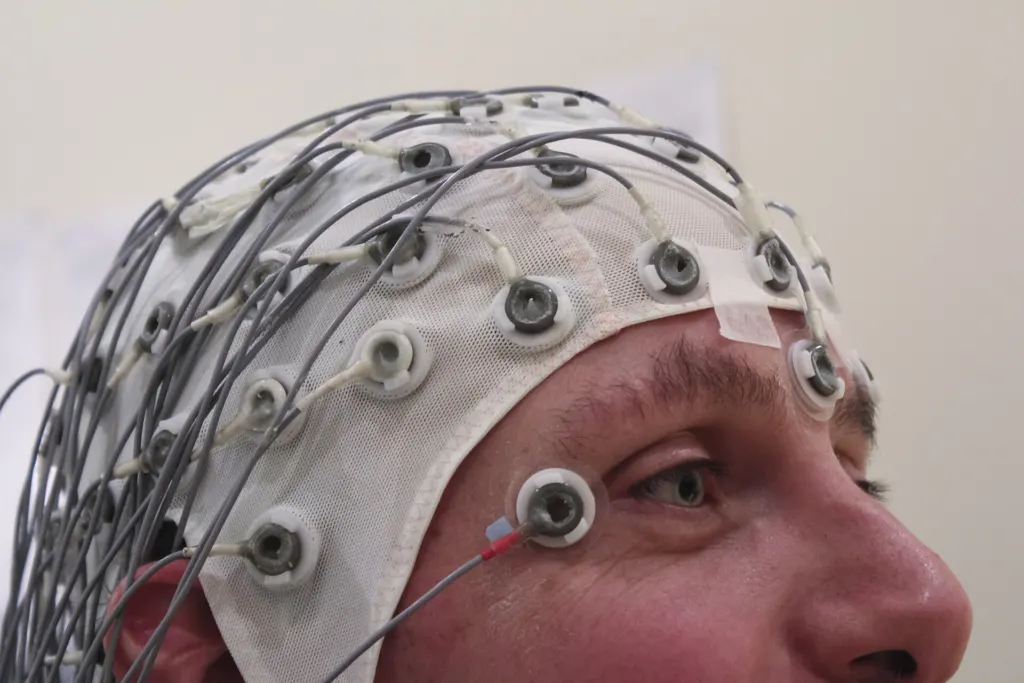
Volunteers wore EEG caps that record electrical activity through the scalp. On some trials they saw two colored balloons and could choose either; on others they saw a single balloon and had to pick it. To separate the decision itself from the hand movement, every answer used the same right-hand keypress.
The team tracked three signals in the run-up to each press:
- the centro-parietal positivity, a rising signal over the top of the head that tracks evidence piling up toward a decision;
- Mu/Beta rhythms between 8 and 30 Hz, which reflect the body getting ready to move;
- a readiness potential over the left hemisphere, opposite the responding hand.
What they found
For both kinds of choice, the first two signals behaved like a loading bar. Faster decisions came with steeper climbs, slower ones with gentler climbs, and all of them topped out at about the same level just before the press. The readiness potential also converged on a fixed level but did not scale reliably with response time, so the authors read it as a late motor “gate” rather than the decision itself. Across the whole time course, the waveforms did not differ reliably between free and forced trials, the paper’s abstract says.
The Libet question
The study speaks to one of neuroscience’s most famous experiments. In 1983 Benjamin Libet asked people to flex a wrist whenever they liked and note the moment they felt the urge. Brain activity started building about 500 milliseconds before the movement, while the felt urge came only about 200 milliseconds before it. Many took that as evidence that the brain decides before we know it.
Later work chipped at that reading. As the Wikipedia overview of the neuroscience of free will sets out, a 2012 PNAS study argued the build-up could come from random background fluctuations, and a 2019 study found readiness potentials before arbitrary choices but not deliberate ones. Libet himself proposed that people keep a “veto” over urges already under way.
What it does and does not mean
Badiyaa’s reading: the Melbourne result is about the mechanics, not the verdict. It shows that open-ended choices are assembled by the same gradual accumulation process as choices with only one right answer. It does not show that the inputs to that process, such as a person’s preferences, are any less theirs.
The limits are clear. The choices were trivial balloon colors, the sample was 49 adults, and scalp EEG captures broad signals rather than single neurons. Decisions that matter, like the ones the 2019 study examined, may behave differently.
Badiyaa has covered speed in decision-making before, in a Tübingen study that clocked crows deciding in 235 milliseconds, and other brain-scan work such as the University of Iowa’s fMRI study of autistic brains.
Sources
- “Tracing the neural trajectories of evidence accumulation and motor preparation processes during voluntary decisions”, Imaging Neuroscience (University of Melbourne), 2026
- “Benjamin Libet”, Wikipedia, 2026
- “Neuroscience of free will”, Wikipedia, 2026
Image: Chris Hope, CC BY 2.0 via Wikimedia Commons
This article was produced with AI assistance and reviewed by our Editorial Desk. How we work.