The banisters are made of crystal. Inside Dolmabahçe Palace on Istanbul’s Bosporus shore, the famous Crystal Staircase sweeps up in the shape of a double horseshoe, built from Baccarat crystal, brass and mahogany, and photos of it climbed to the top of Reddit’s r/Damnthatsinteresting this week.
Seen from the bottom step, the effect is of two curving flights rising toward a glittering chandelier, with rows of cut-crystal balusters catching the light from tall windows. The staircase is only one piece of a palace built to outshine the courts of Europe, and the numbers behind it are just as dazzling.
Why the sultans left Topkapı
For centuries the Ottoman sultans lived at Topkapı Palace, a medieval complex of courtyards and tiled pavilions. By the 1840s it looked old-fashioned next to the palaces of Paris and Vienna. Sultan Abdülmecid I ordered a new, European-style residence on the site of the Beşiktaş Waterfront Palace, which was torn down to make room.
The site itself was man-made. It began as a bay where the Ottoman fleet anchored, and it was gradually filled in from the 17th century to become an imperial garden. That is where the name comes from: Dolmabahçe means “filled garden.”
Construction ran from 1843 to 1853, led by architects of the Armenian Balyan family. Turkey’s Presidency of National Palaces, which runs the building today, lists Karabet and Nikogos Balyan among the imperial architects, alongside Ohannes Serveryan and James William Smith.
Crystal on a royal scale
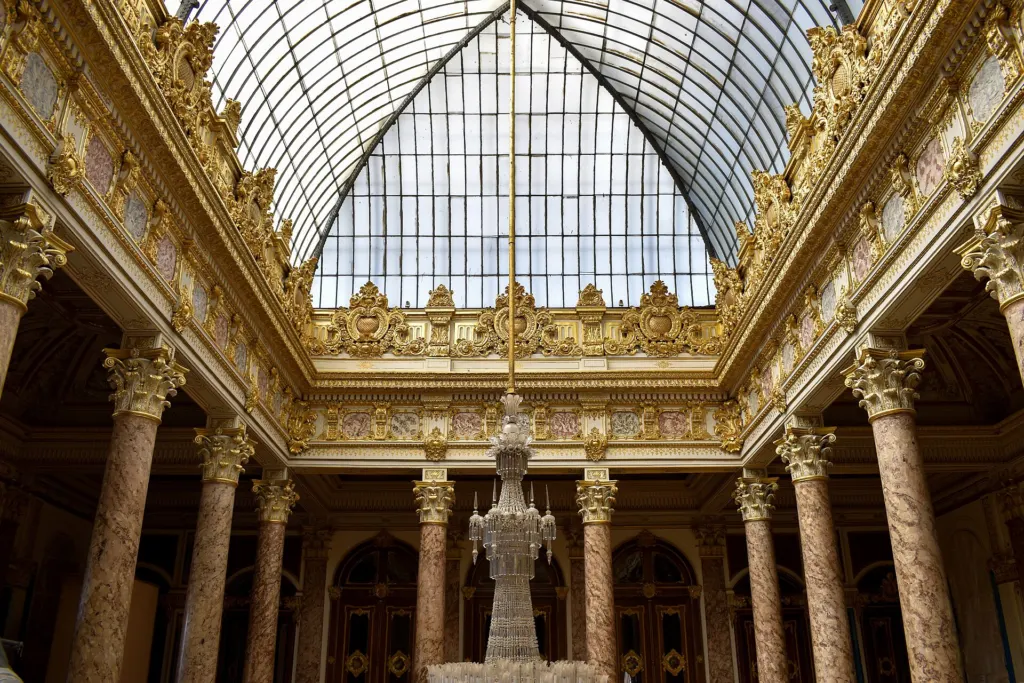
The staircase is not a one-off. Dolmabahçe holds what is described as the world’s most extensive collection of Bohemian and Baccarat crystal chandeliers. Its Ceremonial Hall has the largest crystal chandelier in the world, with 750 lamps and a weight of 4.5 tonnes. For years it was said to be a gift from Queen Victoria, until a receipt found in 2006 showed the sultan had paid for it himself.
The bill for the whole project was enormous: five million Ottoman lira, or about 35 tonnes of gold, roughly a quarter of the empire’s yearly tax revenue. It was paid for partly with paper money and foreign loans, and the strain fed into the Ottoman default on its public debt in 1875.
Dolmabahçe by the numbers
- Built: 1843 to 1853, first lived in from 1856, according to the National Palaces administration.
- Rooms: 285 rooms, 44 halls, 68 toilets and six Turkish baths.
- Footprint: a ground area of 14,595 square meters, the largest palace in Turkey.
- Residents: six sultans and the last caliph, until 1924.
- Museum since: 1984, with its original furnishings.
The design blends Baroque, Rococo and Neoclassical decoration with a traditional Ottoman layout of a central hall ringed by rooms. Hereke carpets, Sèvres porcelain and a collection of 202 oil paintings fill the interiors, including 23 seascapes by Ivan Aivazovsky. The palace also had gas lighting and flush toilets imported from Britain at a time when many European palaces did not.
After the Ottoman era ended, Mustafa Kemal Atatürk used Dolmabahçe as a summer presidential residence, and he died there on November 10, 1938. The clock in the room still points to 9:05, the minute of his death.
Seeing the staircase
The palace’s official listing gives visiting hours of 09:00 to 17:30. A week-long ticket covering the Selamlık, the Harem and the painting museum costs 2,000 Turkish lira for foreign visitors and 250 lira for Turkish residents, with discounts for students aged 7 to 25. Children up to six get in free.
Turkey has a habit of turning up wonders, from the Chimaera flames that have burned out of mountain rock for 2,500 years to Istanbul’s palaces. For dazzling craft of an older vintage, see the Silver Swan automaton that still catches a fish at England’s Bowes Museum.
One last figure for scale: the Ceremonial Hall that sits beside the staircase rises to a dome 36 meters (118 feet) high.
Further reading
Image: Julian Lupyan, CC0 via Wikimedia Commons
This article was produced with AI assistance and reviewed by our Editorial Desk. How we work.