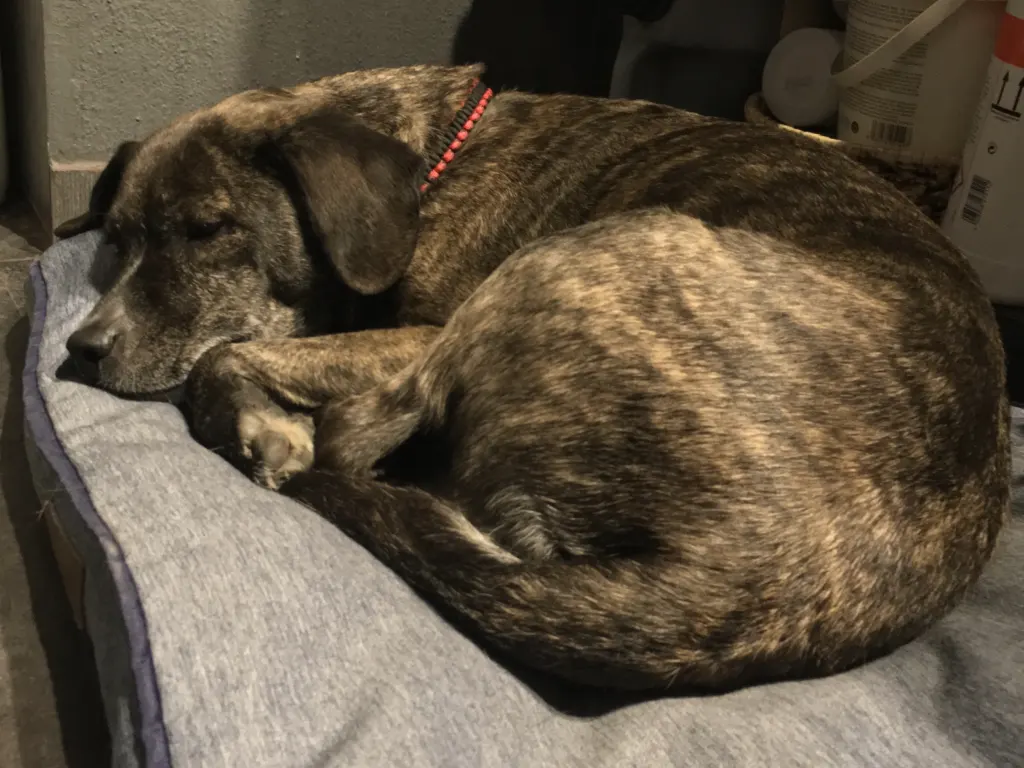
The twitching paws, fluttering eyelids and soft yips of a sleeping dog have a name: rapid eye movement, or REM, sleep. It is the same stage in which people have their most vivid dreams, and it comes with a strange contradiction. The brain runs almost as hard as it does when awake, while the body is held nearly still.
A paralyzed body with a busy brain
REM sleep occurs in all land mammals and in birds. Researchers recognize it by two signs on their instruments: brain waves that look fast and wakeful on an EEG, and a near-total loss of muscle tone, known as REM atonia. Motor neurons across the body become harder to fire, which keeps a sleeper from acting out whatever is running through its head.
The lock is not perfect. Bursts of electrical activity that start in the brain stem, called PGO waves, drive the darting eye movements that give REM its name, and they can make other muscles contract too. Localized twitches and reflexes slip through. In animals, these bouts of twitching during the “phasic” part of REM are one of the standard markers scientists use to identify the stage at all. So a dog that paddles its feet, flicks its whiskers or tugs the corners of its mouth into something like a grin is showing what REM looks like from the outside.
Dogs pass every sleep test researchers use
Dogs have become a serious subject for sleep science. In a 2020 review in Current Opinion in Behavioral Sciences, Hungarian researchers Róbert Bódizs, Anna Kis, Márta Gácsi and József Topál concluded that dogs meet “all behavioral and polygraphic criteria of sleep.” They also have the same building blocks people do: repeating sleep cycles, a daily rhythm, a sleep drive that builds the longer they stay awake, and memory gains linked to sleep.
The numbers are generous. Captive dogs in comparative studies averaged about 10.1 hours of sleep in 24 hours, compared with roughly 8 for humans and 12.5 for cats. Cycle length scales with body size across mammals: a full REM and non-REM cycle lasts about 90 minutes in people, 22 minutes in cats and 12 minutes in rats. Predators also tend to log more REM than prey animals do, which fits the dog’s wolf ancestry.
Are they dreaming?
That is where the evidence stops. Dreaming can only be studied through a verbal report after waking, so whether any non-human animal dreams cannot be proved, even though REM sleep is so closely tied to dreaming in people. A twitching dog is certainly in REM. Whether it is chasing a squirrel in its head is an educated guess, not a finding.
What owners can say with confidence is that the twitching usually comes in short bouts and stops on its own as the dog cycles back into deeper, quieter non-REM sleep. With cycles that short, a dog napping on the couch for an hour can pass through REM several times. Anyone unsure whether a particular episode looks like ordinary sleep movement should describe it to a veterinarian rather than rely on a general explainer like this one.
For more on how dogs move and behave, read about the study of how dogs swim the doggy paddle, or the Finnish puppy cam where six Lagotto pups nap around the clock. The dog who greets her owner with a toy shows another habit with a long backstory.
The rule of thumb from the research is simple: about 10 hours a day of sleep, with REM arriving in repeated short windows, means plenty of twitching for anyone who watches a dog nap.
Further reading
Image: Pittigrilli, CC BY 4.0 via Wikimedia Commons
This article was produced with AI assistance and reviewed by our Editorial Desk. How we work.