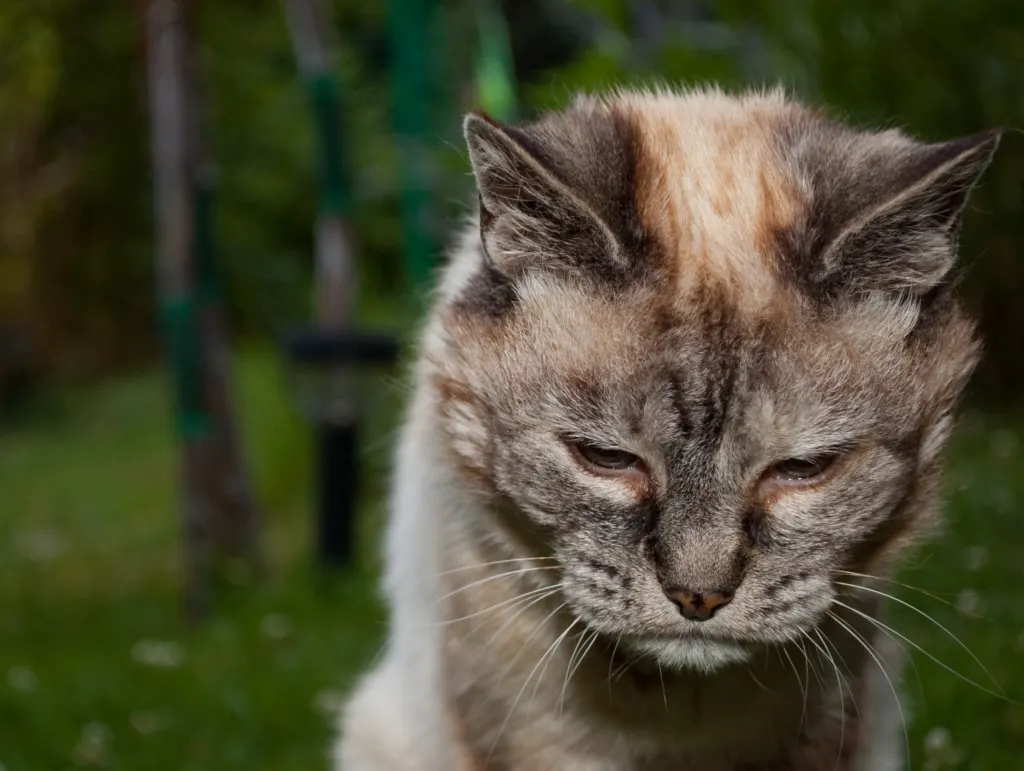
A contented house cat hums at roughly 25 beats a second, low enough that you often feel a purr through your hand before you hear it. And not every purr means the same thing: a cat angling for breakfast tends to slip a sharper, higher note into the rumble.
That second kind is called a solicitation purr. In one study, 50 listeners heard recordings of purrs made in two situations, played back at the same volume. They consistently rated the food-seeking purrs as less pleasant and more urgent than ordinary ones, and researchers have compared that high-pitched layer to the sound of a crying infant.
How a cat makes the sound
Nobody has fully pinned down the mechanism. An early idea held that the noise came from blood rushing through the chest. The leading explanation today, supported by recordings of muscle activity, is that the muscles of the larynx open and close the gap between the vocal folds in rapid bursts, setting the passing air vibrating.
Two details make the cat version unusual. First, a domestic cat purrs on the way in and on the way out, so the sound runs almost without a break. Foxes and some other animals that make purr-like noises manage it only while breathing out. Second, the rhythm may be driven by the brain itself: scientists have triggered purring by electrically stimulating one region of a cat’s brain, and a dedicated “neural oscillator” has been described.
House cat versus cheetah
Big size does not mean a deeper purr. When researchers compared a cheetah with a domestic cat, the numbers came out surprisingly close:
- Cheetah: about 20.9 vibrations per second breathing out, 18.3 breathing in.
- House cat: about 22.0 breathing out, 23.2 breathing in.
Put side by side, the house cat’s purr runs only about 5% faster than the cheetah’s on the out-breath and about 27% faster on the in-breath, even though a cheetah outweighs a typical pet cat many times over. In the cheetah the in-breath is the lower note, while the house cat flips that pattern.
Cheetahs can purr, but lions cannot, and that split runs through the whole cat family. No cat species both purrs and roars, a divide we explored in our story on which big cats can truly roar and why the snow leopard purrs instead.
What a purr is really for
Purring starts almost at birth. Kittens purr while nursing, and the sound may work as a quiet signal of reassurance between mother and litter. Adult cats carry the habit into life with people, purring when stroked, when relaxed or when eating, often while kneading with their front paws, as described in our explainer on why cats knead or “make biscuits”.
A purr is not proof of happiness, though. Cats also purr when stressed or hurt, and a mother cat in labor may purr through the early stage, apparently to calm herself. Some purring may tell another animal that the cat poses no threat.
The food-seeking version seems to show up most in cats living one-on-one with a single caretaker, the same close relationship in which cats learn other tricks for getting human help. Our report on cats meowing four times as often when a person was nearby shows how far that negotiation goes.
So the next time a purr at 6 a.m. sounds a little more insistent than the one on the sofa at night, your ears are probably right: the cat is using a frequency that humans find hard to ignore.
Further reading
Image: Dimitri “Diti” Torterat, CC BY 2.0 fr via Wikimedia Commons
This article was produced with AI assistance and reviewed by our Editorial Desk. How we work.