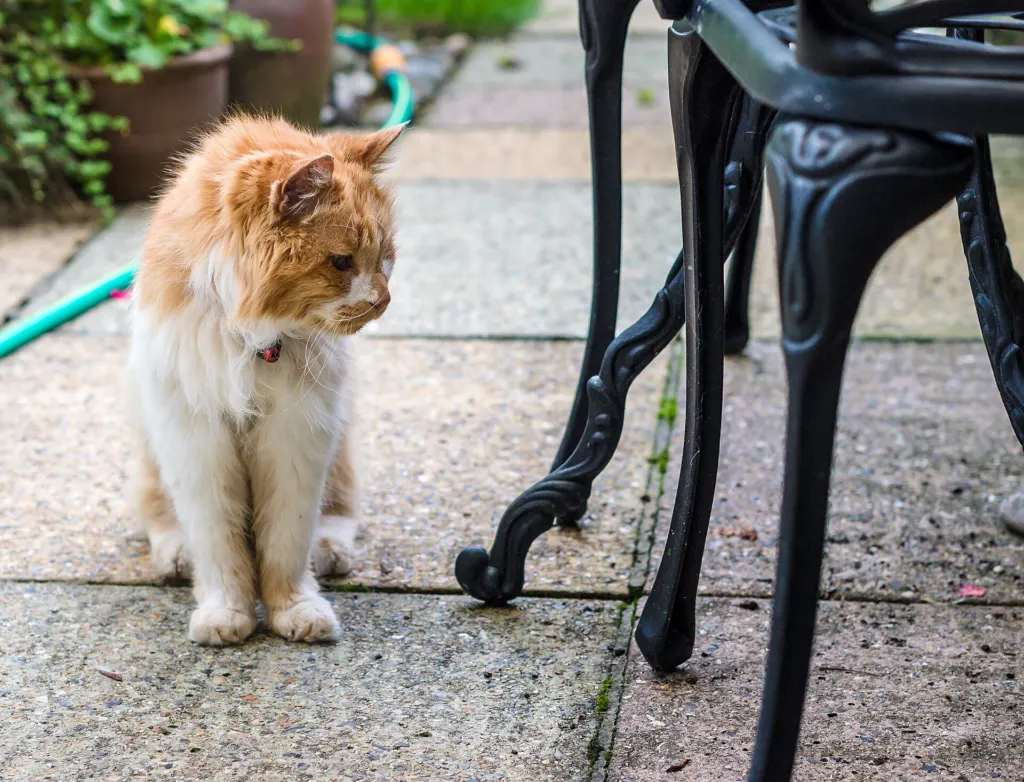
If your cat’s lick feels like sandpaper, that’s because its tongue is studded with roughly 290 tiny hooks, and each one is hollow. Engineers at the Georgia Institute of Technology found that these spines work like miniature scoops, wicking up saliva and pumping it straight down to the skin, where a flat tongue could never reach.
Not solid cones after all
The spines are called filiform papillae: sharp, backward-facing hooks made of keratin, the same protein in fingernails. For decades scientists assumed each one was a solid cone, based on a 1982 study. But when Alexis Noel and David Hu scanned cat tongues with micro-CT for their 2018 study in PNAS, they found a U-shaped cavity at the tip of every spine. They named the structures cavo papillae.
The team examined tongues from six species, donated after the animals died: domestic cat, bobcat, cougar, snow leopard, tiger and lion. Those cats span a 30-fold range in body weight, yet the spines were almost the same height in all of them, about 2.3 millimeters. The lion’s were the longest at 2.7 mm. When the researchers touched a drop of dye to a spine tip, the liquid shot into the cavity in about a tenth of a second.
A built-in saliva delivery system
Each spine holds only a tiny amount, about 0.014 microliters. Across all 290 on a house cat’s tongue, that adds up to roughly a tenth of an eyedropper drop, or around 5% of the fluid on the tongue’s surface. So why bother?
Depth. According to the full text of the paper on PubMed Central, saliva spread by the flat surface of the tongue soaks in only about half a millimeter. The spines dig deeper. When a shorthair cat presses its tongue down, its fur compresses from about 37 mm to 1.2 mm, close enough for the 2.3 mm spines to reach the skin and leave 290 tiny streaks of saliva along the hair roots with every lick.
Those grooming hooks are only one of five kinds of papillae on the top of a cat’s tongue, alongside fungiform, foliate, vallate and conical types, as Wikipedia’s cat anatomy article lists. All that grooming has a side effect too: swallowed fur can build up in the stomach and come back up as a hairball.
Long-haired Persians are the exception. Their fur compresses only to about 2.6 mm, taller than the spines, which is why the paper classed two Persian breeds as the only “ungroomable” cats among the 20 it compared.
Grooming is also air-conditioning
Cats sweat only through their paws, so they rely on other ways to dump heat. The study estimates that a house cat sleeps about 14 hours a day and spends roughly 24% of its waking time grooming, about 2.4 hours. At 1.4 licks a second, the spines alone can spread about 48 grams of saliva a day. As it evaporates, that saliva can supply up to 1.3 watts of cooling, nearly a quarter of the heat a resting cat needs to shed.
Badiyaa ran the numbers: 2.4 hours at 1.4 licks a second comes to about 12,000 licks a day, and 48 grams of saliva is a little over three tablespoons of water.
A brush inspired by a cat
The researchers 3D-printed spines into a flexible silicone pad, scaled up four times, to make what they call the TIGR brush, short for tongue-inspired grooming. In tests on fake fur it needed less than half the steady pulling force of an ordinary hairbrush and cleaned off with a single swipe. The authors have filed a provisional patent, the paper notes.
Want more cat science? Learn how cat whiskers sense the lightest touch in the dark and how pads in a cat’s vocal folds help it purr.
Sources
- Cats use hollow papillae to wick saliva into fur, Proceedings of the National Academy of Sciences (Georgia Institute of Technology), 2018
- Full text, PMC6298077, PubMed Central, US National Library of Medicine, 2018
- Cat anatomy, Wikipedia, 2026
Image: Takashi Hososhima, CC BY-SA 2.0 via Wikimedia Commons
This article was produced with AI assistance and reviewed by our Editorial Desk. How we work.