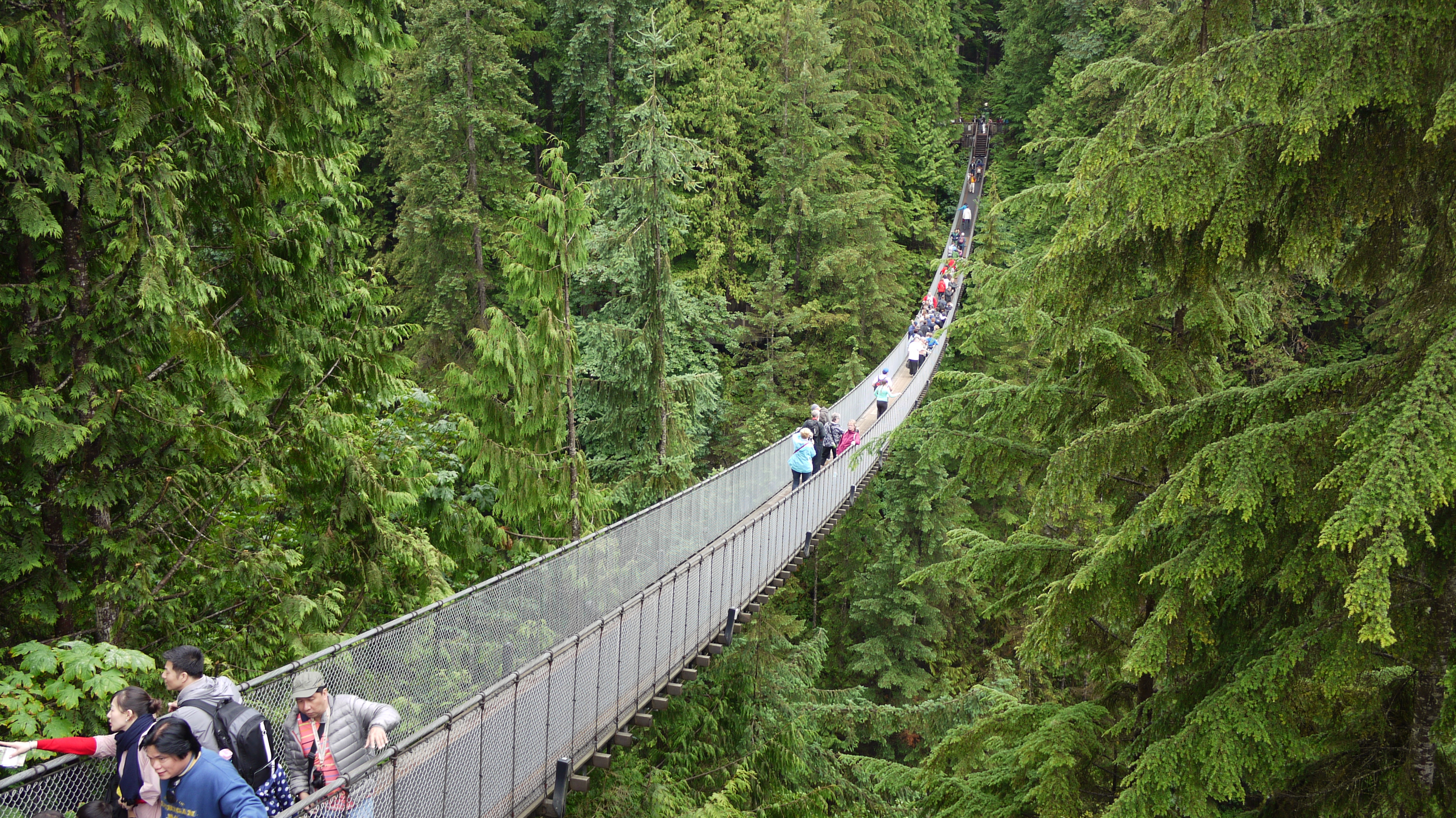
Men who met a woman in the middle of a swaying suspension bridge 70 meters above a Canadian river were more likely to phone her afterward than men who met her on a sturdy bridge. That 1974 experiment by Donald Dutton and Arthur Aron made the Capilano Suspension Bridge the most famous first-date spot in psychology.
Its lesson is a little unsettling: a racing heart from fear can be mistaken for a spark.
The setup on the Capilano
The Capilano Suspension Bridge crosses the Capilano River in North Vancouver, British Columbia. It runs 140 meters and hangs 70 meters above the water. The first version, built in 1889 by Scottish engineer George Grant Mackay, used hemp ropes and cedar planks; it got wire cables in 1903 and a full rebuild in 1956.
Dutton and Aron put an attractive female interviewer at the end of either the wobbly bridge or a solid one, as described in Wikipedia's account of the misattribution of arousal. Each man filled out a short questionnaire, including a story he wrote about an ambiguous picture. Afterward, she gave him her name and phone number in case he had any questions about her project.
The result
More of the men from the scary bridge called. When a male interviewer ran the same routine, the bridge made no real difference.
The researchers' reading, published in their paper in the Journal of Personality and Social Psychology, was that the men misread their own jitters. The pounding pulse and fast breathing came from the height and the sway, but with an attractive stranger right there, the brain filed them under attraction. It built on Stanley Schachter's two-factor theory of emotion, which holds that the body's arousal gets its label from the situation.
What later studies added
The effect did not need a canyon. In a 1981 study by White, Fishbein and Rutstein, men who had just exercised rated a video of an attractive woman as more attractive than men who had not. Arousal cut both ways, too: the same aroused men liked an unattractive version of her less.
A 1989 team led by Allen and Kenrick then challenged the "mistake" part. In their tests, aroused people were still more drawn to a target even when they knew the real cause was exercise, which suggests arousal may simply amplify whatever feeling is already there.
The fine print
The bridge study used a single female interviewer and male hikers, and it measured phone calls, not relationships. It is a vivid snapshot from the 1970s rather than a recipe. Still, it explains why scary movies, roller coasters and a brisk walk keep showing up on date-night lists.
Arthur Aron went on to design the famous closeness quiz in Badiyaa's story on Arthur Aron's 36 questions. For more on the body's role in romance, read how adrenaline creates butterflies in the stomach and why first-date spark tracks syncing heartbeats.
Sources
- "Some evidence for heightened sexual attraction under conditions of high anxiety", Journal of Personality and Social Psychology (American Psychological Association), 1974
- Misattribution of arousal, Wikipedia, 2026
- Capilano Suspension Bridge, Wikipedia, 2026
Image: Markus Säynevirta, CC BY-SA 4.0 via Wikimedia Commons
This article was produced with AI assistance and reviewed by our Editorial Desk. How we work.