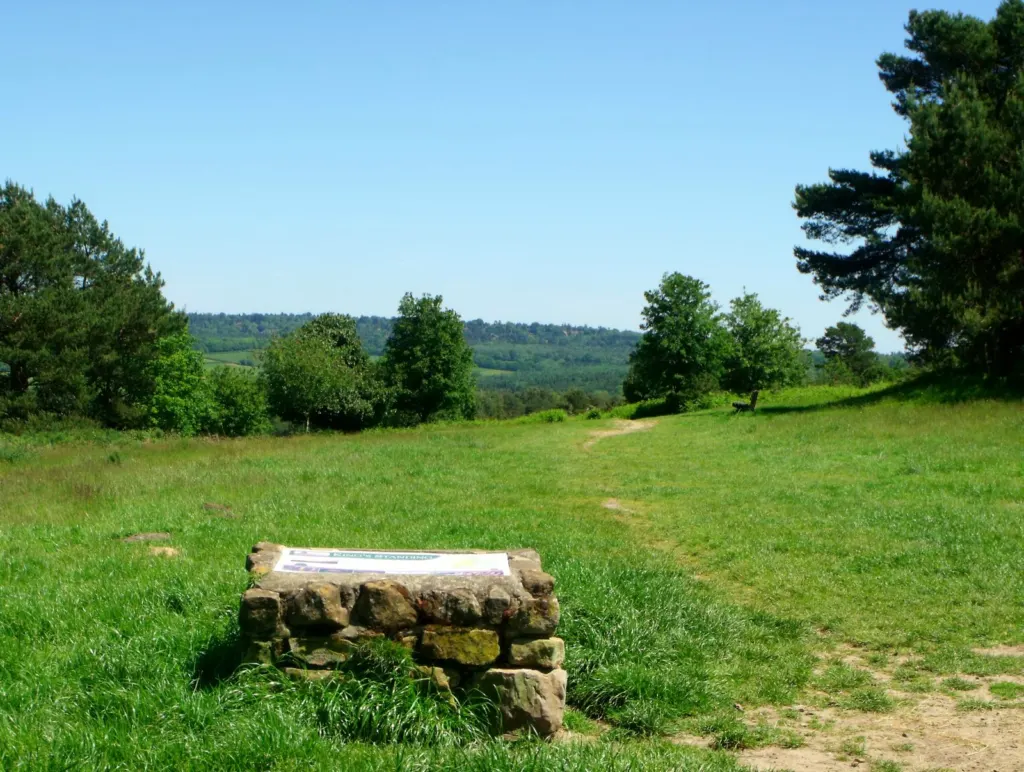
In the final weeks of World War II, German radio listeners heard official-sounding announcements telling them about forged banknotes and urging them to flee to “bomb-free zones.” None of it was true. The broadcasts came from Aspidistra, a 600-kilowatt British transmitter hidden in a bunker on Ashdown Forest in southeast England, which had slipped onto German frequencies the moment the real stations went quiet.
At times it was the most powerful broadcast transmitter on Earth. Its name was a joke: it came from the 1938 comic song “The Biggest Aspidistra in the World,” made famous by Gracie Fields.
How the 1945 hijacks worked
During Allied air raids, German stations in a target area switched off so bombers could not home in on them. But those stations were linked in networks, carrying the same program as stations that stayed on air elsewhere.
Aspidistra exploited the gap. The moment a targeted station fell silent, it started broadcasting on that frequency, first relaying the genuine German network program so listeners noticed nothing. Then its operators slipped in their own false bulletins.
- March 25, 1945: the first intrusion.
- March 30: broadcasts on the Berlin and Hamburg frequencies warn of fake telephone messages.
- April 8: Hamburg and Leipzig listeners hear warnings about forged banknotes.
- April 9: announcements urge people to evacuate to seven bomb-free zones.
German radio fought back, telling listeners: “The enemy is broadcasting counterfeit instructions on our frequencies. Do not be misled by them.” Aspidistra simply aired near-identical warnings of its own, leaving audiences unable to tell which voice to trust.
In modern security terms, the 1945 hijacks were a man-in-the-middle attack carried out with vacuum tubes: sit invisibly between a trusted sender and its audience, pass along the real traffic, then alter it at the moment it matters. Badiyaa has covered other wartime communication tricks, including the Navajo Code Talkers’ unbroken World War II code and Josephine Baker’s invisible-ink notes for the French Resistance.
The trick that made it special
Most medium-wave transmitters of the era sat on one frequency for their whole working lives. Aspidistra could be retuned quickly, and that one ability shaped its secret war.
The UK’s Political Warfare Executive used it for black propaganda, material dressed up to look as if it came from the enemy. Under Sefton Delmer, it carried Soldatensender Calais and Atlantiksender, stations posing as official German military radio. From 1943 it also helped RAF operators impersonate German ground controllers, feeding night fighter pilots false orders during the bombing campaign against Berlin.
An American giant nobody in America could use
Aspidistra was not British-built. RCA had made it as a 500-kilowatt transmitter for WJZ radio in Newark, New Jersey. Then the Federal Communications Commission capped US stations at 50 kilowatts, leaving RCA with a machine it could not legally switch on at full strength. An MI6 front operating in New York, British Security Co-ordination, paid £111,801 for it.
Engineers installed it near Crowborough, East Sussex, at a site about 640 feet above sea level. A Canadian army construction unit dug the underground hall, three masts 360 feet tall aimed the signal east toward Europe, and two big diesel engines supplied the power because the local grid could not. It went on air on November 8, 1942, eventually running at 600 kilowatts.
That figure is 12 times the 50-kilowatt ceiling that had made the transmitter surplus in the US in the first place.
Forty years on air
After 1945 the transmitter carried BBC broadcasts to Europe for decades, though the Foreign Office still ran the site. It made its last transmission on 648 kHz on September 28, 1982. The engineer who pressed the off key, Harold Robin, was the same man who had bought it in the US and set up the station 40 years earlier.
The transmitter was dismantled in 1984 and scrapped. A tuning coil and some valves survive on display at the Orfordness transmitting station in Suffolk, and in 2007 one of the Crowborough buildings, nicknamed “the cinema” for its Art Deco look, was listed as a protected Grade II structure.
Further reading
Image: nick macneill, CC BY-SA 2.0 via Wikimedia Commons
This article was produced with AI assistance and reviewed by our Editorial Desk. How we work.