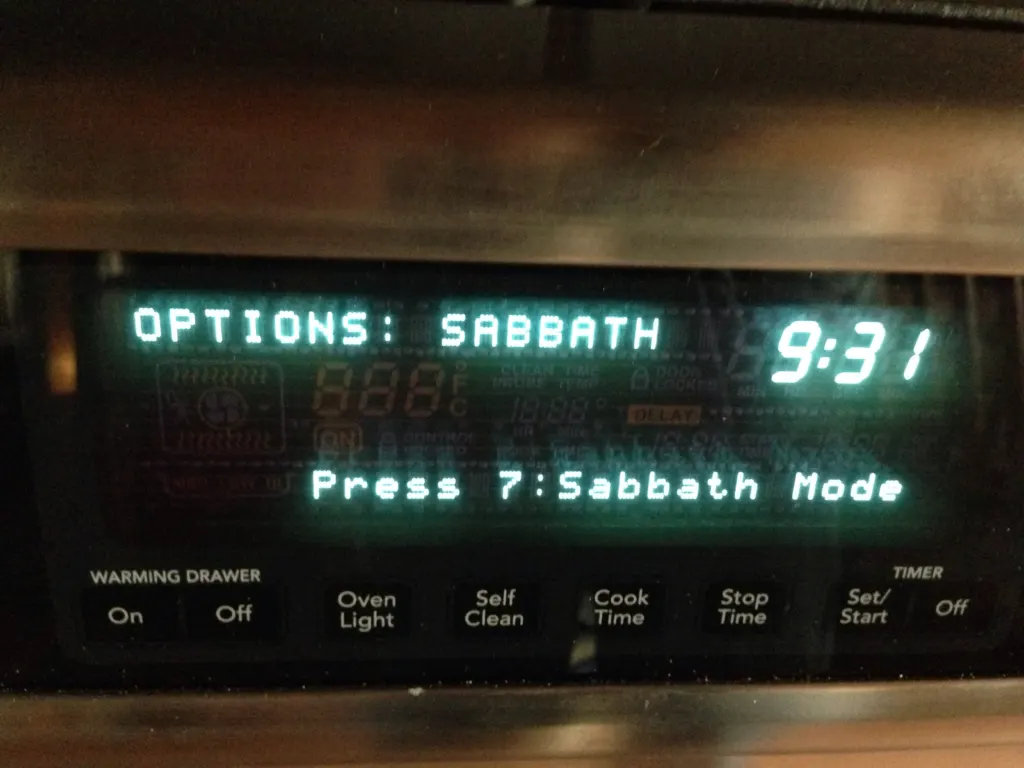
That mysterious “Sabbath” button on your fridge or oven is not a glitch or a hidden energy saver. Sabbath mode is a religious accessibility setting: it stops an appliance from reacting to the person using it, so that Jews who observe Shabbat can keep food cold or warm from Friday evening to Saturday night without breaking the rules of the day.
Most owners never press it. But for observant households it can decide whether a modern kitchen is usable at all for one day a week and on major holidays.
The problem it solves
Jewish law, or halakha, forbids certain kinds of creative work on Shabbat. Many observant Jews read that to include lighting a fire, cooking, and even closing an electrical circuit, which covers flicking a switch or pressing a button.
Older appliances were simple enough to work around. Families left a pot warming on a covered stovetop, or kept an oven on from before sunset until the day ended. Modern machines made that harder. A fridge light snaps on when the door opens. A digital oven beeps, lights its display and, for safety, shuts itself off after a set number of hours.
A Whirlpool patent filed on October 31, 1996, set out the headache in plain terms. Its authors noted that many observant users were unscrewing the interior lights of their appliances before the Sabbath and putting them back afterward, and they called the existing workarounds “very inconvenient.” The patent, US 5,808,278, was granted on September 15, 1998.
What Sabbath mode actually changes
There is no single standard, and features vary by maker and model. The common changes look like this:
- Lights stay put. Opening the door no longer switches on the interior bulb.
- Displays and alarms go quiet. No beeps, no changing numbers, no door-ajar warnings.
- The automatic shutoff is overridden. Ovens normally cut out after six or twelve hours; in Sabbath mode they can hold heat for much longer.
- Actions are disconnected from results. Some fridges put the compressor on a timer, so opening the door does not directly make it start. Some ovens add a random delay before a temperature change takes effect.
The Whirlpool patent describes the core idea simply: every indicator that would break the custom is fixed in a state that does not, so the user can carry on without worrying about it.
Why ovens are the hard case
Ovens raise the trickiest questions. On Shabbat itself, raw food may not be cooked, but food cooked beforehand may be kept warm. On festival days, known as Yom Tov, cooking is allowed but turning the heat on is not, and a festival can run into a Shabbat, so a household may need an oven running continuously for as long as 72 hours. A routine 12-hour shutoff would end that after a sixth of the time.
That is where rabbinic opinions split. In June 2008, nine Haredi rabbinic authorities signed a public statement saying it was forbidden on festival days to raise or lower the oven temperature by reprogramming a certified Sabbath mode. Rabbi Moshe Heinemann of the Star-K kosher certification agency, whose view they rejected without naming him, said he still stood by his opinion that it was allowed.
Related ideas beyond the kitchen
The same thinking produced the Shabbat elevator, which stops at every floor automatically so riders never press a button (Israel’s parliament passed a law in 2001 requiring one such elevator in new buildings with more than one), and the Shabbat lamp, which uses a movable cover to block or reveal light while the bulb stays on. By 1989, the Institute for Science and Halacha in Jerusalem had already built timers for household lighting, heating and hot water.
If you like everyday rules that hide in plain sight, read our explainer on why US sweepstakes must say “no purchase necessary”, or browse more gadget and software guides on the Badiyaa Tech page.
To check whether your own appliance has the feature, look in the manual for “Sabbath,” “Shabbos” or “Shabbat” mode, since the name and the way to switch it on differ from one manufacturer to the next.
Further reading
Image: RyanIsHungry, CC BY 2.0 via Wikimedia Commons
This article was produced with AI assistance and reviewed by our Editorial Desk. How we work.