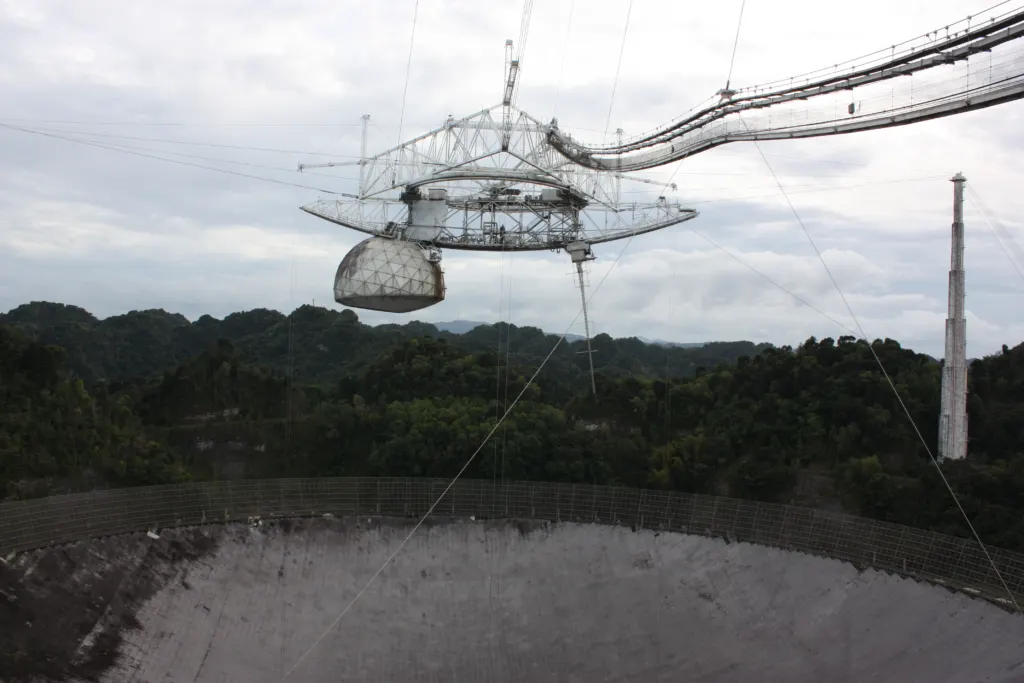
Fifty-two years ago today, on November 16, 1974, the Arecibo radio telescope in Puerto Rico beamed a picture of humanity toward the stars. The whole message was 1,679 ones and zeros, sent once, in under three minutes, toward the globular cluster Messier 13 about 25,000 light-years away.
It went out at a ceremony marking the remodeling of the giant dish. The broadcast used a frequency of 2,380 MHz at 450 kilowatts of power, shifting the frequency by 10 Hz to mark each bit, at a pace of 10 bits per second.
Who wrote it and why 1,679
A group of Cornell University and Arecibo scientists designed it: Frank Drake, the astronomer behind the Drake equation, worked with Richard Isaacman, Linda M. French and James C. G. Walker, and Carl Sagan chipped in too. The goal was to show off what the upgraded telescope could do, not to start a real conversation.
The length was a clever clue. 1,679 is the product of two prime numbers, 73 and 23. A careful receiver could arrange the bits in only two rectangles. Laid out as 73 rows of 23 columns, the bits form a picture. The other way around, they look like noise.
What the picture shows
Read from top to bottom, the image has seven parts:
- The numbers one through ten in binary.
- The atomic numbers of hydrogen, carbon, nitrogen, oxygen and phosphorus, the elements in DNA.
- Formulas for the sugars, phosphates and bases that make up DNA’s building blocks.
- A sketch of the double helix and a count of DNA base pairs in the human genome.
- A stick figure of a person, with an average height and Earth’s population, then about 4 billion.
- The solar system, with Earth nudged up toward the human figure to show where the signal came from.
- The Arecibo dish itself and its width.
Some of it has aged. The message counts about 4.3 billion base pairs in the human genome; the real figure is closer to 3.2 billion. It also shows Pluto as a planet, a status it lost in 2006.
How far it has gone
Doing the math puts the gesture in perspective. At 10 bits per second, the 1,679 bits took about 168 seconds to send, just under three minutes. In the 52 years since, the message has traveled 52 light-years. That is about 0.2% of the way to M13. It needs roughly 24,948 more years to arrive, and by then the cluster will have shifted slightly along its orbit around the galaxy, though the signal should still land near its center.
A copycat in a wheat field
In August 2001 a crop formation appeared beside the Chilbolton radio telescope in Hampshire, England, mimicking the Arecibo grid with altered DNA, a large-headed figure and silicon added to the elements. The SETI Institute called an off-world origin “highly improbable.”
Radio signals across the solar system run on the same slow clock. Our story on Voyager 1 reaching one light-day from Earth shows how long a reply takes even from our farthest probe, and a white dwarf that pulses radio every 8 minutes shows what radio astronomers now pick up coming the other way.
Further reading
Image: RealtimeAI, CC BY-SA 4.0 via Wikimedia Commons
This article was produced with AI assistance and reviewed by our Editorial Desk. How we work.