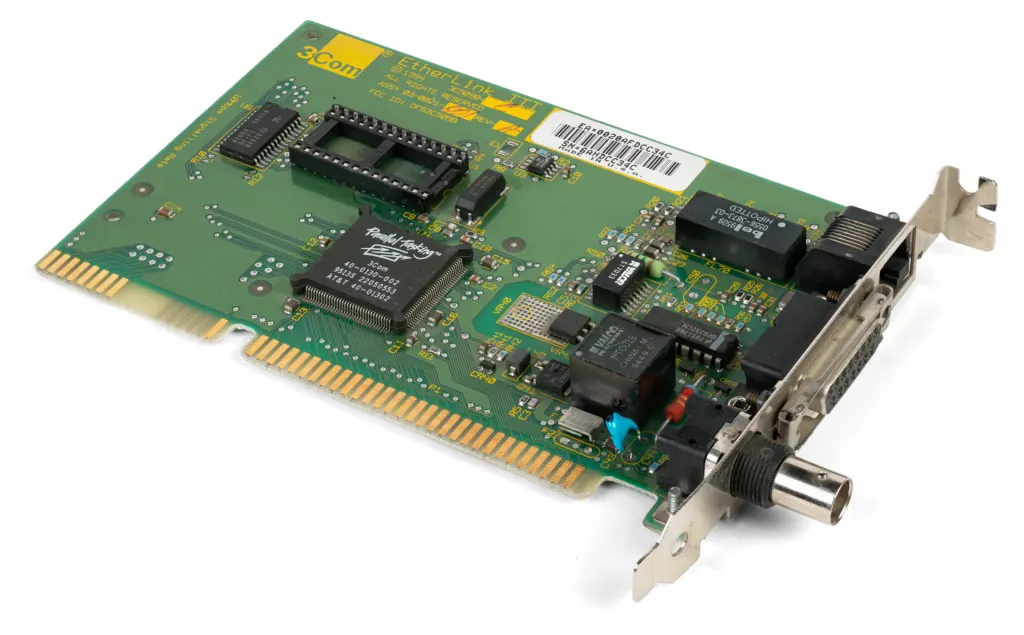
3Com once paid San Francisco $900,000 a year to put its name on Candlestick Park. Fifteen years later the networking company that helped wire the world’s offices was sold to Hewlett-Packard for $2.7 billion, and by 2010 the brand was gone.
The rise and fall took three decades, and it began with a man who was tired of waiting for his employer.
From Xerox to a Palo Alto apartment
Robert Metcalfe co-invented Ethernet at Xerox PARC in the early 1970s with David Boggs. Early 3 Mbit/s versions were running by 1973, but Xerox management showed little interest in selling it. Metcalfe walked out in 1979 and co-founded 3Com, working out of his Palo Alto apartment, with his college friend Howard Charney and two others. He said the name was short for “Computer Communication Compatibility.”
The timing was perfect. Offices were filling with personal computers that could not talk to each other, and 3Com sold the cards that let them. Its Ethernet adapters went into DEC machines, Sun workstations and the IBM PC. Bill Krause arrived as president in 1981, took the CEO job a year later and ran the company until 1992. 3Com went public in 1984, and by the mid-1990s it ruled the market for network interface cards. Metcalfe himself was not there to see it: in 1990 the board picked Éric Benhamou as CEO instead of him, and he left.
A timeline of the long slide
- 1997: 3Com merged with USRobotics, the modem maker that also owned Palm, the handheld computer company. Modems were about to be overtaken by broadband.
- 2000: In March it quit the high-end router and switch market, handing customers to rivals. In June it bought internet radio startup Kerbango for $80 million and launched the Audrey kitchen web appliance; both were dropped within a year. In July it spun off Palm.
- 2001–2003: Its core card business shrank fast as new computers shipped with networking built in. Staff fell from more than 12,000 to under 2,000, and headquarters moved from Santa Clara to Marlborough, Massachusetts.
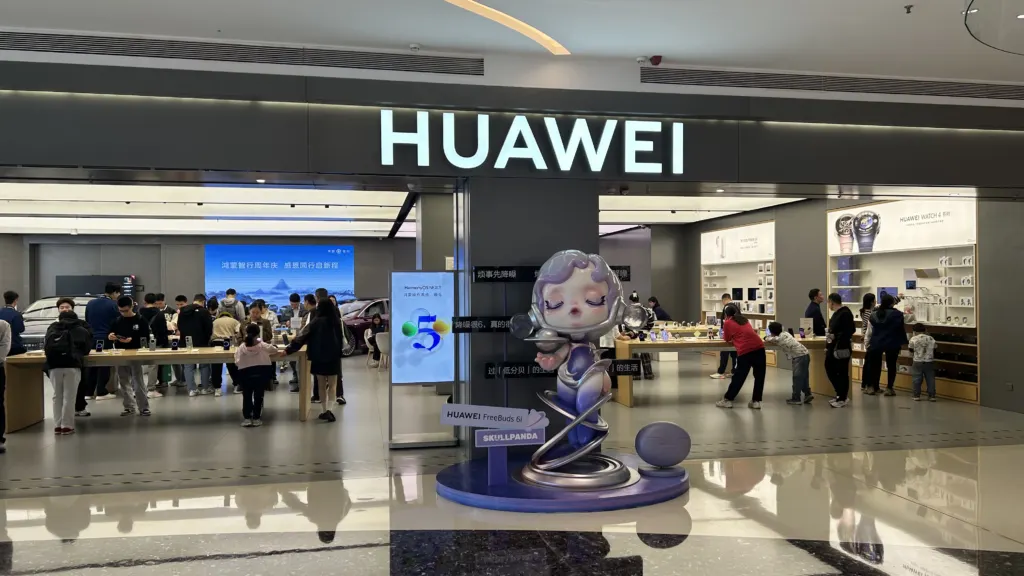
- 2003–2007: A joint venture with Huawei, called H3C, gave 3Com a big presence in China. 3Com bought out Huawei’s 49% stake for $882 million in 2007.
- 2007–2008: A $2.2 billion buyout by Bain Capital, with Huawei as a minority investor, collapsed after US government security objections.
- 2009–2010: HP announced the $2.7 billion cash deal on November 11, 2009, and completed it on April 12, 2010.
The Palm problem
The oddest moment came in 2000. After Palm’s stock market debut, 3Com still held 80% of it, yet the parent company’s market value was smaller than Palm’s alone. Put plainly, investors valued 3Com’s own networking business at less than nothing. It is one of the clearest snapshots of how the dot-com boom scrambled the numbers.
The deeper problem was that 3Com’s best product became a feature. Once Ethernet moved onto the motherboard, nobody needed to buy a separate card, and 3Com had already stepped back from the big corporate routers and switches where rivals were making money.
Where 3Com lives on
HP folded 3Com into its networking arm. When HP split in 2015, that unit went to Hewlett Packard Enterprise and was merged into Aruba Networks. Ethernet, Metcalfe’s original idea, outlived the company entirely and still connects most wired networks today, and it earned Metcalfe the Turing Award, presented in 2023.
For more on the hardware world 3Com helped build, read about Huawei’s all-Chinese Qingyun HM650 desktop and IBM’s plan to link two Nighthawk quantum chips. The full company history is on the 3Com Wikipedia page.
3Com lasted 31 years, from its 1979 founding to the April 2010 HP closing.
Further reading
Image: Dmitry Nosachev, CC BY-SA 4.0 via Wikimedia Commons
This article was produced with AI assistance and reviewed by our Editorial Desk. How we work.