The skeleton inside Westminster Abbey's Roman stone coffin most likely belongs to Aelfwig, an abbot of Westminster who died around 1020, according to a new study by the abbey's consultant archaeologist, Warwick Rodwell. His successor Wulnoth, who died in 1049, is the other candidate.
Rodwell set out the case in "Westminster Abbey's Roman Sarcophagus and its Afterlife," a paper in the Journal of the British Archaeological Association. The limestone coffin carries an inscription to Valerius Amandinus, a wealthy Briton who lived in London between about 300 and 400 AD. But a large Latin cross carved on its lid dates to roughly the 10th or 11th century, a sign the man inside was buried long after the Roman owner.
Two abbots, one coffin
"We have two viable contenders for the occupant of the sarcophagus," Rodwell said in the journal publisher's release on the study. Neither man's birth date is known, he added, but either fits if he became abbot in his early twenties and died close to 50. "The fact Aelfwig was already a monk of Westminster might favour him."
The bones point to someone important. The dead man was given a fine stone coffin, his wooden coffin was set inside it, and the lid was recut with the cross. Rodwell reads that as an early case of recycling a valuable object.
What the bones and the carbon say
A fresh study of the skeleton by James Young Langthorne of Pre-Construct Archaeology put the man at 35 to 49 years old and about 5 feet 9 inches tall. A 19th-century look had called him a robust young man of no more than 30, around 5 feet 7.
A bone sample went to the Scottish Universities Environmental Research Centre at the University of Glasgow, which returned a radiocarbon date of 987 to 1052 AD. Both abbots died inside that window. "This confirms that the reuse of the sarcophagus, and the associated remodelling of its cover, occurred in the late Saxon period," Rodwell said.
How does a lab date a bone? Living things take in carbon-14, and once they die it decays with a half-life of about 5,730 years, as Wikipedia's radiocarbon dating entry explains. By our calculation, a bone about 1,000 years old has lost roughly 11% of its original carbon-14, enough for a lab to measure.
A coffin already centuries old
The Roman sarcophagus was antique when the abbot went into it. If it was made between 300 and 400 AD and reused between 987 and 1052, it was somewhere between about 590 and 750 years old on the day of the burial. The monastery itself was young: Westminster Abbey's history traces a Benedictine community on the site to about 959, so Aelfwig's death came only about six decades after it began.
A 200-year timeline
- 1820: Workmen dig up the coffin by accident on the north side of the abbey and break its lid into six pieces.
- 1869: The sarcophagus is formally "discovered" and the lid repaired.
- 2009: A television archaeology team examines Henry III's original sacristy, where it was found.
- 2016: Researchers lift the lid at a conservation studio and find an almost complete skeleton that was thought lost, plus a white lime outline of a long-gone timber coffin.
- 2025: Pre-Construct Archaeology completes a new dig for the King Charles III Sacristy.
- 2026: Rodwell publishes his identification, 157 years after the formal discovery.
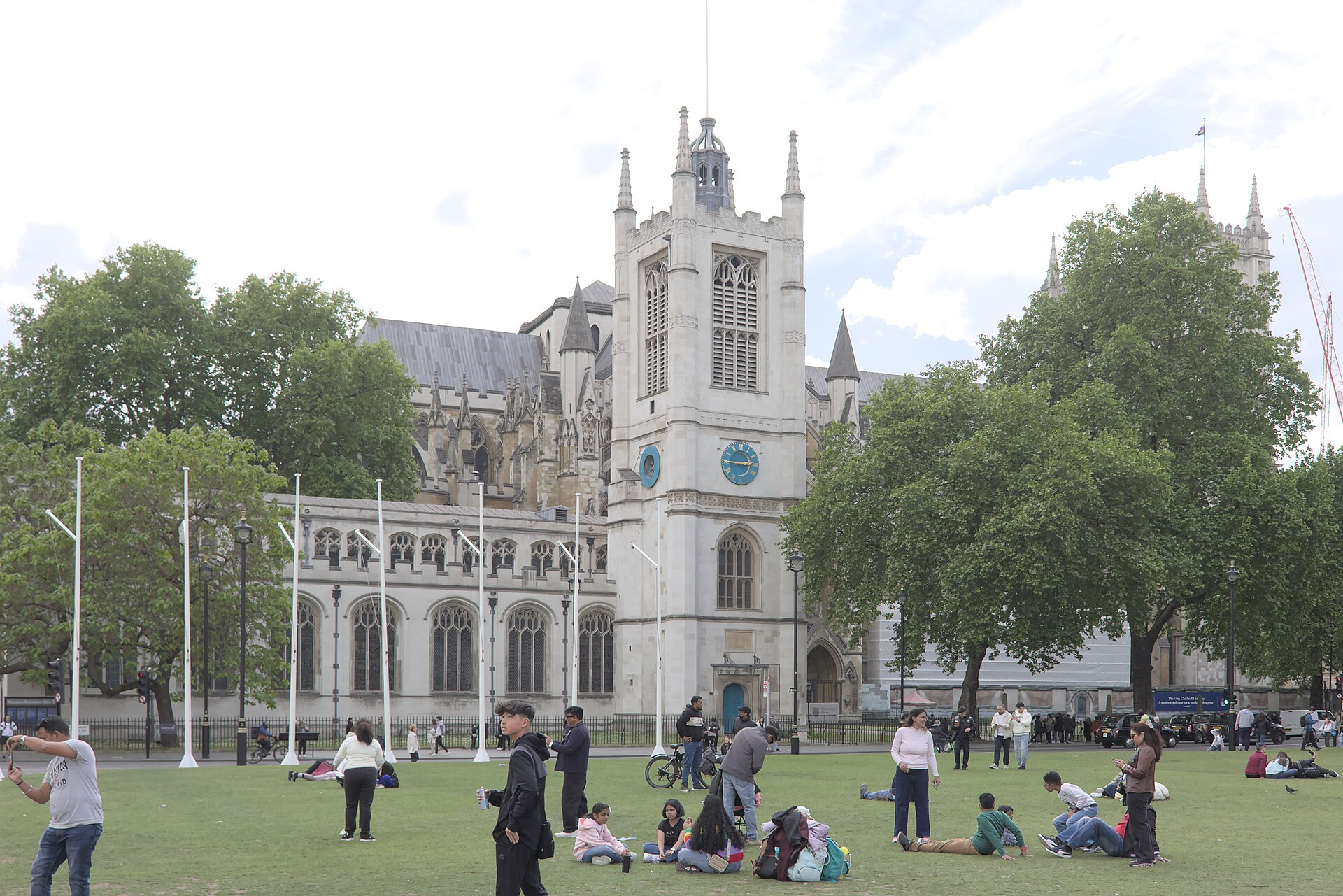
The coffin is on display in the Queen's Diamond Jubilee Galleries at the abbey, the church where Princess Elizabeth married Philip Mountbatten in 1947. For more on the abbey's royal past, see our look at Elizabeth I's accession in 1558.
Sources
- Westminster Abbey's Roman Sarcophagus and its Afterlife, Journal of the British Archaeological Association, Warwick Rodwell, Westminster Abbey, 2026
- Press release on the Westminster Abbey sarcophagus study, Taylor and Francis, publisher of the journal, 2026
- Scottish Universities Environmental Research Centre (SUERC), University of Glasgow, 2026
- Radiocarbon dating, Wikipedia, 2026
- Westminster Abbey, Wikipedia, 2026
Image: Aethonatic, CC0 via Wikimedia Commons
This article was produced with AI assistance and reviewed by our Editorial Desk. How we work.