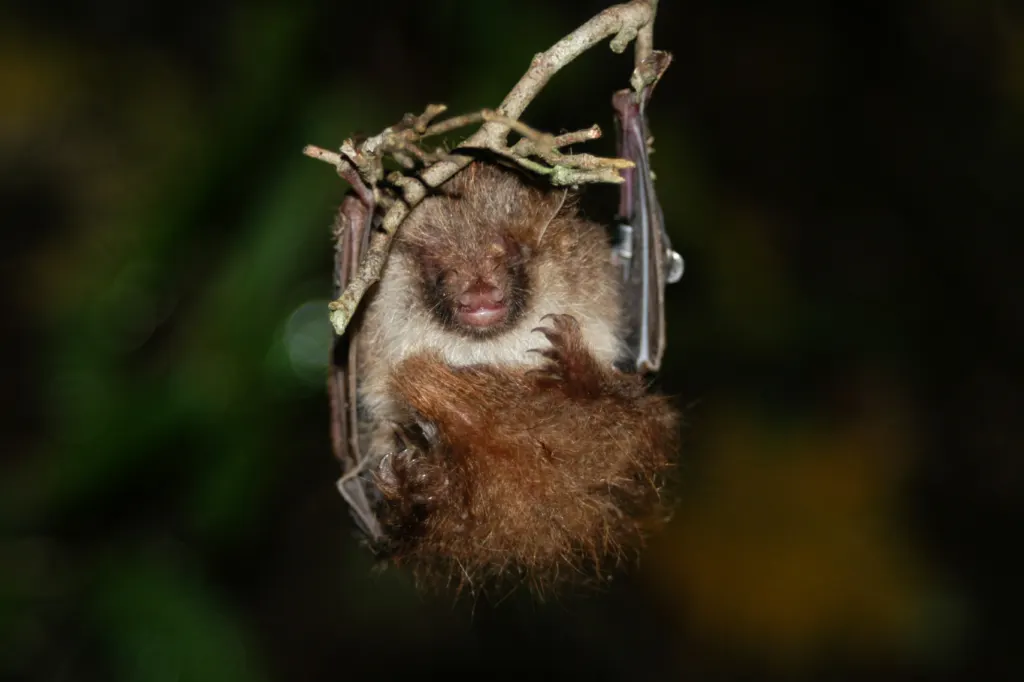
The Ussuri tube-nosed bat, a furry insect-eater that weighs 4 to 8 grams, spends at least part of the winter buried in snow. It is the only bat known to hibernate this way, and only the second mammal of any kind, after the polar bear.
The finding comes from Japan, where two forest researchers spent years chasing reports of tiny, lethargic bats turning up in melting snowbanks. Their evidence was published in 2018 in Scientific Reports, and the bat’s odd winter bed has been trending again as a “today I learned” fact.
How the snow bats were found
In 2005, Hirofumi Hirakawa of the Forestry and Forest Products Research Institute in Sapporo and his colleague began collecting stories. Hikers and foresters had picked up what looked like small brown balls on spring snow, only to find they were bats. He tracked down the original witnesses and logged 22 accounts from heavy-snow regions of Hokkaido and Honshu, the earliest from Sapporo in 1964.
From 2013, Hirakawa and Yu Nagasaka of the Hokkaido Research Organization went looking themselves. Over more than 300 hours of searching across 156 days near Sapporo, they found 37 bats. That works out to roughly one bat for every 8 hours of fieldwork (300 divided by 37), a measure of how well hidden these animals are.
Almost every bat sat curled into a ball, head tucked under its tail membrane, in a neat cylindrical hole up to 6 or 7 centimeters deep. Of 23 bats the team watched after dark, 22 warmed up and flew off within 94 minutes of sunset.
Did they sink in, or sleep there all winter
The obvious objection is that the bats might simply land on spring snow and melt their way down. The researchers ran the numbers. To melt a 6-centimeter hole, a bat would need to keep its body at 37 degrees Celsius for at least 6.4 hours and burn body fat equal to 5 to 7 percent of its weight. A torpid bat, chilled well below that, is unlikely to do so.
The clinching detail came later. On 9 December 2017, Nagasaka uncovered one of the bats under snow and covered it back up. On 15 April 2018 he watched a bat fly out of that exact spot, about four months later.
Why a snowbank works as a bedroom
The authors list three likely advantages:
- Moisture: a small snow cavity stays saturated, so the bat loses little water while it sleeps.
- Safety: predators rarely dig through snow for prey they cannot see.
- Steady cold: near the ground, deep snow holds close to 0 degrees Celsius, while tree hollows swing above and below freezing.
The team suspects the bats can supercool, letting body temperature drop below freezing without turning to ice, a trick known from some North American tree bats in lab tests. That idea has not yet been tested in this species.
Where the bat lives the rest of the year
From spring to autumn the bat roosts in clumps of dead leaves, tree hollows and peeling bark. Females gather in maternity colonies of 2 to 22 animals from June to August, and the rest of the year each bat lives alone. Its range covers Japan, the Korean Peninsula, Russia’s Primorye region, southern Sakhalin and the Kuril Islands.
It is a short-lived bat, with recorded maximum ages of 4 years for males and 4.5 for females, which means a single snowy winter can fill a meaningful slice of its life.
Other small animals have their own winter tricks, from woolly bear caterpillars that survive being frozen to Britain’s hazel dormice, whose winter death rate fell to 31%.
Snow hibernation may not be unique for long. The researchers note that a hiker’s dog pulled a torpid hoary bat out of snow in Arizona’s Santa Catalina Mountains on 27 December 2008.
Further reading
Image: Pxc06142, CC BY-SA 4.0 via Wikimedia Commons
This article was produced with AI assistance and reviewed by our Editorial Desk. How we work.