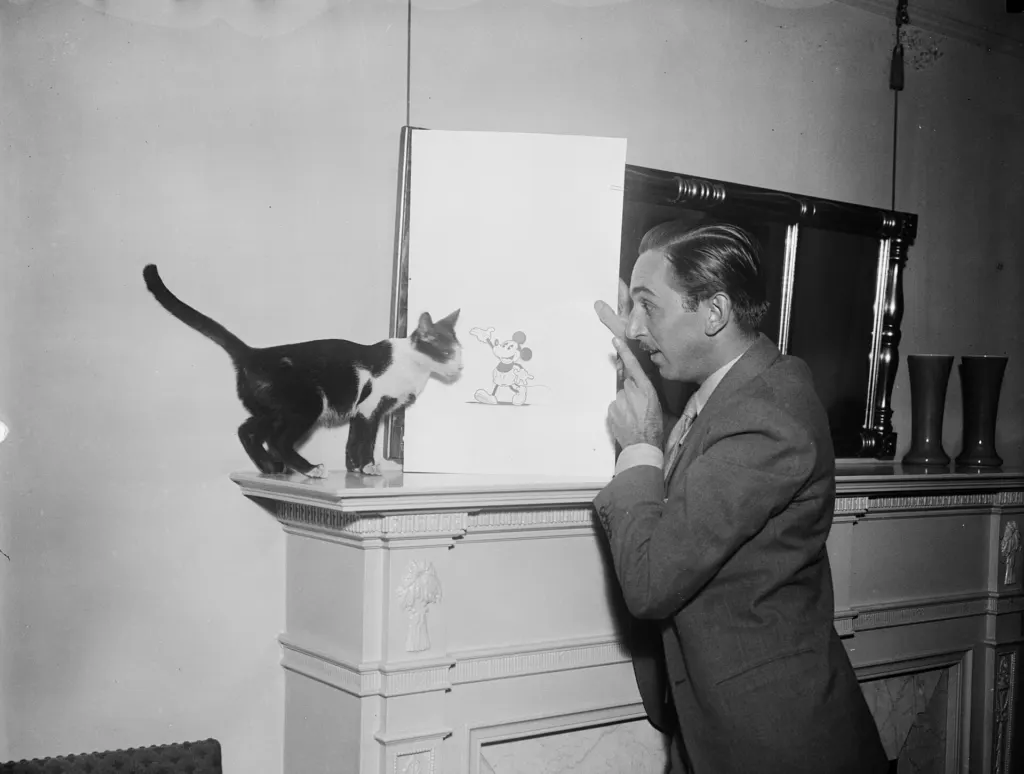
Walt Disney sold his car to pay for the soundtrack that made Mickey Mouse famous. The first attempt to sync music to Steamboat Willie, on September 15, 1928, was a disaster, so Disney sold his Moon roadster to fund a second session. Two months later, on November 18, 1928, the cartoon premiered at Universal’s Colony Theater in New York, and next Wednesday marks 98 years since that opening.
A cartoon made for less than $5,000
According to Roy O. Disney’s own notes, Steamboat Willie cost $4,986.69 to make, prints included. That is roughly $94,000 in 2025 money for a seven-minute, 47-second short that launched one of the most valuable characters in entertainment.
Mickey was not new. He had already appeared in two silent shorts, Plane Crazy and The Gallopin’ Gaucho, but neither found a distributor. After seeing The Jazz Singer, Disney became convinced that synchronized sound was the future, and the third Mickey film became the first one released.
Pots, pans and a bedsheet
Before committing, the team tested whether a sound cartoon would convince anyone. On July 29, 1928, with the film only partly finished, they ran it for staff and their wives in a room next to Walt’s office:
- Roy projected it from outside, through a window, to hide the projector noise.
- Ub Iwerks hung a bedsheet as a screen, with a microphone behind it feeding speakers in the room.
- Wilfred Jackson played the music on a harmonica, Iwerks banged pots and pans, and Johnny Cannon made effects with slide whistles and spittoons.
- Walt supplied the grunts, laughs and squawks.
Disney later called the effect on that small audience “nothing less than electric.” The final score was recorded in New York with the Green Brothers Novelty Band, conducted by Carl Edouarde, and a filmed bouncing ball kept the musicians on tempo.
Not the first sound cartoon
A popular myth says Steamboat Willie was the first cartoon with sound. It was not. The Fleischer brothers made 19 sound cartoons between 1924 and 1926, and Paul Terry’s Dinner Time came out a month before Mickey’s debut. What Disney did differently was use a click track to keep sound and picture locked together, and to build the soundtrack entirely after filming.
The opening run, by the numbers
The Colony played the short five times a day for two weeks, ahead of a feature called Gang War, which is now a lost film. Disney earned $500 a week. Here is the simple math: 5 shows a day for 14 days is 70 screenings, and two weeks at $500 brought in $1,000, about one-fifth of what the cartoon cost to make. The real return came from what followed, as Mickey became an international star.
The short was added to the Library of Congress’s National Film Registry in 1998, and after copyright extensions pushed its protection for decades, it entered the US public domain on January 1, 2024, more than 95 years after release. Disney still uses a clip of Mickey whistling at the wheel in the Walt Disney Animation Studios logo.
Anniversaries of screen classics are a regular stop at Badiyaa; read about Harry Potter and the Philosopher’s Stone turning 25 and how Sesame Street survived three near-collapses.
The 98th anniversary of the Colony Theater premiere falls on Wednesday, November 18, 2026.
Further reading
Image: Harris & Ewing, Public domain via Wikimedia Commons
This article was produced with AI assistance and reviewed by our Editorial Desk. How we work.