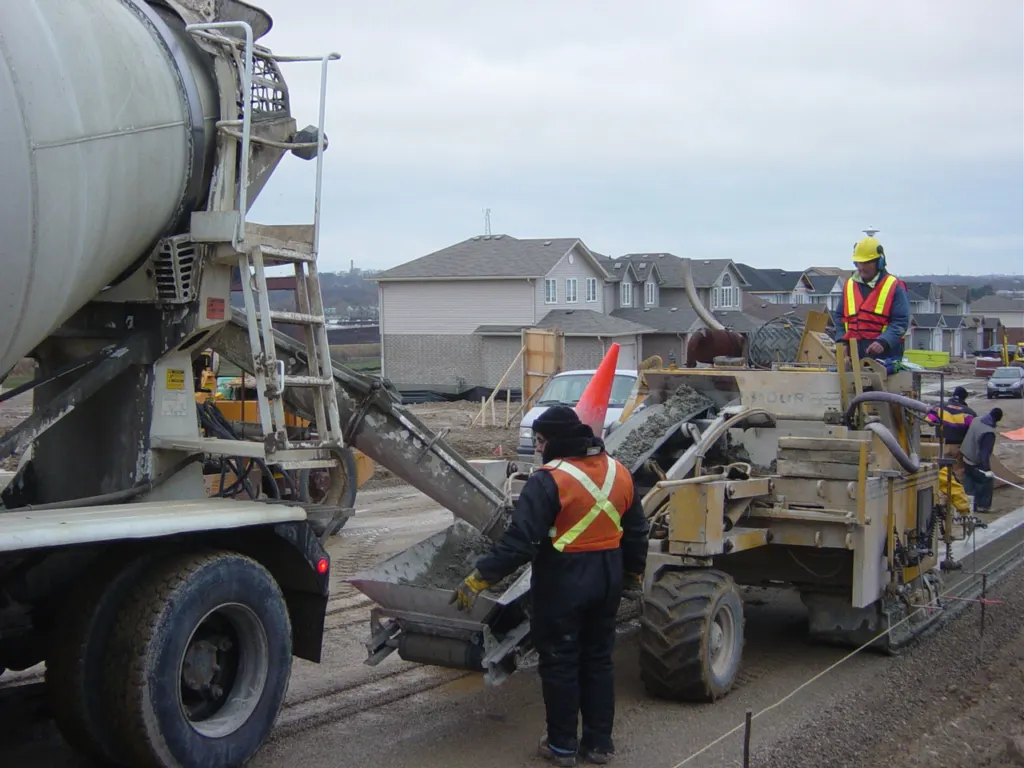
No wooden boards, no hand-set molds, no seams. A slipform curb machine squeezes wet concrete out of a shaped steel mold as it creeps forward, leaving behind a finished curb that holds its shape the moment it emerges. Clips of the process, with a perfectly uniform curb unspooling behind the machine like toothpaste, keep drawing viewers who cannot believe the concrete does not slump.
It does not slump, thanks to careful chemistry and timing.
What slipforming is
Slip forming, also called continuous pouring or slipform construction, is a way of placing concrete into a form that keeps moving. On roads and curbs the form travels horizontally along the ground. On towers, silos and building cores it is jacked upward in small steps.
In the horizontal version used for pavements, curbs and traffic barriers, the the machine drops the concrete, shakes it to drive out air, shapes it and lets it settle, all while the mold keeps inching forward. The ground carries the weight of the concrete, the mold and the machine.
The balancing act inside the mold
Everything depends on the mix. The concrete has to be workable enough to flow into the mold and be compacted by vibration. It also has to stiffen fast enough that, when it slides out of the back of the form, it can stand on its own.
That fresh concrete has three jobs at once. It must let the mold glide past without being torn, carry the pressure of the newer concrete pushed in behind it, and resist collapsing under the shaking of the compaction gear. Get the mix too wet and the curb sags; too dry and it cracks or will not fill the mold.
The payoff is a continuous structure with no cold joints or seams, the weak lines that appear where separate batches of concrete meet.
How the machine stays on line
The Federal Highway Administration describes slipform pavers as machines that extrude concrete, which means the material has to be made fluid enough while it is being forced through the mold, which crews call the pan. Keeping the extrusion pressure steady is what gives the curb its identical profile from one end to the other.
Steering is low-tech by comparison. Most crews still guide slipform pavers with physical string lines staked beside the route, and a sensor on the machine follows the string. Stringless control using GPS has been tested as a way to drop the string lines entirely, but the agency described it as still fairly new technology with limited trials.
Why cities bother
A concrete curb can be built the slow way: workers set forms by hand, fill them, wait for the concrete to set, and strip the forms. When a job calls for long stretches, contractors usually switch to a slip form casting machine instead, and many machines cast the curb and gutter together in a single piece.
Curbs mark the edge of the road, keep cars off sidewalks and lawns, support the pavement edge and channel rain and snowmelt into storm drains. Engineers specify the “reveal,” the height visible above the road, which typically runs 4 to 8 inches, or 100 to 200 millimeters. Much of the curb sits underground for stability, with a total height often around 16 inches, or 406 millimeters.
That means a curb with a 6-inch reveal on a 16-inch section is roughly 62 percent hidden below the road surface, a detail no viral clip ever shows.
From grain silos to the Interstate
The technique is older than most people think. Builders were slipforming grain silos and elevators by the early 20th century, and Chicago engineer James MacDonald received a patent on May 24, 1917, for a device to move and raise a concrete form vertically. Horizontal slipforming for paving was developed for the Interstate Highway program launched under the Eisenhower administration in the 1950s.
The vertical method went on to build Toronto’s CN Tower and the core of the Shard in London.
For another giant machine that wowed readers, see how Bronto Skylift’s F112HLA fire platform reached 112 meters in Helsinki. More oddities live in our Offbeat section.
Further reading
Image: Imprezzive1 at English Wikipedia, Public domain via Wikimedia Commons
This article was produced with AI assistance and reviewed by our Editorial Desk. How we work.