The prairie vole is science's favorite romantic: a small rodent of the North American grasslands that pairs up, huddles, grooms its partner and raises the kids together. It is also, it turns out, not entirely faithful.
That contradiction is exactly why researchers love it. Few animals show so clearly that a lasting bond and a wandering eye can live in the same brain.
A cozy couple, for life
Prairie voles weigh just 30 to 70 grams and range from the central United States into the Canadian Prairies. Mated pairs stay in close contact for life, and Wikipedia's prairie vole entry notes that if the female dies, the male does not go looking for a new partner. The same entry stresses that the relationship is more social than sexual. Their close cousins, meadow voles, do not pair bond at all.
Bonded females also turn frosty toward strangers, often showing aggression to unfamiliar males.
The fine print on fidelity
Here is the twist. Prairie voles are socially monogamous, not sexually monogamous. Both sexes will occasionally mate with other voles if the chance comes up, according to the same Wikipedia article. The University of Michigan's Animal Diversity Web puts it plainly: some male-female pairs stay monogamous, while other voles take several partners, and the mix shifts with the seasons, food supply and group life. Couples are more common in the warm months; in the cold, voles tend to crowd into communal groups.
Think of it as a committed relationship with the occasional weekend away. Biologists simply call it pair bonding.
The chemistry behind the crush
The vole's devotion has long been tied to two hormones, oxytocin and vasopressin. Female prairie voles carry more oxytocin receptors than other species, packed densely in the brain's reward system, which researchers liken to a kind of addiction to their partner. In males, the gene for the vasopressin receptor carries a longer stretch of DNA than in the non-bonding montane vole.
A team at the University of California, San Francisco, led by first authors Ruchira Sharma and Kristen Berendzen, tested what happens when voles lack the oxytocin receptor entirely. In their study, an eLife reviewed preprint titled "Oxytocin receptor controls promiscuity and development in prairie voles", they report that pair bonding breaks into separate pieces: preferring your own partner, and rejecting new suitors. The receptor helped new couples click early on, with effects that differed between males and females. After bonding, it also suppressed promiscuity toward potential new mates.
In other words, loyalty is not one switch. Liking your partner and ignoring everyone else appear to run on partly different wiring.
Why it matters beyond the burrow
Prairie voles are a leading model for studying social bonds because so few mammals form them. Still, the Wikipedia overview cautions that a lot more work is needed before vole findings can be applied to bonding species such as humans.
Their lives are short, rarely more than a year or two in the wild, which makes the lifelong part a little less daunting than it sounds.
For more on the science of attraction, read Badiyaa's look at Arthur Aron's 36 questions that turned strangers into confidants, and our story on how bowerbirds woo mates with decorated love nests.
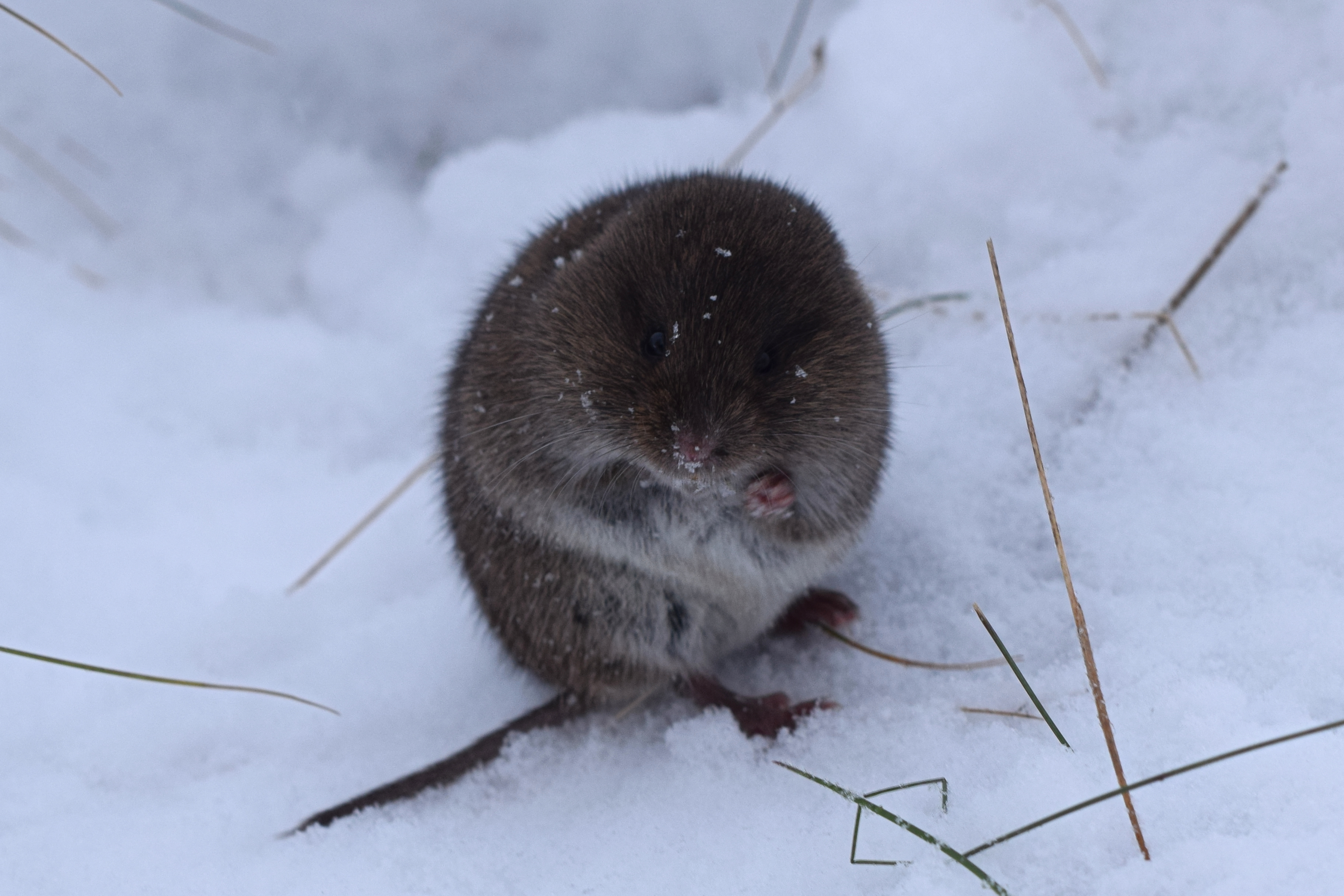
The lead image is illustrative: it shows an eastern meadow vole in snow, a close relative that does not form pair bonds.
Sources
- "Oxytocin receptor controls promiscuity and development in prairie voles (Sharma, Berendzen et al.)", University of California, San Francisco / eLife, 2025
- "Prairie vole", Wikipedia, 2026
- "Microtus ochrogaster (prairie vole)", Animal Diversity Web, University of Michigan, 2002
- "Eastern Meadow Vole in Snow", Tyler Savitski via Wikimedia Commons, 2020
Image: Tyler Savitski, CC BY-SA 4.0 via Wikimedia Commons
This article was produced with AI assistance and reviewed by our Editorial Desk. How we work.