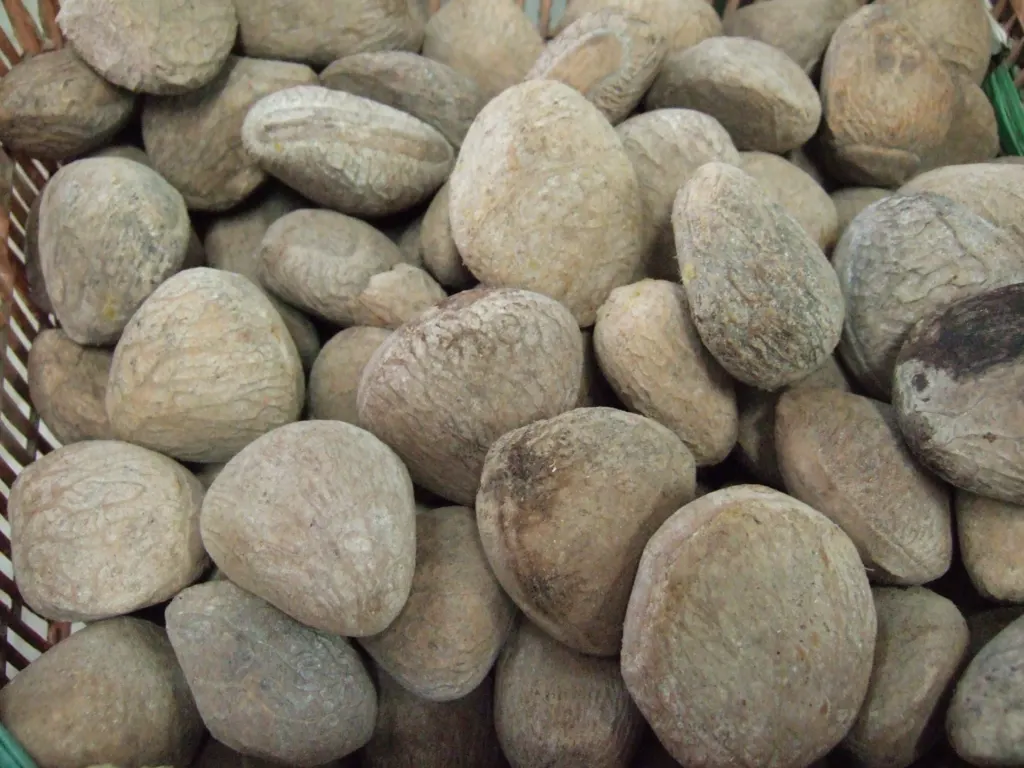
The seed that turns one of Indonesia’s oldest soups jet black contains hydrogen cyanide, and in its fresh state it can kill.
The tree is Pangium edule, a tall Southeast Asian species growing from the Philippines through Malaysia and Indonesia to Papua New Guinea, with a large brown fruit that has earned the nickname “football fruit.” Indonesians know the seed as keluak or kluwek. A post on the r/todayilearned forum on Reddit about the 40-day process sent the plant back into circulation this week, and the first question in the replies was the obvious one: “Who was the guy that volunteered to try it on day 39?”
A 40-day transformation
People worked out a way around the poison long ago. In the traditional method recorded for the seeds, they are boiled, then packed underground with ash and banana leaves for 40 days, nearly six weeks. Over that stretch the kernels shift from a creamy white to dark brown or black.
The chemistry is what makes it work: the cyanide freed during boiling and fermenting dissolves in water and rinses away. The dark paste that emerges is the prized end product. A commenter from Singapore called it “very rich and nutty and earthy” and added that the wait is not the hard part: “Waiting to ferment is the easiest part of prep.”
This is a description of food history and not a recipe. Fresh material from this plant is deadly. Nothing we read records who first worked the method out.
A soup with a date stamp
Keluak’s most famous job is rawon, the East Javanese beef soup often described simply as black beef soup. Its paper trail is remarkable. A dish called rarawwan appears in the Taji inscription, carved in 901 CE during the Mataram kingdom. If rarawwan is the ancestor of today’s bowl, that gives rawon a documented run of about 1,125 years (2026 minus 901).
The version sold today is usually built on beef stock, with ground garlic, shallots, ginger, turmeric, chili and keluak sautéed and stirred in, then served with rice. Surabaya’s style is the best known. Rawon setan, or “devil’s rawon,” is a late-night variation sold from midnight to dawn, the hours when devils are supposedly about.
Keluak travels well beyond one soup:
- In Jakarta and West Java, gabus pucung is snakehead fish in a keluak broth, a Betawi dish.
- In Singapore and Malaysia, the seed defines ayam buah keluak, a pillar of Peranakan cooking.
- In Borneo, the Dusun people use the pounded kernel in bosou, a sour fermented fish.
Bali supplies the exception. Balinese rawon skips keluak, so the soup comes out brown, and pork often stands in for beef.
Two cultures, two answers to one poison
The ash pit is not the only solution. In Marilog District of Davao City in the Philippines, the Obu Manuvu community has its own method: seeds are washed, boiled for 30 minutes, cut in half to take out the embryo, and then left overnight in a net bag held in a flowing river.
Set side by side, the two traditions reach the same destination by different roads, one spending 40 days underground and the other a single night in moving water. Both depend on the same property of the toxin, that it can be carried off by water.
The trees themselves stay stubbornly wild. They take so long to mature that planting them commercially does not pay, which means most seeds are still gathered from forest trees. Those same seeds, toxic to people, are ordinary food for the babirusa, the tusked wild pig of Indonesia, which eats them as part of its natural diet.
Further reading
Image: Midori, CC BY-SA 3.0 via Wikimedia Commons
This article was produced with AI assistance and reviewed by our Editorial Desk. How we work.