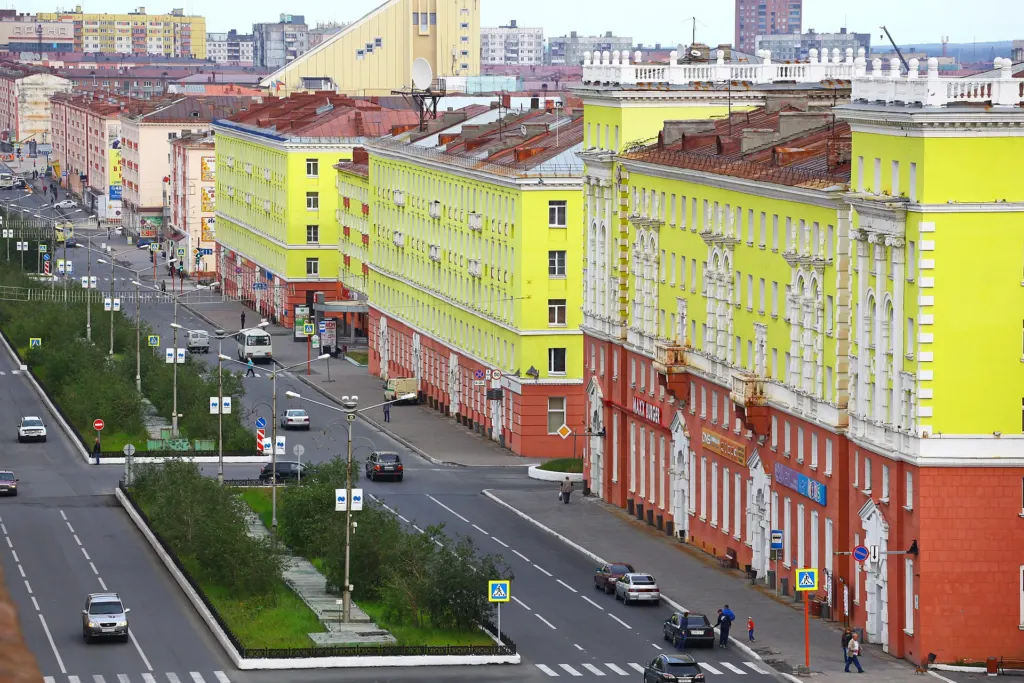
In about 12 days Norilsk, Russia, will see its last sunrise of the year, and daylight will not return until the middle of January. The Arctic city of roughly 176,700 people sits deep enough inside the polar circle that its polar night runs from approximately November 30 to January 13, according to published climate data for the city.
Norilsk is trending again on Reddit, where a widely shared post this week called it the most depressing place on Earth. We covered the city’s basic geography in our explainer on Norilsk, the northernmost city of over 50,000 people. This piece looks at the thing that most shapes daily life there right now: the dark season that is about to start.
Where Norilsk sits
The city lies south of the western Taymyr Peninsula in Krasnoyarsk Krai, about 300 kilometers (190 miles) north of the Arctic Circle and 2,400 kilometers from the North Pole. No road or railway links it to the rest of Russia, which is why residents refer to everywhere else as “the mainland.” Foreign citizens need special permission to visit.
Counting the dark days
Using the dates above, the polar night lasts about 45 days: November 30 itself, 31 days of December and 13 days of January. The opposite season is longer. The midnight sun stays above the horizon from May 20 to July 24, which works out to about 66 days of constant daylight.
The sunshine figures make the contrast plain. Average daily sunshine in Norilsk is zero hours in November, December and January, and about one hour in February. In July it averages 10 hours a day.
How cold it gets
- Average January temperature: minus 26.5 °C (minus 15.7 °F).
- Record low: minus 53.1 °C (minus 63.6 °F), set in January.
- Average year-round temperature: minus 8.3 °C (17.1 °F).
- Winter: roughly the end of September to the end of May, with snow on the ground for seven to nine months and more than 50 days of snowstorms a year.
Summer is short, cool and damp, and mostly fits into July, when the average is 14.5 °C (58.1 °F). Even so, the city’s record high of 32.2 °C (90 °F) was set this year, on June 27, 2026.
That puts Norilsk alongside Yakutsk as one of the two coldest sizable cities on the planet. It is far colder than Murmansk at almost the same latitude, because Murmansk is warmed by the Gulf Stream.
A city built around frozen ground
Only two big cities, Norilsk and Yakutsk, stand on ground that is frozen solid all year round, and in Norilsk you can see it in the streets. Gas and water pipes run above ground, not buried, because the top layer of permafrost thaws and refreezes each year. Early planners tried laying streets along the prevailing winds so snow would blow straight through; the wind and snow proved too strong, and the city switched to compact blocks built around inner courtyards.
The return of daylight is marked too. Indigenous peoples of the region, including the Nenets and Dolgans, celebrate the festival of Heiro when daylight returns after the polar night. For anyone wondering what Arctic city life looks like across the year, our Offbeat section collects more of these strange-but-true places.
By the calendar, the first full day without a sunrise in Norilsk arrives on or around November 30, and the next sunrise is expected around January 13, 2027.
Further reading
Image: Пихтарь Виктор Дмитриевич, CC BY-SA 4.0 via Wikimedia Commons
This article was produced with AI assistance and reviewed by our Editorial Desk. How we work.